Employment

Nanny Contract Australia (nanny and au pair employment agreement, Miscellaneous Award)

Employment agreement between a family and a nanny or au pair caring for the children at home, under the Fair Work Act and the Miscellaneous Award 2020: full-time, part-time or casual, hours, Award pay, super, leave, live-in option, driving and notice. Word and PDF.
4.6/5— 21 reviewsAustralian law 2026Instant download
Share

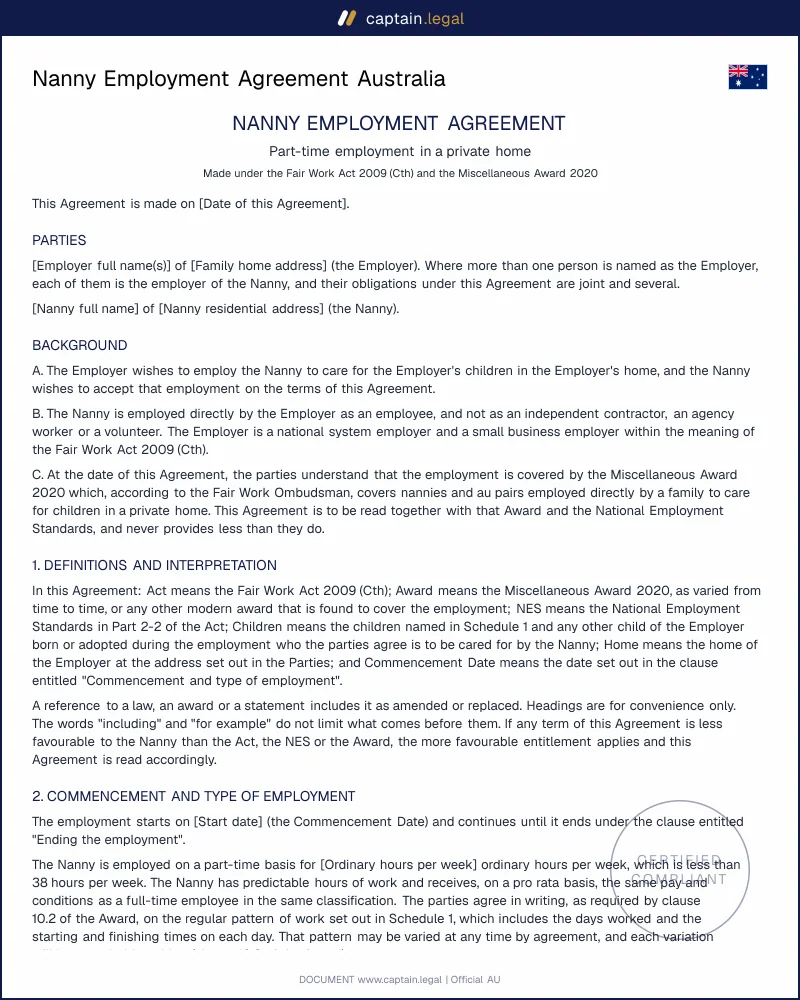
A nanny contract is the written employment agreement between a family and the nanny or au pair who looks after their children at home. In Australia it is far more than a courtesy letter: the moment you pay someone to care for your children under your direction, you are an employer under the Fair Work Act 2009 (Cth), with minimum pay, leave, notice and superannuation duties attached. This template is built for parents and guardians who employ directly, without an agency, whether the arrangement is full-time, part-time or casual, live-in or live-out. It records the hours, the Award classification and pay rate, driving, safety rules and confidentiality, so both sides know where they stand from the first morning.

Compliant

2026 Legislation

50,000+ clients

trust us

Affordable

From $4.90 / doc

Secure payment

Instant download

Nanny Contract Australia (nanny and au pair employment agreement, Miscellaneous Award)

Secure payment

Fill in the template

What is a nanny contract?

A nanny contract is a contract of employment, nothing less. The Fair Work Ombudsman treats a nanny or au pair who works in a private home, cares for the children, prepares their meals, plans their activities and does light household work linked to them as an employee of the family, covered by the Miscellaneous Award 2020. The label "au pair" does not change that, and nor does free board: an au pair who lives in is still owed the Award minimum wage, paid in money. Calling it "contracting" rarely works, because the family controls the day.

The document differs from a general employment contract for Australian employees in its focus. A nanny agreement deals with things no office contract mentions: who may give medication, what happens when the family is away on holiday, whether the nanny drives the children and in whose car, how cameras in the home are disclosed, and what a live-in nanny's private room means in practice. It also differs from a placement through an agency, where the agency is the employer.

When do you need this document?

The obvious moment is before a new nanny's first day. Most disputes in household employment trace back to an arrangement agreed over coffee, with hours, pay and duties that drifted for months until someone resigned. Putting the regular days and start and finish times in writing is not optional for a part-time nanny, since the Award requires the pattern of work to be agreed in writing at engagement, and the same schedule becomes the reference point for overtime.

Families also need the agreement when an informal babysitter becomes a regular fixture. A student who started with two evenings a month and now does every school pickup is likely a part-time employee, not a casual, and the paperwork should catch up. If the hours really are irregular, the casual employment contract under section 15A logic applies, and the template switches to casual terms.

Live-in arrangements raise their own trigger. When an au pair moves into the family home, the contract should record that board and accommodation are provided free of charge, on top of wages, and set a reasonable time to move out when the employment ends. Au pairs on working holiday visas often face a limit on how long they can work for one employer, so check the right to work before day one. Families who hire through an agency should not use this document at all, because the agency is the employer.

Key clauses included in our template

The opening clauses fix the framework. The parties section names each parent or guardian as the employer, jointly and severally, and the background records that the nanny is a direct employee covered by the Miscellaneous Award 2020. Clause 2 then sets the type of employment: full-time on an average of 38 ordinary hours, part-time on an agreed number of hours with a written pattern, or casual with no firm advance commitment. An optional probation clause gives both sides one, three or six months to test the arrangement without cutting the notice owed under the NES.

The core of the agreement covers the daily reality of the job. Duties are listed in practical terms (supervision, meals, bathing, activities, school runs), plus the light household tasks you choose. Safety rules prohibit physical punishment and leaving children unattended, require written instructions for medication and set an emergency procedure. The pay clause records the Award level and hourly rate, overtime and penalty rates, the casual loading where relevant, and an automatic uplift when the Award minimum rises. A separate clause handles superannuation, with the choice of contributing only above the 30-hour threshold or for every hour worked.

The closing clauses protect both sides. Driving comes in three versions: no driving, the nanny's own car with the per-kilometre allowance, or a family car insured by the parents. You can make a Working with Children Check a condition of employment, the nanny warrants their right to work in Australia, and confidentiality extends to photos of the children on social media. The termination clause reproduces the s 117 notice table, the employee notice in clause 30.1 of the Award and final pay within seven days.


How to fill out this nanny contract

You start with the family details: the full name of each parent or guardian who employs the nanny and the home address where the work happens. The next screens ask for the nanny's name and address, the children in their care and the type of employment. Choosing part-time reveals a field for weekly ordinary hours; choosing casual removes notice and paid leave and adds the casual loading and the information statement wording.

From there you describe the days and hours: the regular pattern for a full-time or part-time nanny, or the usual availability for a casual. You then say whether the nanny lives in, what accommodation is provided and how long they have to move out after the employment ends. The pay step asks for the Award level, the hourly rate and how often you pay, followed by the superannuation choice and the driving question.

The last steps cover probation, the Working with Children Check, household tasks and the State or Territory where the nanny works, which drives the long service leave and workers compensation references. You review the document in the preview, click Finish and download it. If the nanny will take the children interstate or overseas without you, a child travel consent form for Australian families is worth preparing at the same time.

Common mistakes to avoid

The most expensive mistake is paying a flat weekly amount without checking the Award. A "generous" flat fee often hides unpaid overtime, Saturday penalty rates or evening babysitting at ordinary time. Close behind is treating a regular part-timer as casual: casual status depends on the real pattern of work, not on the label, and the Act gives a casual employee a pathway to become permanent. Families also forget that a part-time pattern can only be changed by agreement recorded in writing, so moving a nanny's days because the school timetable changed, without the nanny's agreement, is a breach.

Deductions are the next trap. Taking money out of wages for board, a broken phone or a car excess is unlawful unless it fits sections 324 to 326 of the Act, which is why the template provides accommodation free of charge rather than offsetting it. Do not forget the Fair Work Information Statement, a separate obligation from signing the nanny contract. Many parents also assume a nanny can be let go on the spot when the youngest starts school. Notice under s 117 still applies, even though a small business employer owes no redundancy pay, and the letter should follow the contract. Our termination letter for Australian employers is built for that step.

Key takeaways

AWARD PAY

Pay set against the Miscellaneous Award

The agreement records the nanny's classification under the Miscellaneous Award 2020 and an hourly rate that can never fall below the Award minimum, with an automatic increase each time the minimum rises on 1 July. Overtime, evening and weekend penalty rates, public holiday rates and, for a casual, the 25% loading are written in. Pay slips within one working day and records kept for seven years complete the payroll duties.

FULL-TIME, PART-TIME OR CASUAL

One agreement for every type of nanny

Choose full-time, part-time or casual and the clauses follow. A part-time nanny gets the written pattern of days and hours the Award requires, which can only change by written agreement. A casual nanny gets the section 15A wording, the two-hour minimum engagement and the information statement. Leave, notice and final pay are adjusted to each type, so the document never promises a casual paid leave or forgets a permanent nanny's notice.

FAMILY LIFE

Live-in rooms, driving and child safety covered

For a live-in nanny or au pair, accommodation and meals are provided free of charge on top of wages, the room stays private and a time to move out is agreed. Driving comes in three versions: no driving, the nanny's own car with the Award allowance per kilometre, or a family car insured by the parents. A Working with Children Check, the right to work in Australia, medication rules and social media limits protect the children.

Frequently Asked Questions

Yes. Once both parties sign, it is a binding contract of employment, enforceable in the courts and before the Fair Work Commission. It cannot reduce anything the National Employment Standards or the Miscellaneous Award 2020 give the nanny: if a clause is less generous, the statutory entitlement applies instead, and the template says so expressly. Electronic signatures are valid, and each party should keep a signed copy. The pay rate must be at least the Award minimum for the level you select.

It depends on hours. A person paid for domestic or private work for 30 hours a week or less is not an employee for the super guarantee, under s 12(11) of the superannuation guarantee legislation. Once the nanny is paid for more than 30 hours in a week, the family contributes the guarantee rate on qualifying earnings, and the payment must reach the fund within seven business days of payday. The template lets you contribute only when the law requires it, or for every hour as a contractual benefit, which many families prefer because it simplifies payroll.

For a full-time or part-time nanny, written notice of one week for up to a year of service, two weeks after one year, three weeks after three years and four weeks after five years, plus a week if the nanny is over 45 with two years of service. You can pay in lieu instead. A casual nanny has no statutory notice, although the template asks both sides to give a week where practicable. Serious misconduct such as endangering a child allows dismissal without notice, and final pay is due within seven days.

No. The Fair Work Ombudsman's position is that an au pair working in a family home is an employee covered by the Award, so the minimum hourly rate for their level must be paid in money for every hour worked. Accommodation and meals can be provided on top, which is how this template treats them, but they cannot replace wages or be deducted without meeting the strict rules in the Act. Check the visa conditions too. The Australian employment document library covers related letters such as warnings and resignations.

Most families finish the questionnaire in about fifteen minutes, provided they have agreed the days, hours and hourly rate with the nanny beforehand. The document is generated as soon as you click Finish, so it can be signed the same day. Give the nanny time to read it before the first shift. Download the Fair Work Information Statement from the Fair Work Ombudsman at the same time, since it must be handed over at the start.

Both. You receive the finished agreement as an editable Word file and as a PDF. The Word version is useful when you need to adjust the household task list or update the schedule after a change agreed in writing, while the PDF is the cleaner copy for signature and for your employment records, which must be kept for seven years. Families often browse the full catalogue of Australian legal templates for related paperwork, such as a statutory declaration.

4.6/5

21 verified reviews · Australian law 2026

Nanny Contract Australia (nanny and au pair employment agreement, Miscellaneous Award)
  • Immediate access to the document
  • PDF + Word download
  • Compliant with 2026 legislation
  • Reviewed by lawyers
Fill in the template
Secure payment
Updated on November 26, 2026

You might also like

Workplace Policy Pack Australia
Statement of Service Template Australia