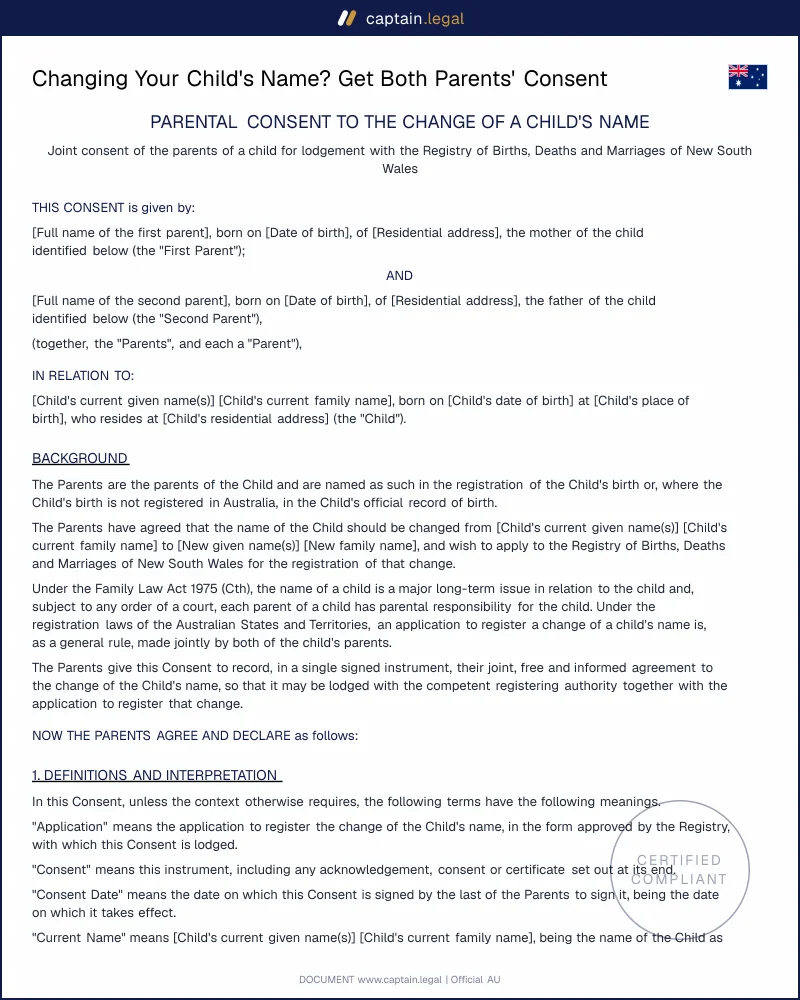
New South Wales applies s 28 of the Births, Deaths and Marriages Registration Act 1995 (NSW), which allows one parent to apply alone only where that parent is the sole parent named on the registration, there is no other surviving parent, or a court approves. The District Court can give that approval under s 28(4) if satisfied the change is in the child's best interests. A child born overseas qualifies after 3 consecutive years of residence in the state. Children aged 12 or over sign the application, and those aged 14 to 18 must consent to a National Police Check. NSW also caps changes at one in any 12 months and three in a lifetime.
Families in Victoria deal with a Registry that puts the child's own voice first. Under the Births, Deaths and Marriages Registration Act 1996 (Vic), a child aged 12 or over must consent unless unable to understand the meaning and implications of the change, and BDM Victoria will not proceed if that child refuses. Sole parental responsibility under a court order does not, on its own, allow one parent to apply.
Queensland replaced its 2003 legislation with the Births, Deaths and Marriages Registration Act 2023 (Qld). Applications by parents fall under s 29, the Magistrates Court may approve a change under s 30, the child's consent is dealt with in s 31, and s 32 limits how often a child's name can change. The 2024 Regulation lists what the court weighs, including previous changes and the child's preferred name.
In Western Australia, disputes go to the Family Court of Western Australia rather than a magistrate. Where both parents are named on the registration and only one applies, the Registry requires a sealed order from that court. A child's name cannot change again within 12 months of a previous registered change.
South Australia goes further than any other state. Under s 26 of the Births, Deaths and Marriages Registration Act 1996 (SA), a child of any age must consent unless unable to understand the change, and disagreements between parents can be taken to the South Australian Civil and Administrative Tribunal under s 22. The ACT, Tasmania and the Northern Territory follow the same joint-application model under their own registration Acts of 1997, 1999 and 1996 respectively.

 Australian law 2026