Family & Divorce

Who Keeps the Dog After Separation? Pet Agreement AU

Companion animal agreement aligned with the June 2025 reforms to s.79(6) and s.90SM. Ownership, costs and visits for married and de facto couples.
4.6/5— 9 reviews50 000+ downloadsInstant download
Share

A pet ownership agreement is a signed written record that settles who keeps the family dog, cat or other companion animal after separation, how its care costs are shared and whether the other partner will still spend time with it. It suits married and de facto couples in Australia who would rather settle the question themselves. Since 10 June 2025, the Family Law Act 1975 (Cth) has treated pets as companion animals, a distinct class of property with its own statutory checklist, and the courts cannot order anything resembling shared pet custody. Our template follows that framework, so your terms can sit beside a property settlement, feed into consent orders or stand alone as a deed.

Compliant

2026 Legislation

50,000+ clients

trust us

Affordable

From $4.90 / doc

Secure payment

Instant download

Who Keeps the Dog After Separation? Pet Agreement AU

Secure payment

Fill in the template

What is a pet ownership agreement?

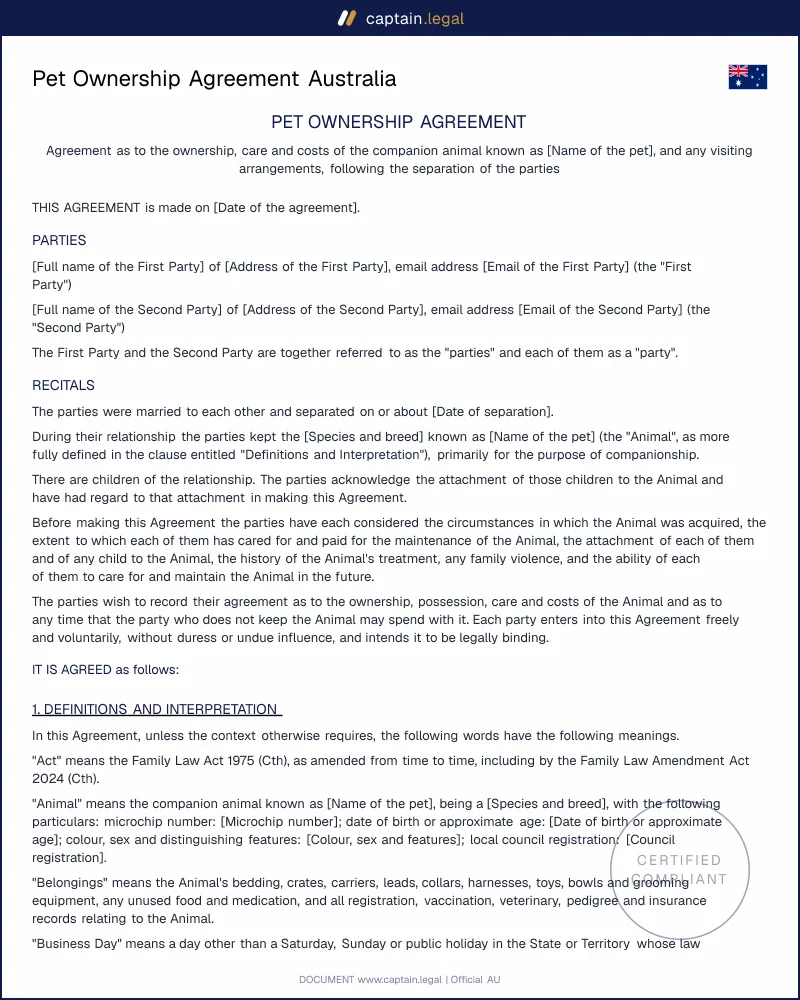
A pet ownership agreement is a contract between separating partners about one or more animals kept for companionship. It identifies each animal, names the party who will hold sole legal ownership, records the transfer of the microchip and council registration, and allocates the running costs: vet bills, insurance, food, grooming and boarding. Where both partners want ongoing contact, it also fixes a visiting or time-sharing routine. A family law court can award a pet to one party, transfer it to a consenting third person or order it sold, but it cannot order shared care, so a private agreement is the only place a week-about arrangement for the dog can live.

The document differs from its neighbours in scope. A separation agreement under the Family Law Act usually covers the home, joint debts and interim finances, and may mention the animal in one line; the pet agreement holds the detail that line cannot. A binding financial agreement under Part VIIIA or Part VIIIAB can also deal with a pet, but each party needs independent legal advice and a signed certificate under section 90G (married couples) or section 90UJ (de facto couples). A parenting plan under section 63C has no role at all, because the parenting provisions apply only to children.

When do you need a pet ownership agreement?

The most common trigger is simple possession. One partner moves out, the dog stays behind, and months later nobody can say whether that was temporary or final. Writing it down early stops possession from quietly becoming the strongest factor under section 79(7)(b). A genuine wish to share the dog between homes comes second, and only a private agreement can record it.

Disputed origins are a third source of conflict. A cat bought before the relationship, a puppy given as a birthday present, an animal registered in one name while the other paid every vet bill: each needs a clear statement of current ownership. Money is the fourth. An older dog with a chronic condition can generate heavy veterinary expenses. Agree a spending threshold and a notice process before the first major bill arrives.

An animal used in a breeding business may not be a companion animal at all, and it then joins the general property pool at market value. Where there has been family violence, a visiting routine can put a party or the animal at risk, and the agreement should give outright ownership with no contact clause.

Key clauses included in our template

The template opens with an identification schedule for each animal: species, breed, name, microchip number and council registration number. It also flags assistance animals, which fall outside the companion animal rules. The ownership clause then names the sole legal owner from a stated date, with the other party releasing any claim, and a registry clause obliges both parties to sign the change of owner documents within a deadline matched to your state or territory.

Money is handled in two layers. Routine expenses stay with the owner, while extraordinary veterinary costs above an agreed threshold are shared in fixed percentages, subject to a written quote and prior notice except in an emergency. Where contact continues, the visiting clause sets the schedule, handover points and holiday cover, and states expressly that the routine is a private arrangement rather than a court order.

The owner keeps the final say on treatment but must give notice before an interstate move, and the other party holds a right of first refusal before any rehoming or surrender. Disagreements go to mediation before any court step, and contact ends automatically on the death of the animal or on a safety concern linked to family violence.

State-specific considerations

Owners in New South Wales work with the NSW Pet Registry under the Companion Animals Act 1998 (NSW). A change of owner must be recorded within 14 days of the transfer. A restricted, dangerous or menacing dog cannot be sold or given away, so an agreement for one of these dogs should confirm the existing owner rather than transfer it. Since 19 May 2025, the Residential Tenancies Act 2010 (NSW) has required landlords to answer a pet application within 21 days, failing which consent is deemed, and the keeping party should make sure any new residential tenancy agreement records that consent.

The position in Victoria turns on council registration. Under the Domestic Animals Act 1994 (Vic), cats and dogs must be microchipped and registered with the local council, and registration renews each 10 April, so the agreement should say which party pays the next renewal. For renters, the Residential Tenancies Act 1997 (Vic) lets a renter ask to keep a pet, and a rental provider who wants to refuse must apply to VCAT within 14 days.

Registration in Queensland also sits with local government. The Animal Management (Cats and Dogs) Act 2008 (Qld) makes dog registration compulsory, and microchip details must be updated after a change of owner. Under the Residential Tenancies and Rooming Accommodation Act 2008 (Qld), a lessor must answer a pet request within 14 days and can refuse only on prescribed grounds.

Western Australia is the outlier. Married couples there are covered by the federal companion animal provisions through the Family Court of Western Australia, but de facto couples claim under the Family Court Act 1997 (WA), which did not adopt those provisions when they commenced. WA de facto partners should check the current text of that Act before relying on the companion animal rules, because without a mirror amendment the pet is treated as ordinary property. Registration falls under the Dog Act 1976 (WA) and the Cat Act 2011 (WA).

How to fill out this pet ownership agreement

You start by choosing the state or territory where the animal lives and confirming whether you were married or in a de facto relationship. That choice sets the statutory references, the registry deadline and, for Western Australian de facto couples, the governing Act. The questionnaire then asks for the animal's details exactly as they appear on the microchip database and council register.

Next you decide who keeps the animal and from what date. If the other party will still see it, you describe the routine in ordinary terms (alternate weekends, school holidays, a set handover point) and the form turns those answers into clause wording with notice periods. Cost shares and the veterinary threshold follow.

Finally you choose how to sign. Most couples execute the document as a deed in front of an independent adult witness; witnessing rules differ between states. If you are also filing consent orders, attach the agreement so the ownership terms match word for word.

Common mistakes to avoid

The mistake we see most often is treating the microchip record as proof of ownership. The database shows who registered the animal, not who owns it. Close behind is the attempt to write a week-about schedule into consent orders. A registrar cannot make an order for shared time with a pet, and draft orders that try come back for amendment. A third error is assuming a signed private agreement closes the matter for good, when only consent orders or a binding financial agreement achieve that.

Housing and relocation catch people later. The owner moves into a rental or strata building that refuses pets, or takes a job interstate, and the agreement is silent. Estate planning is often forgotten too: an owner who wants the former partner to take the animal on death should say so in an Australian will template, because the pet agreement does not bind executors. Timing is the last trap. Under section 44(3) a married party has 12 months after the divorce order takes effect, and under section 44(5) a de facto partner has 2 years from separation, after which the court's leave is needed.

Key takeaways

LAW CHANGE

Pets now have their own category

From 10 June 2025, the Family Law Act 1975 treats pets kept mainly for companionship as companion animals, not just ordinary chattels. Assistance animals, business animals, farm animals and laboratory animals sit outside that definition. For married couples, s 79(6) applies; for most de facto couples, s 90SM(6) mirrors it.

TERMS

Put ownership and costs in writing

A good agreement identifies each animal, names the sole legal owner, records microchip and council registration transfers, and allocates vet bills, insurance, food, grooming and boarding. If the other partner will still see the pet, put the routine in writing. That detail is often too specific for a general separation agreement.

COURT LIMITS

Courts cannot order shared pet custody

If a dispute reaches court, the available orders are narrow: one party keeps the animal, a consenting third person receives it, or the animal is sold. The court cannot order shared pet custody or a week-about arrangement, even by consent. A private deed can record that plan, but it does not prevent a later property application.

Frequently Asked Questions

It binds the two of you as a contract once signed. What it cannot do on its own is stop either party from applying to the court for property orders within the section 44 time limits, although a judge would treat the agreement as strong evidence of what you intended. For finality, file consent orders mirroring the ownership terms, limited to the three outcomes in section 79(6), and keep the visiting routine in the deed.

No. Since 10 June 2025, section 79(6) of the Family Law Act 1975 allows only sole ownership by one party, transfer to a consenting third person, or sale. The court may not make any other order about ownership, which excludes shared care, alternate weeks and visiting rosters. Shared care remains possible, but only through a private written agreement that both of you sign and honour.

In New South Wales, the Companion Animals Act 1998 requires the change of owner to be recorded within 14 days. Victoria and Queensland run registration through local councils, which expect prompt notice of the new owner and an updated microchip record. The template sets a contractual deadline matching your state's rule and obliges both parties to sign whatever the registry requires.

De facto couples everywhere except Western Australia fall under section 90SM of the Family Law Act 1975, provided the relationship meets the threshold in section 90SB and the geographic requirement in section 90SK. Married couples in Western Australia are also covered. De facto couples there are governed by the Family Court Act 1997 (WA), which did not adopt the companion animal rules alongside the federal reform, so the pet may be treated as general property.

Both formats are generated once you complete the questionnaire. The Word file lets you and your former partner negotiate wording, add a second animal or adjust the visiting schedule, while the PDF is the clean copy for signing. Every template in the Captain.Legal Australian document library works the same way, so related separation paperwork can be prepared in one session.

Not for the agreement itself. A pet agreement executed as a deed carries no statutory advice requirement, unlike a binding financial agreement, where section 90G or section 90UJ makes independent advice a condition of validity. Advice is still sensible when there has been family violence, or when the pet is one piece of a contested settlement. For straightforward cases, the template and our family law agreements for separating couples let you finalise everything yourselves.

4.6/5

9 verified reviews · 50 000+ downloads

Who Keeps the Dog After Separation? Pet Agreement AU
  • Immediate access to the document
  • PDF + Word download
  • Compliant with 2026 legislation
  • Reviewed by lawyers
Fill in the template
Secure payment
Updated on October 15, 2026

You might also like

Post-Nuptial Financial Agreement
Parenting Plan Australia