Personal

Vehicle Bill of Sale AU | s 44 PPSA & State Rego Rules

Private vehicle bill of sale drafted to the Sale of Goods Acts and s 44 PPSA: title warranty, PPSR check, and NSW, VIC, QLD and WA transfer deadlines.
4.8/5— 21 reviews50 000+ downloadsInstant download
Share

A vehicle bill of sale is the written record of a private sale of a car, motorcycle or other registered vehicle between two individuals in Australia. It names both parties, identifies the vehicle by registration number and Vehicle Identification Number (VIN), and records the price, the odometer reading at handover and the condition in which the vehicle changes hands. Sellers use it to prove the exact moment their liability for tolls and fines ended. Buyers rely on it to show ownership and support the registration transfer. Our template covers private car sales in every state and territory, from marketplace hatchbacks to motorbikes sold between friends.

Compliant

2026 Legislation

50,000+ clients

trust us

Affordable

From $4.90 / doc

Secure payment

Instant download

Vehicle Bill of Sale AU | s 44 PPSA & State Rego Rules

Secure payment

Fill in the template

What is a vehicle bill of sale?

In Australian law a vehicle bill of sale is a contract for the sale of goods, reduced to writing and signed by both parties. Under s 22 Sale of Goods Act 1923 (NSW) and its counterparts in the other states, ownership passes when the parties intend it to pass. If the contract is silent, rule 1 in s 23 transfers property in a specific vehicle in a deliverable state the moment the contract is made, even before the buyer pays. That default suits buyers, not sellers, which is why our template states expressly that property passes on receipt of cleared funds. Registration is a different question: the registry certificate only identifies the registered operator, the person answerable for the vehicle on the road, while the signed bill of sale is the best evidence of who owns it and from what moment.

The name confuses people: "bill of sale" once described a security over goods under the state Bills of Sale Acts, legislation largely displaced by the Personal Property Securities Act 2009 (Cth). This document is a contract, not a mortgage. It also differs from the registry transfer form (F3520 in Queensland, MR9 in Western Australia), which says nothing about payment terms, defects or risk. A complete sale file holds both, kept with the other personal legal templates for Australian households a family relies on.

When do you need this document?

The everyday case is the online classified sale. A stranger inspects the car on Saturday morning and pays by bank transfer before driving away. Without a signed record of the handover time, the seller has no answer when a camera fine arrives for a trip taken that afternoon, because the registry still lists the seller as registered operator.

Family sales come next. A parent selling a car to an adult child at a reduced price should still document it, if only to head off later sibling arguments about an early inheritance. Where no money changes hands, a deed of gift for transferring a car to a family member is the better instrument, because a deed needs no consideration. Separating couples use a bill of sale when one partner buys out the other's share of a jointly owned car, and the figures should match the separation agreement under the Family Law Act 1975.

Business vehicles are the edge case people get wrong. A GST-registered business selling a work ute makes a taxable supply, and the Australian Consumer Law can apply because the sale happens in trade or commerce. When vehicles leave together with the business itself, the fleet belongs in a sale of business agreement covering goodwill, staff and stock, not a standalone bill of sale.

Key clauses included in our template

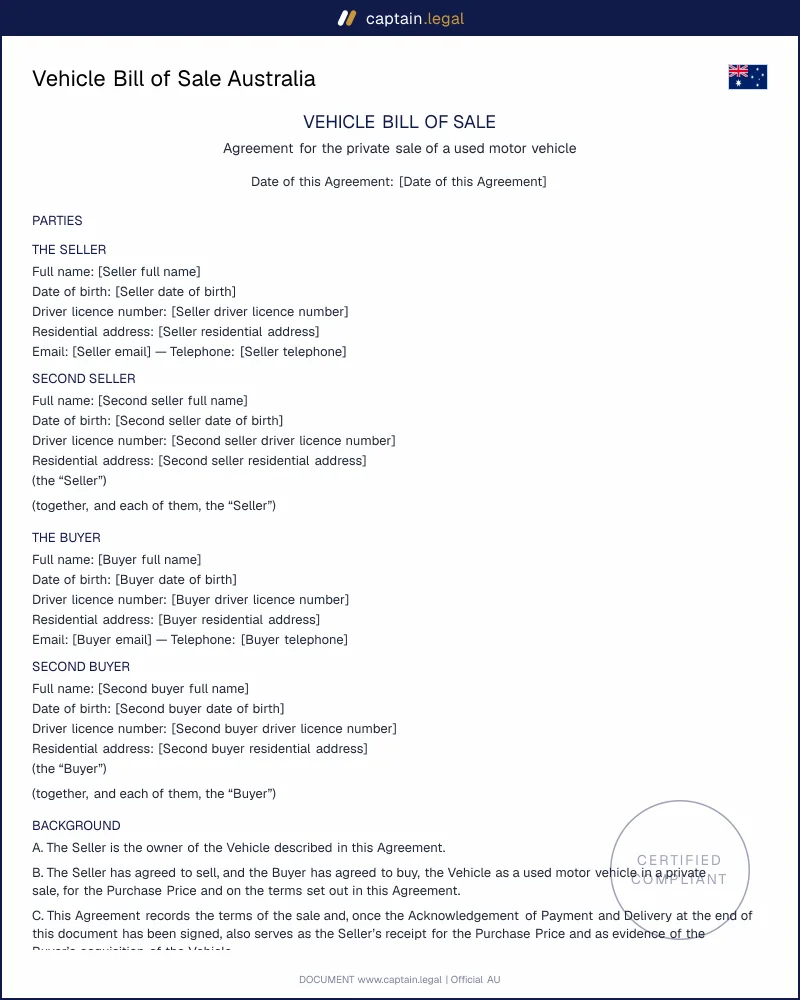
Each party appears exactly as on their driver licence, with address and licence number, and the vehicle is described by make, model, build year, registration number and expiry, VIN or chassis number and engine number. The seller then gives an express warranty of title, confirming ownership, the absence of any undisclosed security interest and whether the vehicle has ever been recorded as written off, with the PPSR search certificate number written into the document.

The commercial core follows. The template records the purchase price, any deposit, the payment method and the exact date and time of handover, the moment risk passes to the buyer. Keys and vehicle are released only once cleared funds arrive, which defeats the fake payment receipt scam. The odometer reading goes in kilometres, with the seller's statement that it reflects the true distance travelled to the best of their knowledge. The condition clause states that the vehicle is sold as is, where is, lists every disclosed defect and confirms the buyer had the chance to arrange an independent inspection. Courts read that wording narrowly, as going to condition rather than title, and the express title warranty removes any argument.

The closing clauses deal with the aftermath. Each party undertakes to complete its side of the registration transfer within the state deadline, the seller keeps responsibility for fines incurred before the recorded handover time and the buyer takes everything after it. A short clause records whether personalised plates go with the vehicle, since they stay with their holder unless the parties agree otherwise. The document ends with dated signature blocks and an optional witness line.

Regional considerations

New South Wales runs a two-step process through Service NSW. The seller lodges a notice of disposal within 14 days of the sale, and the buyer transfers the registration within the same 14-day window or pays a late fee. Duty under the Duties Act 1997 (NSW) is calculated on the sale price or the market value, whichever is higher, so an artificially low price on the bill of sale achieves nothing.

Sellers in Victoria face a stricter inspection rule. A current roadworthy certificate is generally needed before the registration can be transferred, and it must have been issued within the 30 days before the transfer is lodged. Seller and buyer each have 14 days to complete their part, and the buyer pays duty under the Duties Act 2000 (Vic) on the greater of price and market value. Handing over a Victorian car without a valid roadworthy certificate leaves the buyer unable to transfer, and the seller stays on record for every fine that follows.

Queensland goes further. A registered vehicle cannot even be offered for sale without a current safety certificate displayed on it, valid for two months or 2,000 kilometres when issued to a private seller. Both parties sign form F3520, the transfer must be completed within 14 days and vehicle registration duty is assessed under the Duties Act 2001 (Qld). Failing to give the buyer a current certificate attracts an on-the-spot fine, and without it the buyer cannot complete the transfer.

The shortest seller deadline belongs to Western Australia. Both parties complete form MR9, the seller notifies the Department of Transport within 7 days and the buyer has 14 days to finalise the transfer and pay vehicle licence duty under the Duties Act 2008 (WA). No roadworthy inspection applies to a standard private sale, so the disclosure clauses carry more weight. For Tasmanian vehicles, stolen vehicle data does not appear on the PPSR search, so buyers check it separately with the state registry.

How to fill out this vehicle bill of sale

You start by choosing the state or territory where the vehicle is registered, because that choice sets the transfer deadlines, the inspection certificate wording and the duty references in the final document. Both parties' details follow, exactly as on their licences. Copy every vehicle figure from the registration certificate, then check the VIN against the compliance plate or windscreen stamp before going any further.

Next comes the PPSR certificate number. The buyer should run that search personally, the day before or the day of the sale, even when the seller offers one. The payment step records the price, any deposit and the payment method, and the handover step captures the date, the time and the odometer reading. Known defects go in plain words, followed by spare keys, service books, accessories and the position on personalised plates.

Once generated, the vehicle bill of sale downloads in Word and PDF. Print two copies, have both parties sign each one at handover, and lodge your side of the registration transfer the same day where possible.

Common mistakes to avoid

The most frequent error is writing a lower price to reduce duty. Duty runs on the higher of price and market value, so the saving is illusory, and a false declaration exposes the parties to penalty tax and offences under the state Taxation Administration Acts. A close second is trusting the name on the registration papers. The registered operator is not always the owner, and a car owned by a company, an estate or an elderly parent can only be sold by whoever holds title or lawful authority. Adult children selling a parent's car usually need an enduring power of attorney that is already in effect.

Sellers also leave the transfer to the buyer. It often never happens. Lodging your own notice on the day of sale is the reliable way to cut off liability for fines, and the handover time in the bill of sale is the evidence behind it. Odometer readings recorded as "about 140,000" invite disputes, and a VIN copied with one wrong character makes the PPSR search worthless. Finally, many sellers write "sold as is" and stop there. A bare as-is statement does not protect a seller who knew of a serious defect and denied it when asked.

Key takeaways

TITLE

Ownership waits for cleared funds

A signed bill of sale fixes when the vehicle changes hands. Under the Sale of Goods Act 1923 (NSW), including s 22 and the default rule in s 23, ownership can pass when the parties intend. This template avoids the seller-friendly gap by saying property passes only when cleared funds are received, not merely when keys are handed over.

PPSR

Search the VIN before paying

Finance registered against the VIN can follow the vehicle after sale. Under s 44 of the Personal Property Securities Act 2009 (Cth), a buyer takes free only of an interest that a proper VIN search would not have revealed. A PPSR certificate from the day of sale, or the day before, is the buyer's practical shield against repossession.

REGO

Registration transfer is a separate step

The bill of sale proves the deal, but it does not update the road authority record. NSW, Victoria, Queensland and Western Australia each have registration transfer rules and motor vehicle duty requirements. The seller needs the paperwork to show when liability for tolls and fines ended, while the buyer still needs the state transfer form lodged on time.

Frequently Asked Questions

A signed bill of sale is a binding contract for the sale of goods under state law, enforceable in the local or magistrates court like any other contract. A document identifying the vehicle by VIN, with price, handover time and both signatures, is strong evidence of the sale and of when property and risk passed. No witness or justice of the peace is required. It does not replace the registration transfer, which remains a separate step with the state registry.

The standard window is 14 days from purchase in New South Wales, Victoria, Queensland and Western Australia, with late fees once it expires. The seller's own deadline varies: 14 days in New South Wales and Victoria, 7 days in Western Australia. Because the seller remains the registered operator until the registry processes the change, lodging the seller's part on the day of sale is the safer practice in every state.

Every completed document comes in both formats. The PDF is ready to print and sign at handover, while the Word version lets you adjust a clause beforehand, for instance to add a defect found during the final inspection. Both carry the state-specific wording selected in the form. When the sale sits within a wider set of paperwork, the full catalogue of Australian legal documents offers related templates in the same formats.

The clause covers defects the buyer could have found by inspection and ordinary wear consistent with the vehicle's age and kilometres. A private seller gives no implied quality guarantee anyway, so the clause mainly records that the buyer knew it. Its limits are real. Courts will not read it as excluding the seller's obligation to pass good title, and no clause shields a seller who lied about accident history or a known mechanical fault, because fraud cannot be contracted out of.

Duty is paid by the buyer when registration is transferred, but the agreed price is only one input. Each state assesses duty on the higher of that price and the vehicle's market value, using its own rates. A car sold cheaply to a relative will therefore usually be assessed on its market value, and the registry can ask for evidence when a declared price looks low. Certain transfers between spouses or under family law orders may qualify for concessions under the relevant duties legislation.

Registration papers say nothing about money owing on the vehicle. Only a search of the Personal Property Securities Register against the VIN reveals a registered security interest, along with stolen or written-off status. Under s 44 Personal Property Securities Act 2009 (Cth), a clear search made just before purchase protects the buyer if a financier later claims the vehicle. Run it yourself and record the certificate number in the bill of sale.

4.8/5

21 verified reviews · 50 000+ downloads

Vehicle Bill of Sale AU | s 44 PPSA & State Rego Rules
  • Immediate access to the document
  • PDF + Word download
  • Compliant with 2026 legislation
  • Reviewed by lawyers
Fill in the template
Secure payment
Updated on October 16, 2026

You might also like

Revocation of Power of Attorney Template
Statutory Declaration Template