Family & Divorce

Ex Won't Mediate? Family Dispute Resolution Letter

Invitation to family dispute resolution aligned with s.60I and the FCFCOA pre-action rules: 14-day reply, issues in dispute, WA s.66H option. Word & PDF.
4.8/5— 17 reviews50 000+ downloadsInstant download
Share

A family dispute resolution invitation letter is a written request asking your former partner to attend mediation with an accredited practitioner before either of you applies to court about the children. Under the Family Law Act 1975 (Cth), most parenting applications cannot be heard without a section 60I certificate, and that certificate depends on a documented attempt at family dispute resolution (FDR). This template suits separated parents, grandparents and other carers who want to open the conversation in a calm, child-focused tone while keeping a dated record that meets the court's pre-action procedures, whether the matter is heading to the Federal Circuit and Family Court of Australia or the Family Court of Western Australia.

Compliant

2026 Legislation

50,000+ clients

trust us

Affordable

From $4.90 / doc

Secure payment

Instant download

Ex Won't Mediate? Family Dispute Resolution Letter

Secure payment

Fill in the template

What is a family dispute resolution invitation letter?

In practice, the invitation letter is the opening move of the FDR process. It tells the other parent you want to resolve parenting issues through mediation, names those issues, proposes one or more providers and sets a reasonable date for a reply. It is not the practitioner's own invitation, which the mediator sends once you register with a service. Nor is it the notice of intention to start proceedings, the firmer letter the court rules require when mediation fails. Settlement proposals about the house or the number of overnight stays belong in separate correspondence.

The letter creates no binding arrangement and does not oblige anyone to attend. Its value is evidential. A clear, courteous invitation gives the practitioner a starting point, shows the court you took the genuine steps expected of a prospective applicant, and often lowers the temperature enough for the other parent to say yes. When mediation works, the outcome is usually recorded in a parenting plan under section 63C of the Family Law Act. When it fails, the paper trail that starts here is what allows the practitioner to issue your certificate.

When do you need this document?

The classic trigger is a stalled conversation in the months after separation. One parent wants week-about care, the other wants the children home during the school week, and every text exchange ends in a standoff. A formal invitation moves the discussion to a neutral venue and starts the certificate process. Change is the second big category: rostered shifts, a new school or a new partner moving in can make existing orders unworkable. Varying final parenting orders also requires a significant change in circumstances under s 65DAAA, which codified the rule in Rice & Asplund, so the letter should name that change plainly.

Relocation deserves a specific warning. A parent planning a move should hold off signing a residential tenancy agreement in another city until the issue has been mediated, because courts take a dim view of a fait accompli. Holiday disputes are predictable too: providers can carry waiting lists, so an invitation sent in early November stands a far better chance of producing a session before the Christmas handover. Grandparents use the same letter, because s 60I applies to anyone seeking a parenting order.

Where the other parent lives interstate or overseas, offer telephone or online mediation from the outset. Where there is a history of family violence, do not send the letter directly. Let an FDR provider or lawyer assess whether mediation is safe.

Key clauses included in our template

The letter opens by identifying the sender, the recipient and each child by full name and date of birth, then states its purpose in one sentence framed around the children's best interests rather than adult grievances. A short paragraph records current arrangements without arguing about them, so nothing changes while mediation is organised.

The core of the document handles scope, format, timing and cost:

  • Every issue you may later ask the court to decide needs to appear in the letter, because s 60I(8) ties the certificate to the issues the order would deal with.
  • Format options are offered rather than imposed: face to face, online, by telephone or as shuttle mediation in separate rooms.
  • A reply date of at least 14 days is built in, with a short follow-up paragraph for a second written attempt.
  • Costs get one neutral sentence proposing that provider fees be shared or assessed on the service's own income-based scale.

The closing section notes that FDR communications are confidential under s 10H, encloses the court's pre-action procedures brochure as Schedule 1 requires, and explains without threats that if no reply arrives the practitioner will make contact directly. It ends with a preferred contact channel and an offer to arrange an interpreter or support person.

State and territory considerations

Parents in New South Wales can use the Legal Aid NSW Family Dispute Resolution Service, which runs lawyer-assisted mediation for eligible families, as well as Family Relationship Centres and private practitioners. The common trap is an apprehended domestic violence order under the Crimes (Domestic and Personal Violence) Act 2007 (NSW). Some ADVOs carve out contact through a lawyer or for mediation, while others prohibit contact altogether. If yours does, sending the invitation yourself can amount to a breach, however polite the wording. Route it through the provider or a solicitor, and remember that s 60CF Family Law Act requires you to tell the court about family violence orders once proceedings begin.

Victoria raises the same issue under the Family Violence Protection Act 2008 (Vic). Intervention orders made by the Magistrates' Court vary considerably in their conditions, and the exceptions they allow differ from one order to the next. Read the order line by line before choosing a delivery method. Victoria Legal Aid runs its own family dispute resolution service for eligible parents. Online sessions are routine for families in regional areas, which makes a remoteness exemption hard to justify anywhere in the state.

Distance is the defining issue for many families in Queensland. Where one parent lives in Brisbane and the other in Mount Isa, the letter should lead with telephone or video options. Relationships Australia Queensland runs a national Telephone Dispute Resolution Service built for that situation, and Legal Aid Queensland offers family dispute resolution conferences for eligible clients. Protection orders made under the Domestic and Family Violence Protection Act 2012 (Qld) govern delivery exactly as elsewhere. A letter that ignores an order's conditions can turn a parenting dispute into a criminal one.

Western Australia runs a separate system and deserves the most care. The Family Court of Western Australia hears both Commonwealth and state family matters. The accredited practitioner issues a section 60I certificate where the parents were married, but a certificate under s 66H Family Court Act 1997 (WA) where they never married. Pre-action steps sit in Schedule 1 of the Family Court Rules 2021 (WA), and family violence restraining orders fall under the Restraining Orders Act 1997 (WA). Citing the wrong certificate provision in a WA letter signals inexperience and confuses the practitioner who picks up the file.

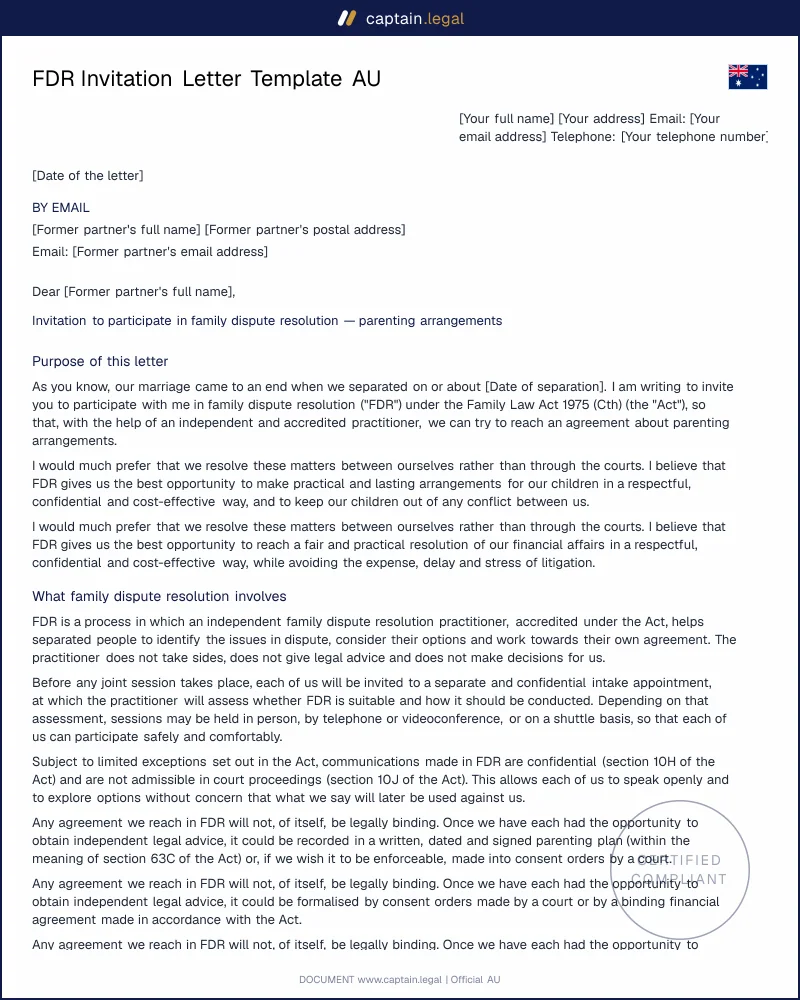
How to fill out this family dispute resolution invitation letter

You start by selecting the state or territory where the children usually live. That choice sets the court references, and in Western Australia it triggers a question about whether the parents were married. From there you enter details for yourself, the other party and each child, with the option to withhold your street address. The form then asks for the date of separation; if it is disputed or you separated under the one roof, a separation declaration under section 90DA is worth preparing alongside.

The issues screen matters most. You tick each topic you want to mediate, from living arrangements and changeovers to schooling, health decisions and travel. You then name one or more providers, choose acceptable formats and confirm a reply date of no less than 14 days. A final safety question asks whether any family violence order exists, and if so the letter is formatted for delivery through a provider or lawyer. Other paperwork follows the same guided process across our Australian family law templates.

Common mistakes to avoid

Tone sinks more invitations than anything else. A letter that recounts the affair, missed child support or last month's argument at the school gate gives the other parent every reason to refuse, and Schedule 1 expressly discourages correspondence that entrenches hostility. Close behind is a scope that is too narrow: parents mediate one pressing issue, settle it, then find the certificate does not cover the bigger dispute that follows. Offering a single provider on a single date looks like an invitation designed to be declined.

Other mistakes are procedural. Stamping "without prejudice" across the top out of habit makes it harder to rely on the letter later, so keep settlement proposals in a separate document. Sending it by text alone leaves no reliable proof. Keep a dated copy and evidence of delivery, ideally email plus registered post, because the practitioner, and later the court, may ask exactly when and how the invitation went out. Finally, never ask a child to carry the letter to the other parent.

Key takeaways

S 60I

No certificate, no parenting hearing

For most parenting applications, s 60I of the Family Law Act 1975 blocks the court from hearing the case unless a family dispute resolution practitioner has issued a certificate. The certificate must match the parenting issues you later ask the court to decide, so the invitation should clearly name the children-related disputes from the start.

14-day reply

Make the invitation court-ready

The letter should calmly set out the issues, propose one or more accredited FDR providers and give a reasonable reply date. Under the Federal Circuit and Family Court pre-action procedures, if dispute resolution does not resolve the matter, written notice must allow at least 14 days for a response before proceedings are started.

Paper trail

A refusal still moves things forward

The invitation does not force your former partner to attend or create a binding parenting arrangement. Its value is proof. Accredited practitioners generally need at least two contact attempts, including one in writing, before recording refusal or non-attendance. A certificate is generally issued and filed within 12 months of the last FDR attendance or attempted attendance.

Frequently Asked Questions

It creates no contractual obligation, and the other parent cannot be forced to attend because you wrote. Its legal weight is evidential. The letter shows compliance with the pre-action procedures in Schedule 1 of the Family Law Rules 2021 and supports the practitioner's decision to issue a s 60I(8) certificate if the other party refuses or fails to engage. A court may also consider an unreasonable refusal when deciding whether to order FDR under s 13C or costs under s 117. For the letter to carry that weight, it must be accurate, polite and specific about the issues.

Both approaches are common, and most families combine them. A direct, courteous approach from the other parent often lands better than a cold letter from a service. The certificate itself, however, can only come from an accredited practitioner, who must attempt contact at least twice, once in writing, before recording a refusal. So the usual sequence is simple: you send this letter, register with a provider, and the practitioner follows up.

Fourteen days is the benchmark, taken from the court's pre-action procedures, and the template never sets a shorter deadline. Anything less reads as pressure. If the date passes in silence, send one brief follow-up allowing another seven days, then hand the matter to your practitioner. Watch the overall timeline as well, because the certificate has to be used within 12 months of the last attempted FDR, after which the process starts again.

Refusal does not block your access to court. After their own contact attempts, the practitioner can issue a certificate stating you did not attend because the other party refused or failed to attend, and you file your parenting application with it. The court then decides the case under the best interests factors in s 60CC and may still order both parties to attend FDR before a hearing. A parent who refused without good reason may see that raised in argument about costs.

The exemption in s 60I(9) applies where there are reasonable grounds to believe there has been, or is a risk of, family violence or child abuse. You claim it by affidavit and must disclose any existing family violence order. Under s 60J, you should also have received information from a family counsellor or FDR practitioner about available services, unless doing so would cause risk or harmful delay. Practitioners screen every case for safety and may offer shuttle mediation with separate rooms instead. If unsure, speak with a Legal Aid service before sending anything.

Both formats download as soon as you finish. The PDF is ready to sign and send, while the Word version lets you adjust wording after advice from a lawyer or your FDR provider. Every template in our complete Australian legal document catalogue comes in the same formats, so a parenting plan drafted after mediation will match your original letter.

4.8/5

17 verified reviews · 50 000+ downloads

Ex Won't Mediate? Family Dispute Resolution Letter
  • Immediate access to the document
  • PDF + Word download
  • Compliant with 2026 legislation
  • Reviewed by lawyers
Fill in the template
Secure payment
Updated on October 15, 2026

You might also like

Financial Disclosure Statement Template AU
Limited Child Support Agreement