Business

Unpaid Invoice? Letter of Demand Before Court | AU

Debt recovery letter drafted to s.50 ACL, the ACCC/ASIC guideline and state limitation rules. Contractual or statutory interest, ready to sign.
4.7/5— 24 reviews50 000+ downloadsInstant download
Share

A letter of demand is the formal written notice an Australian creditor sends before commencing court proceedings to recover an unpaid invoice, loan or other liquidated debt. It states the amount owed, the interest claimed and a firm deadline, and warns that legal action will follow without further notice. Small business owners, sole traders, contractors, landlords and private lenders use it as the last step before filing in the Local or Magistrates Court. Drafted properly, a debt recovery letter often settles the matter on its own, and it builds the paper trail a registrar expects to see.

Compliant

2026 Legislation

50,000+ clients

trust us

Affordable

From $4.90 / doc

Secure payment

Instant download

Unpaid Invoice? Letter of Demand Before Court | AU

Secure payment

Fill in the template

What is a letter of demand?

In Australian practice, a letter of demand is an open letter (not marked without prejudice) that crystallises a monetary claim and gives the debtor one final, defined opportunity to pay. It has no prescribed statutory form. Its force comes from what it proves later: the debt was identified precisely, the debtor knew what to pay and by when, and proceedings were a last resort. Courts look at pre-litigation conduct when deciding costs, and a creditor who sues without a written demand risks losing part of their costs even after winning.

The document is often confused with a statutory demand under section 459E of the Corporations Act 2001 (Cth). A statutory demand is a prescribed form served on a company, and a failure to comply within 21 days creates a presumption of insolvency that can ground a winding-up application. Its counterpart for individuals is the bankruptcy notice under section 41 of the Bankruptcy Act 1966 (Cth), which requires a final judgment first. A letter of demand carries none of these consequences and can be sent to an individual, a partnership or a company alike. Experienced creditors send it first and escalate only for an undisputed debt above the prescribed minimum.

When do you need a letter of demand?

The textbook case is an overdue trade invoice: the work is delivered, the payment terms have lapsed and reminders have gone unanswered. If your engagement was documented through a service agreement with milestone payments and late payment interest, the letter can quote the clause directly. The second most common trigger is a defaulted payment plan: the debtor agreed in writing to pay by instalments, missed two of them, and the full balance has fallen due under an acceleration clause. Private lending produces a steady flow of demands too. Money lent to a relative or business partner is still a debt, and a private loan agreement drafted outside the National Credit Code gives the lender the repayment date and default terms on which the demand will rely.

Two edge cases deserve attention. Builders and subcontractors should usually start with a payment claim under their state's security of payment legislation, such as the Building and Construction Industry Security of Payment Act 1999 (NSW), because adjudication is faster than litigation. And where the debtor is a company showing signs of insolvency, timing becomes strategic: a demand that prompts a preferential payment shortly before liquidation may later be clawed back under section 588FA of the Corporations Act.

Key clauses included in our template

  • The identification of the parties names the creditor and the debtor exactly as they appear on the contract or invoice, with the ABN or ACN, because a demand addressed to a mere trading name causes problems at filing.
  • The statement of the debt sets out the principal sum, each invoice number and date, and any part payments received. Precision turns the letter into evidence.
  • The interest claim distinguishes contractual interest, calculated at the rate in your terms of trade, from statutory pre-judgment interest where the contract is silent. Our template references the clause relied on, an approach that works especially well where your terms come from a supply agreement with retention of title under the PPSA.
  • The payment deadline gives a fixed calendar date, usually 7 or 14 days from delivery, rather than a vague reference to "a reasonable time".
  • The notice of intended proceedings states that you will commence action in the named court without further notice and will seek interest and costs. The wording is firm, but it threatens only steps you can lawfully take.
  • The invitation to respond asks the debtor to raise any dispute in writing before the deadline. It protects you against claims that collection continued during a dispute.

State-specific considerations

New South Wales creditors file smaller debts in the Small Claims Division of the Local Court, where procedure is informal and costs are limited. The court's power to award pre-judgment interest comes from section 100 of the Civil Procedure Act 2005 (NSW), and the rate applied is set by the Uniform Civil Procedure Rules 2005. The overriding purpose in section 56 also exposes a creditor who skips the letter of demand to criticism on costs. Under section 54 of the Limitation Act 1969 (NSW), a signed written confirmation of the debt restarts the limitation clock, and section 63 goes further than other states by extinguishing the debt itself once the period has run.

Victoria offers two main venues. Disputes over the supply of goods and services can go to VCAT under Part 8.2 of the Australian Consumer Law and Fair Trading Act 2012 (Vic), while ordinary commercial debts are filed in the Magistrates' Court. Pre-judgment interest is awarded under section 58 of the Supreme Court Act 1986 (Vic) and the corresponding Magistrates' Court powers, using the rate fixed under the Penalty Interest Rates Act 1983 (Vic). Once proceedings issue, section 22 of the Civil Procedure Act 2010 (Vic) obliges every party to use reasonable endeavours to resolve the dispute, and a prior letter of demand is the simplest proof that you did.

Queensland sends many smaller debts to QCAT as minor civil disputes, a category that covers claims for a debt or liquidated demand. Larger claims go to the Magistrates Court under the Uniform Civil Procedure Rules 1999 (Qld). Pre-judgment interest is available under section 58 of the Civil Proceedings Act 2011 (Qld), and the limitation period for a contract debt is six years under section 10 of the Limitation of Actions Act 1974 (Qld). Retail tenancy arrears under a retail lease agreement governed by the state Retail Leases Acts can be recovered as a debt after a letter of demand, but terminating the lease or re-entering the premises requires a separate notice under section 124 of the Property Law Act 1974 (Qld), which the demand cannot replace.

Western Australia routes debt claims through the Magistrates Court under the Magistrates Court (Civil Proceedings) Act 2004 (WA), including its minor case procedure. The six-year limitation period for contract claims sits in section 13 of the Limitation Act 2005 (WA). Enforcement after judgment falls under the Civil Judgments Enforcement Act 2004 (WA), where a well-documented demand file makes a later property seizure and sale order easier to obtain.

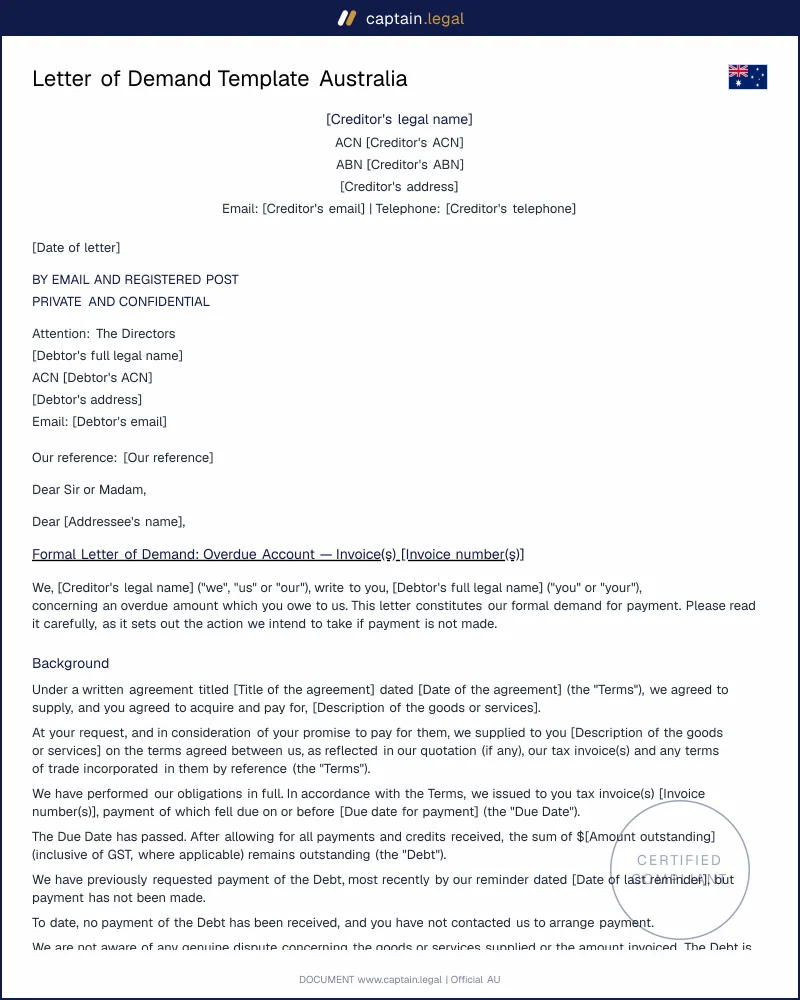
How to fill out this letter of demand

You start by choosing whether the creditor is an individual, a sole trader or a company, then enter the debtor's exact legal name. For a business debtor, the form asks for the ABN or ACN, because a quick ASIC register check avoids suing the wrong entity. You then list each unpaid invoice and any part payments. The template totals the principal automatically.

Next comes the interest. If your contract or terms of trade contain a late payment clause, you enter the clause number and rate, and the letter cites it. If not, the template switches to a claim for statutory interest from the date the debt fell due, which avoids asserting a contractual right you do not hold. The state or territory you select decides which court or tribunal the letter names.

The final step is the deadline and the delivery method. You set a specific payment date and select how the letter will be served: email, registered post or hand delivery. For a company, posting or delivering the letter to its registered office is the safest route, because section 109X of the Corporations Act treats that address as the place for service. Your letter of demand is then generated, ready to sign on your letterhead.

Common mistakes to avoid

The most frequent error in a letter of demand is inflating the claim. Creditors add collection fees or a punitive interest rate the contract never mentioned, and the debtor's lawyer uses the overreach to discredit the whole letter. Only claim what the agreement or the statute supports. The second error is a vague deadline. Phrases like "promptly" or "in the near future" give the debtor room to argue they were never put on proper notice. Always state a fixed date, and keep it.

Threatening language is the third trap. Warnings about criminal charges, credit reporting that you have no right to make, or contacting the debtor's employer can amount to harassment or coercion under section 50 of the Australian Consumer Law. The fourth mistake is ignoring a genuine dispute about quality or quantity: the regulators expect you to pause and deal with it, not send a harsher second demand. Finally, many creditors wait too long. Once the limitation period expires, the debtor has a complete defence (and in NSW the debt is extinguished), so implying that the debt is still enforceable is itself misleading conduct.

Key takeaways

PRE-LITIGATION

Make the debt court-ready

A demand letter is an open, formal notice: it identifies the unpaid invoice, loan or other liquidated debt, states the interest claimed, and sets a firm payment deadline. That paper trail matters if you later file in the Local or Magistrates Court, because courts can consider pre-litigation conduct when dealing with costs.

ESCALATION

Do not confuse demand types

A standard letter of demand is not a statutory demand. Under section 459E of the Corporations Act 2001 (Cth), a company statutory demand is a prescribed form and 21 days of non-compliance can support insolvency steps. For individuals, a bankruptcy notice under section 41 of the Bankruptcy Act 1966 (Cth) requires a final judgment first.

COMPLIANCE

Keep pressure lawful and timed

Debt collection pressure has limits. Section 50 of the Australian Consumer Law, and section 12DJ of the ASIC Act 2001 (Cth) for financial services, prohibit undue harassment and coercion. The ACCC and ASIC guideline says collection should pause while liability is genuinely disputed. Also check limitation periods: often six years, but three years in the Northern Territory.

Frequently Asked Questions

A letter of demand does not create a new obligation. The debt already exists under your contract, invoice or loan, and the letter formally calls it in. Its weight is evidentiary. It fixes the date from which you claim interest, shows the court that the debtor had a fair opportunity to pay, and supports an order for costs in your favour. A signed letter that identifies the debt precisely and cites its contractual basis is what a magistrate or tribunal member expects to see before hearing a debt claim.

Seven to fourteen days is the accepted range for a commercial debt in Australia. Seven days suits a small, undisputed invoice; fourteen is safer for a larger amount or an individual debtor. Shorter can look oppressive; beyond 28 days, the urgency fades. Count the period from the date the debtor is likely to receive the letter, not the date you post it, and add a few business days for registered post.

Yes. The Electronic Transactions Act 1999 (Cth) and its state equivalents recognise written communications delivered electronically, and email is now the usual method for commercial demands. Send it as a signed PDF to an address the debtor has used with you, and keep the sent message. For a larger claim or a silent debtor, follow up by registered post so that receipt cannot be credibly denied. If the contract nominates an address for notices, use that one as well, because a court will look first at what the parties agreed.

You download the completed letter in Word and PDF. The Word file lets you place the text on your own letterhead or attach a statement of account. The PDF is ready to sign and send immediately. Both files are generated from the same answers, so the amounts, dates and statutory references match exactly. Related contracts and notices sit in our business legal templates for Australian companies.

Once the deadline passes, you can file a claim in the court or tribunal named in the letter. If the debtor still does not respond after service, you can apply for default judgment and then enforce it through a garnishee order, a property seizure order or an examination of the debtor's finances. For larger debts owed by a company, a statutory demand is the next lever, and the complete catalogue of Australian legal documents covers the agreements that prevent the next dispute.

You can claim contractual interest if your agreement provides for it, and statutory interest otherwise, as long as the basis is stated. Legal costs work differently. You can warn that you will seek costs, but you cannot add a sum for legal costs to the debt itself unless the contract expressly allows recovery of collection costs. Overclaiming at this stage only weakens the letter of demand.

4.7/5

24 verified reviews · 50 000+ downloads

Unpaid Invoice? Letter of Demand Before Court | AU
  • Immediate access to the document
  • PDF + Word download
  • Compliant with 2026 legislation
  • Reviewed by lawyers
Fill in the template
Secure payment
Updated on October 14, 2026

You might also like

Privacy Policy Template Australia
Sale of Business Agreement Australia