Real Estate

Paying Guest Agreement India: Section 52 Easements Act

PG licence drafted under Section 52, Indian Easements Act 1882. Keeps your guest a licensee, with Maharashtra registration and police verification clauses.
4.6/5— 17 reviews50 000+ downloadsInstant download
Share

A paying guest agreement is the written licence that allows a person to occupy a bed or a room in someone else's premises, usually with meals and housekeeping, without becoming a tenant. PG operators, homeowners letting a spare room and co-living managers use it to fix the monthly licence fee, the security deposit, the house rules and the exit notice in one signed instrument. Our PG accommodation agreement is drafted under Section 52 of the Indian Easements Act 1882, so the occupant remains a licensee and possession stays with the owner, while the clauses on shared rooms, meals and tenant police verification reflect how PGs actually run in Indian cities.

Compliant

2026 Legislation

50,000+ clients

trust us

Affordable

From $4.90 / doc

Secure payment

Instant download

Paying Guest Agreement India: Section 52 Easements Act

Secure payment

Fill in the template

What is a paying guest agreement?

In Indian law a paying guest arrangement is a licence, not a lease. The owner grants a personal permission to use part of the premises, typically a bed in a shared room with access to a dining area, a bathroom and common spaces, while legal possession and control stay with the owner. A lease under Section 105 of the Transfer of Property Act 1882 transfers an interest in immovable property; a licence transfers nothing. The licensee cannot sublet, cannot bring in another occupant and, under Section 56 of the Indian Easements Act, cannot pass the permission to anyone else. Meals, laundry, Wi-Fi and cleaning are usually bundled into one licence fee, and courts treat that bundle as a strong sign that the occupant is a guest rather than a tenant.

The closest relative is the 11-month leave and licence agreement for a whole flat, which rests on the same Section 52 but hands an entire unit to one licensee. A PG agreement is narrower. The owner or a warden stays on site, the room may be shared with strangers, entry hours and visitors are regulated, and the owner keeps a key to every room. Once the occupant takes exclusive control of a self-contained unit with no services, the arrangement starts to look like a tenancy, and a residential rent agreement drafted to the Model Tenancy Act 2021 becomes the correct instrument. The wrong choice rarely hurts at signature, only at exit.

When do you need this document?

The classic case is a homeowner who converts spare rooms, or a whole floor, into PG accommodation near a college, a tech park or a hospital. Each resident signs individually, because a licence is personal and one occupant's default should never put the other beds at risk. The second frequent scenario is the student PG where the resident is seventeen or barely eighteen. A minor is not competent to contract under Section 11 of the Indian Contract Act 1872, and since Mohori Bibee v Dharmodas Ghose (1903) an agreement signed by a minor is void, so the parent or guardian must contract in their own name as the licence holder of record and pay the fee.

Professionals on a transfer or probation period use PG agreements for their first months in a new city, often with a short lock-in followed by a rolling monthly term. Co-living brands issue a standard PG licence for each bed, while an employer that books blocks of beds for trainees signs a separate corporate service agreement under the Indian Contract Act with the operator. One trap deserves attention: a tenant who runs a PG inside a rented flat without the landlord's written consent breaches the head lease, and the paying guests lose their beds when that lease ends.

Key clauses included in our template

  • The identification of the parties records the licensor's and licensee's names, permanent addresses and identity particulars. For a minor resident, the parent or guardian signs as the contracting party, not as a mere surety, and Aadhaar details are captured in masked form only.
  • The grant of licence describes the bed, the room and the sharing type (single, twin or triple), plus the common areas the licensee may use. It states in terms that possession remains with the licensor and that no tenancy is created.
  • The licence fee and inclusions clause lists what the monthly fee covers: meals per day, electricity up to a stated usage, water, Wi-Fi, housekeeping and laundry. It separates the accommodation component from food and services, because only rent counts for a rent receipt used to claim the HRA exemption, and obliges the licensor to issue one each month.
  • The security deposit clause expresses the deposit in months of fee and sets a refund deadline after checkout. Deductions are limited to unpaid dues and damage beyond normal wear, each supported by a written statement.
  • The house rules schedule covers entry timings, visitors, overnight guests, cooking in rooms, smoking and alcohol, quiet hours and shared appliances. Breach of a material rule after one written warning is a stated ground for revocation.
  • The notice period and lock-in clause gives both sides a written notice, commonly 15 or 30 days, and explains what happens to the deposit if the licensee leaves during the lock-in.
  • The police verification clause obliges the licensee to supply identity proof, photographs and emergency contacts, and the licensor to file them with the local police station within the time set by the local order.

State-specific considerations

Maharashtra is the clearest case of compulsory registration for leave and licence arrangements, PG agreements included. Section 55 of the Maharashtra Rent Control Act 1999 requires the agreement to be in writing and registered, and places that duty on the licensor. If the owner fails to register, the licensee's version of the terms prevails unless the owner proves otherwise, and the owner faces a criminal penalty. Section 24 lets the licensor seek eviction before the Competent Authority once the licence expires and makes an overstaying licensee liable for damages at twice the licence fee, a remedy that works best on a registered written agreement. Stamp duty falls under Article 36A of the Maharashtra Stamp Act; registration can be completed online.

Karnataka regulates PGs mainly through municipal licensing. In Bengaluru, trade licence conditions for PG accommodation were set in August 2024 under Section 305 of the Bruhat Bengaluru Mahanagara Palike Act 2020, now enforced under the Greater Bengaluru Authority: CCTV on entries, exits and corridors with 90 days of storage, at least 70 square feet per occupant, fire safety clearance, a guard round the clock and an FSSAI licence where a mass kitchen operates. The trade licence caps the number of occupants, so our template records the licensed capacity of the room. Unlicensed PGs have already been sealed.

Delhi relies on police orders rather than a PG statute. Verification of tenants and licensees is required by orders of the Commissioner of Police, now issued under Section 163 of the Bharatiya Nagarik Suraksha Sanhita 2023, and disobedience is prosecuted under Section 223 of the Bharatiya Nyaya Sanhita 2023. The Delhi Police portal accepts registration online. Operators near North Campus or Laxmi Nagar should file for every new arrival, not in annual batches.

Tamil Nadu is the strictest State for PGs housing women. The Tamil Nadu Hostels and Homes for Women and Children (Regulation) Act 2014 requires every hostel or lodging house for women to hold a licence, and the Madras High Court upheld the Act against a constitutional challenge. Since the 2025 amendment to the rules, the application is filed online and the licence runs for ten years once the certificates are verified. Running a women's PG in Chennai or Coimbatore without it is an offence, so our template carries the licence number in the recitals.

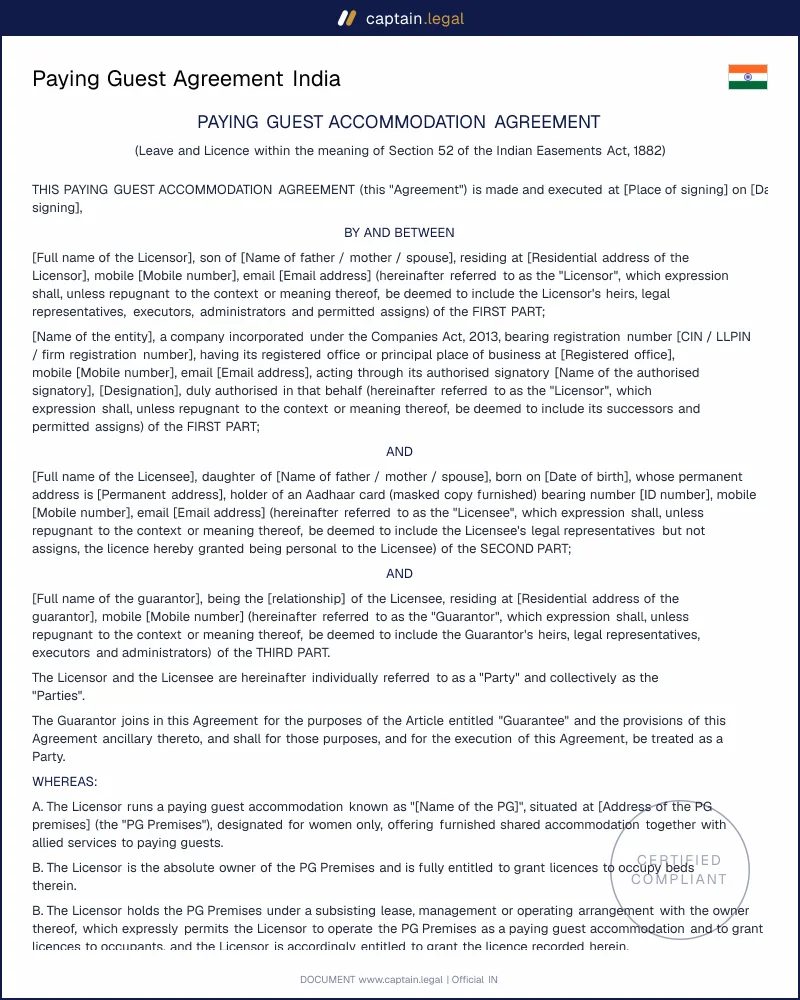
How to fill out this paying guest agreement

You start by selecting the State where the PG is located. That choice sets the stamp duty guidance, the registration note for Maharashtra and the wording of the verification clause. You then enter the licensor's details and, if the building is itself rented, confirm that the owner has consented to PG use. The form next asks for the licensee's identity and whether the resident is under eighteen; if so, it switches the contracting party to the parent or guardian. The room section covers the sharing type, the bed number, the furniture inventory and the common areas included.

After that, you choose the services bundled into the monthly fee, the due date, the deposit in months and the refund window. The house rules arrive pre-filled from common practice, and you adjust timings, visitor policy and kitchen access to match the property. The last screen sets the lock-in, the notice period and the start date. The finished agreement downloads in Word and PDF, ready for e-stamping, signature before two witnesses and, in Maharashtra, online registration.

Common mistakes to avoid

The most expensive mistake is a PG agreement that reads like a lease. Owners copy a rent agreement, call the resident a tenant, hand over the only key and omit the services, then discover in court that the occupant holds a tenancy under State rent law. The second is skipping police verification because the resident is a student or a friend's relative; the owner, not the resident, is prosecuted when the order is breached. The third is a vague deposit clause. "Refundable subject to deductions" invites an argument at every checkout, while a list of permitted deductions and a fixed refund date closes it.

Operators also overfill rooms beyond the licensed capacity, which gives the civic body grounds to seal the building and weakens any insurance claim. Residents make their own errors, the usual one being a cash deposit with no receipt. When an owner withholds a deposit without justification, the resident's first move is a written legal demand notice for recovery of the unpaid deposit before approaching the civil court or the consumer commission, since Section 2(42) of the Consumer Protection Act 2019 covers board and lodging. Collect only masked Aadhaar copies and store them securely, and never change house rules mid-stay by WhatsApp; a change that binds the licensee needs a signed addendum.

Key takeaways

LEGAL STATUS

Keep the guest as a licensee

A PG agreement should be framed as a licence under Section 52 of the Indian Easements Act 1882, not as a lease. The guest gets personal permission to use a bed, room and shared facilities, while possession stays with the owner. Under Section 56, the guest cannot transfer that permission, sublet, or bring in another occupant.

OPERATING TERMS

Put fees, rules and checks in writing

The agreement should capture the monthly licence fee, security deposit, meals, housekeeping, Wi-Fi, entry hours, visitors and exit notice in one signed document. For Indian PGs, police verification clauses matter because operators commonly need tenant or guest checks. In Maharashtra, registration needs closer attention because licences are treated differently from most other States.

EXIT RISK

Exclusive possession can create tenancy trouble

Labels will not save a badly structured PG. Courts look at substance, as seen in Associated Hotels and C.M. Beena, so a lockable self-contained unit with no services may be treated as a tenancy. Section 60 allows revocation, but Section 63 gives reasonable time to leave, and Section 64 may trigger compensation if eviction is without fault.

Frequently Asked Questions

Yes. A PG agreement is a contract under the Indian Contract Act 1872 and a licence under Section 52 of the Indian Easements Act 1882, so it binds both parties once signed by competent adults. An unstamped agreement is not void, but since the Supreme Court's seven-judge ruling of 2023 on unstamped instruments it stays inadmissible in evidence until duty and penalty are paid. Registration is optional in most States but compulsory in Maharashtra.

Whatever the agreement states, commonly 15 or 30 days for either side. Without a written clause, Section 63 of the Indian Easements Act only guarantees a reasonable time to leave, which invites disagreement, and Section 64 allows compensation if the owner revokes early without fault by the resident. An owner should never lock out a resident or remove belongings without notice, as self-help eviction exposes the owner to civil and criminal liability.

Stamp duty is payable everywhere, on non-judicial stamp paper or through e-stamping. Some States have a dedicated article for leave and licence, such as Maharashtra, while others charge it under the lease or agreement article of their stamp law. Registration depends on the State. Maharashtra requires it for every leave and licence agreement, whatever the duration, through an online process. Elsewhere a licence falls outside the compulsory categories of Section 17 of the Registration Act 1908, so most owners skip it.

In most Indian cities, yes. District magistrates and police commissioners issue orders under Section 163 of the Bharatiya Nagarik Suraksha Sanhita 2023 requiring owners to report tenants and licensees to the local police station within a set period. Breach is prosecuted under Section 223 of the Bharatiya Nyaya Sanhita 2023, and the owner is the one charged. Our template obliges the resident to supply documents promptly so the owner can file on time.

The completed agreement downloads in both Word and PDF. The Word file lets you adjust house rules or add a furniture inventory, while the PDF is ready to print on stamp paper or attach to an e-stamp certificate. Both carry the State wording you selected and signature blocks for the licensor, the licensee, a guardian where needed and two witnesses. Related forms sit in the full catalogue of Indian legal document templates.

It depends on duration and value. Entry 12A of Notification 12/2017-Central Tax (Rate) exempts accommodation supplied for at least 90 continuous days, provided the value per person per month stays within the ceiling fixed by the GST Council; both conditions must be met. A resident who leaves before 90 days, or a room priced above the ceiling, can make the supply taxable, and food billed separately may be treated differently. That is why our template states the minimum stay and the fee per person explicitly.

4.6/5

17 verified reviews · 50 000+ downloads

Paying Guest Agreement India: Section 52 Easements Act
  • Immediate access to the document
  • PDF + Word download
  • Compliant with 2026 legislation
  • Reviewed by lawyers
Fill in the template
Secure payment
Updated on September 29, 2026

You might also like

Agreement to Sell Format India
No Objection Certificate (NOC) Format India