Personal & Family

Relinquishment Deed India | Section 17 Registration Act

Release deed drafted to Section 17 of the Registration Act 1908, Article 55 Stamp Act and State family concessions (MH, KA, TN, Delhi). Word & PDF.
4.6/5— 18 reviews50 000+ downloadsInstant download
Share

A relinquishment deed is the registered instrument by which a co-owner or legal heir gives up their share in an immovable property in favour of one or more of the remaining co-owners. In Indian families it is the standard way to bring an inherited flat, house or plot into a single name after a parent dies intestate, without a partition suit and without the stamp duty of a sale. Our template is written for legal heirs, siblings, surviving spouses and NRI family members who want a release deed the Sub-Registrar accepts on first presentation, drafted around Section 17 of the Registration Act 1908 and the family concessions in the State stamp schedules.

Compliant

2026 Legislation

50,000+ clients

trust us

Affordable

From $4.90 / doc

Secure payment

Instant download

Relinquishment Deed India | Section 17 Registration Act

Secure payment

Fill in the template

What is a relinquishment deed in India?

No Indian statute defines relinquishment as such. The concept comes from stamp law, which calls the instrument a release: under Article 55 of Schedule I to the Indian Stamp Act 1899, a release is any instrument by which a person renounces a claim upon another person or against a specified property. The releasor already holds an undivided share, typically as a legal heir, and the releasee is another co-owner of the same property. The released share does not travel to a third party; it merges into the releasee's existing interest and enlarges it. The Supreme Court accepted in Kuppuswami Chettiar v. A.S.P.A. Arumugam Chettiar (1967) that a registered release between co-owners can pass the releasor's title. Once registered, the deed is irrevocable by the releasor alone.

The distinction from neighbouring instruments drives the stamp duty. A gift deed under Sections 122 to 126 of the Transfer of Property Act can pass property to someone who holds no share at all, but it needs acceptance by the donee and two attesting witnesses under Section 123. A partition deed divides the property among all co-owners, while a relinquishment deed removes one co-owner and leaves the property undivided with the others. The Delhi High Court drew the line in Ramesh Sharma v. Government of NCT of Delhi (October 2025), holding that sisters who gave up inherited shares to their brother, all Class I heirs, executed releases and not gifts.

When do you need this document?

The classic trigger is an intestate death. A Hindu father dies owning a flat, and under Section 8 of the Hindu Succession Act it devolves on his Class I heirs: his widow, his sons and daughters, and his mother if she survives him, each taking one share. The family agrees that the widow should hold the flat outright, so each child and the grandmother execute a release in her favour. Consolidation before a sale is the second scenario, since buyers prefer one vendor with clean title. The third is the family settlement where one heir keeps the house and another takes cash from the estate; that release is made for consideration, the deed must say so, and the stamp position changes completely.

Two edge cases come up regularly. Co-legatees who inherit jointly under a will can release in favour of one another, and the Bombay High Court held in Shailesh Harilal Poonatar v. District Collector of Stamps (2004) that such a release is not a conveyance. Where the will was made in Mumbai, Chennai or Kolkata, probate is usually required under Section 213 of the Indian Succession Act before the legatees can prove their title. An NRI heir who cannot travel can sign before an Indian consulate or through an attorney. Families who want to spare the next generation this exercise usually follow up with a registered last will drafted to Section 63 of the Indian Succession Act.

Key clauses included in our template

  • The parties clause identifies each releasor and releasee with full name, parentage, age, address and PAN, with Aadhaar shown in masked form only, and states their relationship. The relationship is the fact on which any family stamp concession depends.
  • The recital of title traces the property from its original acquisition to the present co-owners, citing the deceased owner's registered deed, the date of death and the legal heir certificate, probate or letters of administration. The Sub-Registrar reads it first to confirm the releasor holds an existing share.
  • The schedule of property describes the asset with survey or CTS number, flat details, boundaries, area and municipal assessment number, exactly as in the title deed and revenue records.
  • The extent of the share relinquished is stated as a fraction of the whole, such as an undivided one-fifth share. It is the base for stamp duty wherever a conveyance rate applies.
  • The consideration clause records either a release out of natural love and affection or the exact amount paid. A no-consideration declaration that later proves false exposes the deed to impounding and a penalty for deficient stamp duty.
  • The operative release and covenant renounces all right, title and interest in the scheduled share and binds the releasor's heirs and assigns not to raise any future claim.
  • The execution block provides for signatures of all parties and two identifying witnesses before the Sub-Registrar, with space for photographs and thumb impressions under Section 32A.

State-specific considerations

Maharashtra applies Article 52 of Schedule I to the Maharashtra Stamp Act 1958. A release of ancestral property made without consideration in favour of the releasor's spouse, brother or sister, father, mother, son, daughter, a child of a predeceased son, or the legal heirs of those relatives attracts a fixed duty, revised upward in 2024 but still nominal. Every other release is charged at the conveyance rate under Article 25 on the Ready Reckoner value of the share given up. Sub-Registrars often question whether a flat bought by a parent is ancestral, so the recital of devolution must be precise. The society then transfers the share certificate and the city survey office or talathi updates the property card.

Karnataka governs releases under Article 45 of the Karnataka Stamp Act 1957. A release in favour of a family member, defined as the spouse, father, mother, son, brother, sister, the wife of a predeceased son, the children of a predeceased son or daughter, and the spouse and children of a predeceased brother or sister, carries a fixed duty graded by location, highest in BBMP areas and lowest for rural land. The Karnataka Registration (Amendment) Act 2025 made the registration fee ad valorem without the old cap, so check it on the Kaveri portal before booking. E-Khata mutation follows at the municipal office.

Tamil Nadu applies Article 55 of Schedule I to the Indian Stamp Act 1899 as amended for the State. A release among family members is charged at a concessional percentage of the guideline value, with a cap on both stamp duty and registration fee, while a release to anyone outside the family definition is charged as a conveyance. Documents and slots go through TNREGINET, and the patta transfer at the taluk office completes the file.

Delhi stamps a release under Article 55 of Schedule I-A at a low fixed duty where one co-owner releases to another without consideration, whatever the property value. The Sub-Registrar will reclassify the instrument as a gift or sale if the releasee holds no share or money changes hands. MCD mutation is not automatic for inheritance and release transfers and needs a separate application.

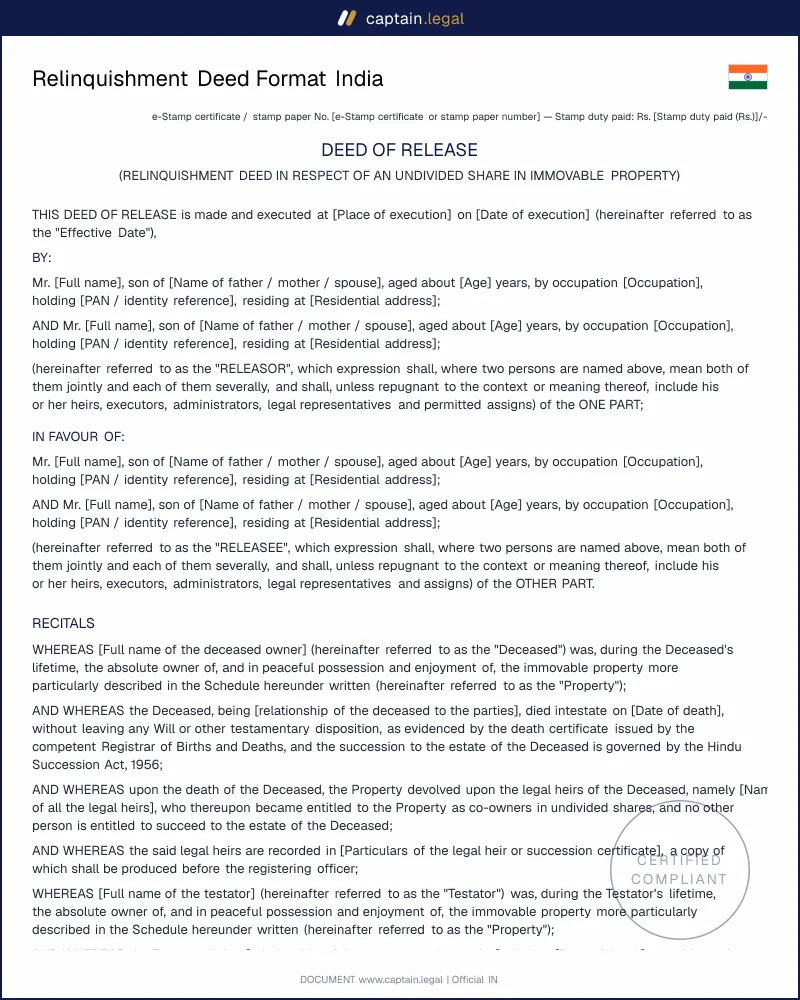
How to fill out this relinquishment deed

You start by selecting the State where the property lies, because that choice loads the correct stamp article, the family definition and the wording the local Sub-Registrar expects. The form then asks for the deceased owner's details and acquisition deed, the date of death and the reference of the legal heir certificate or probate. Next you list every co-owner, mark who releases and who receives, and state each share; the template computes the fraction released and inserts it into the operative clause and the schedule.

If no money is involved, the deed records a release out of love and affection. If one heir compensates another, you enter the amount and the wording switches to conveyance stamping. Copy the schedule of property word for word from the title deed and the latest tax receipt. An NRI releasor who cannot attend can sign through a special power of attorney for property under the Powers of Attorney Act 1882, stamped in India within three months of its receipt. You then print the draft on e-stamp paper of the correct value and book a Sub-Registrar slot.

Common mistakes to avoid

The most expensive error is releasing in favour of the wrong person. A daughter who wants her share to go to her brother's son, who holds no share himself, cannot use a relinquishment deed at all; the transfer is a gift and will be stamped as one. The second is leaving an heir out, and the surviving grandmother is the heir families forget most often. A deed signed by some Class I heirs does not bind the others: an omitted daughter keeps her share untouched and can sue for partition, which reopens the whole arrangement. The third is signing before the owner's death, which Section 6(a) of the Transfer of Property Act renders void, even if courts have occasionally applied estoppel against an heir who took money for it.

Registration mistakes follow close behind. Families sign the deed, keep it in a drawer, and discover after four months that the fine under Section 25 is the only way back. An unregistered release gives the releasee no title, whatever the family understood. And a release made for money but declared gratuitous is the classic trigger for impounding, a demand for deficit duty and a penalty.

Key takeaways

LEGAL NATURE

It releases only an existing share

A relinquishment deed works where the releasor already has an undivided interest, usually as a legal heir, and gives it up to another co-owner. It is not a gift to an outsider or a partition of the property. After registration, the released share merges with the releasee's existing interest and the releasor cannot revoke it alone.

REGISTRATION

Registration makes the release effective

Section 17(1)(b) of the Registration Act, 1908 requires registration because the deed extinguishes rights in immovable property. Under Section 49, an unregistered deed will not affect the property or prove the transaction, except for collateral purposes. Presentation must normally happen within four months of execution, at the Sub-Registrar office where the property is situated.

STAMP DUTY

Stamp treatment depends on structure

Stamp duty is driven by how the release is framed and by the State schedule. Article 55 treats it as a release, and family concessions may apply in States such as Maharashtra, Karnataka, Tamil Nadu or Delhi. If money is paid, the deed may be charged closer to conveyance on the share renounced, changing the cost.

Frequently Asked Questions

Yes, once it is executed on correctly stamped paper and registered before the Sub-Registrar with jurisdiction over the property. Registration is compulsory under Section 17(1)(b) of the Registration Act 1908, and an unregistered deed does not transfer the share under Section 49. After registration the release is final: the releasor cannot withdraw it unilaterally, and only a civil suit for cancellation on grounds such as fraud, coercion or undue influence, filed within three years of discovering the facts, can set it aside.

No. A relinquishment can only enlarge an interest the releasee already holds, so the recipient must be an existing co-owner of the same property. If your share should go to a spouse, a nephew or a friend who holds nothing in the property, the correct instrument is a gift deed, usually stamped at a higher rate. Our personal and family legal document formats for India cover both instruments.

The deed must be presented within four months of execution under Section 23 of the Registration Act 1908. Where parties sign on different dates, Section 24 runs the four months from each signature. A deed signed outside India can be registered if it is presented within four months of its arrival in India under Section 26. If the window lapses, Section 25 allows the Registrar to accept the document within a further four months on payment of a fine. After that, the family must execute a fresh deed.

Yes. The NRI can sign the deed before an Indian embassy or consulate, or appoint an attorney in India through a special power of attorney attested at the consulate. A document executed outside India must be stamped within three months of its first receipt in India under Section 18 of the Indian Stamp Act 1899 or the corresponding State provision. The deed is then presented before the Sub-Registrar where the property lies.

Income tax law treats the relinquishment of a capital asset as a transfer. A release without consideration usually creates no taxable gain for the releasor, and a releasee who receives a share from a relative falls within the exemption for receipts from relatives. Where the co-owners are not relatives, the stamp duty value of the share may be taxable in the releasee's hands. A release for money is different: the releasor may owe capital gains tax on the amount received.

You receive the completed deed as an editable Word file and a print-ready PDF. The Word version lets your advocate or document writer adapt wording requested by a particular Sub-Registrar office, while the PDF is ready to print on e-stamp or franked paper for execution. Every other Indian template is listed in our catalogue of legal documents for India.

4.6/5

18 verified reviews · 50 000+ downloads

Relinquishment Deed India | Section 17 Registration Act
  • Immediate access to the document
  • PDF + Word download
  • Compliant with 2026 legislation
  • Reviewed by lawyers
Fill in the template
Secure payment
Updated on September 28, 2026

You might also like

Personal Loan Agreement India
Legal Heir Affidavit India