Employment & HR

Show Cause Notice India | IR Code 2020 & Standing Orders

Misconduct show cause notice aligned with the Industrial Relations Code 2020, Model Standing Orders 2026 and natural justice. Ready for a domestic enquiry.
4.6/5— 15 reviews50 000+ downloadsInstant download
Share

A show cause notice to an employee is the written communication by which an Indian employer puts specific allegations of misconduct to an employee and calls for a written explanation within a fixed time. It opens the disciplinary process, and it is the record on which any domestic enquiry and later penalty will be judged. This template is built for HR heads, plant managers and in-house counsel who want a notice drafted the way a labour practitioner would draft it: precise charges, a fair reply deadline and wording that does not pre-judge the outcome. It tracks the Industrial Relations Code, 2020, the Model Standing Orders, 2026 and the natural justice standards applied by Indian tribunals.

Compliant

2026 Legislation

50,000+ clients

trust us

Affordable

From $4.90 / doc

Secure payment

Instant download

Show Cause Notice India | IR Code 2020 & Standing Orders

Secure payment

Fill in the template

What is a show cause notice to an employee?

A show cause notice identifies the alleged misconduct, sets out the facts relied upon and asks the employee to explain why disciplinary action should not be taken. It is neither a penalty nor a finding. It gives the employee a real opportunity to answer before anything is decided, the audi alteram partem rule that labour tribunals and High Courts read into every contract of employment. A notice that reads as though the decision has already been made is, in law, no notice at all.

Three documents are regularly confused with it. A charge sheet frames the articles of charge on which a domestic enquiry proceeds; many establishments combine the two into a single charge sheet-cum-show cause notice. A warning letter closes a minor lapse without calling for a reply and cannot alone support a dismissal. The final order, if the charges are proved, is issued separately on a termination letter format aligned with the Industrial Relations Code. Between the two sits the enquiry report which, since Managing Director, ECIL v. B. Karunakar (1993) 4 SCC 727, must be furnished to the employee for comment before the penalty is decided whenever the enquiry officer is not the disciplinary authority.

When do you need this document?

In practice the most common trigger is unauthorised absence, whether a worker who has overstayed sanctioned leave or a habitual late-comer. Act promptly. Months of inaction are read as condonation, and because the Second Schedule expressly targets untrue allegations of absence without leave, the attendance record behind the charge must be exact. The second group is insubordination, from refusal of a lawful order to abuse of a supervisor. The third is breach of trust: theft, false reimbursement claims, tampering with attendance data or disclosure of confidential information, all listed as misconduct in the Model Standing Orders, 2026. For a data leak, the charge should cite the confidentiality clause of the contract or of a signed non-disclosure agreement enforceable under the Indian Contract Act, 1872.

Two situations call for a different route. Poor performance is not misconduct. Underperformance is handled through a documented improvement plan, and ending a worker's service for it is retrenchment, which for a worker with a year's continuous service requires notice and compensation under Section 70 of the Code. A complaint of sexual harassment belongs to the Internal Committee under the Sexual Harassment of Women at Workplace (Prevention, Prohibition and Redressal) Act, 2013. The employer's notice follows the Committee's recommendation; it never replaces the Committee's inquiry.

Key clauses included in our template

  • The identification block names the employee, designation, employee code and establishment, and cites both the appointment letter and the clause of the certified or model standing orders that makes the conduct misconduct.
  • The statement of charges lists each allegation separately with date, time, place and the persons involved. The Supreme Court held in Sawai Singh v. State of Rajasthan (1986) 3 SCC 454 that vague charges vitiate the entire enquiry.
  • The documents relied upon are listed and annexed. State of Punjab v. Bhagat Ram (1974) 4 SCC 386 entitles the employee to the material used against him, and supplying it with the notice removes a frequent ground of challenge.
  • The reply deadline fixes the date, time and officer to whom the written explanation must be delivered, and allows a reasoned request for extension. Seven days is the working default where there are several charges.
  • The proposed action clause states, without pre-judging, that an unsatisfactory reply will lead to a domestic enquiry and that proven charges may attract penalties up to dismissal. It also records the right to be assisted by a co-worker or union representative where the standing orders allow.
  • The optional suspension clause places the employee under suspension pending enquiry and records the subsistence allowance payable, at the Section 38(3) rates where Chapter IV applies.
  • The service block records delivery by hand against signature, by registered post and by email. Courts presume service of a registered letter refused at the correct address, applying Section 27 of the General Clauses Act, 1897.

State-specific considerations

Maharashtra channels unfair labour practice complaints under the Maharashtra Recognition of Trade Unions and Prevention of Unfair Labour Practices Act, 1971 to its Industrial and Labour Courts. Item 1 of Schedule IV covers dismissal in utter disregard of natural justice, with undue haste, or with a punishment shockingly disproportionate to the misconduct. Its fit with the new Code is unsettled, but Mumbai and Pune employers should expect it to be pleaded. Standing orders long applied in the State under the Bombay Industrial Employment (Standing Orders) Rules, 1959 require a charge sheet clearly setting out the circumstances against the workman and calling for his explanation, and many certified orders still follow that model.

Karnataka protects employees with six months' continuous service through Section 39 of the Karnataka Shops and Commercial Establishments Act, 1961. Dismissal needs reasonable cause and one month's notice or wages in lieu, unless the charge of misconduct is supported by satisfactory evidence recorded at an enquiry held for the purpose. The employee may appeal within thirty days, and the appeal turns on the notice and the enquiry record. IT and ITES establishments in Bengaluru have for years operated under exemptions from standing orders, so their notice and HR policy often form the whole procedure.

Tamil Nadu follows the same model in Section 41 of the Tamil Nadu Shops and Establishments Act, 1947: six months' continuous service, reasonable cause, one month's notice, and the same exception for misconduct proved at an enquiry, with an appeal to the appellate authority. Manufacturing units in Chennai and Coimbatore with certified standing orders should cite the clause number of their own certified text, which often still reflects the Tamil Nadu Industrial Employment (Standing Orders) Rules, 1947.

Delhi applies Section 30 of the Delhi Shops and Establishments Act, 1954 after three months' continuous service and waives notice where the termination is for misconduct, yet the authorities still look for a fair enquiry before accepting that label. Most Delhi offices sit below the 300-worker threshold, so the notice, the appointment letter and the HR manual are the entire procedure. In every State, wages due on dismissal must be paid within two working days under Section 17(2) of the Code on Wages, 2019, so prepare the full and final settlement letter meeting the two-day rule before the dismissal order issues.

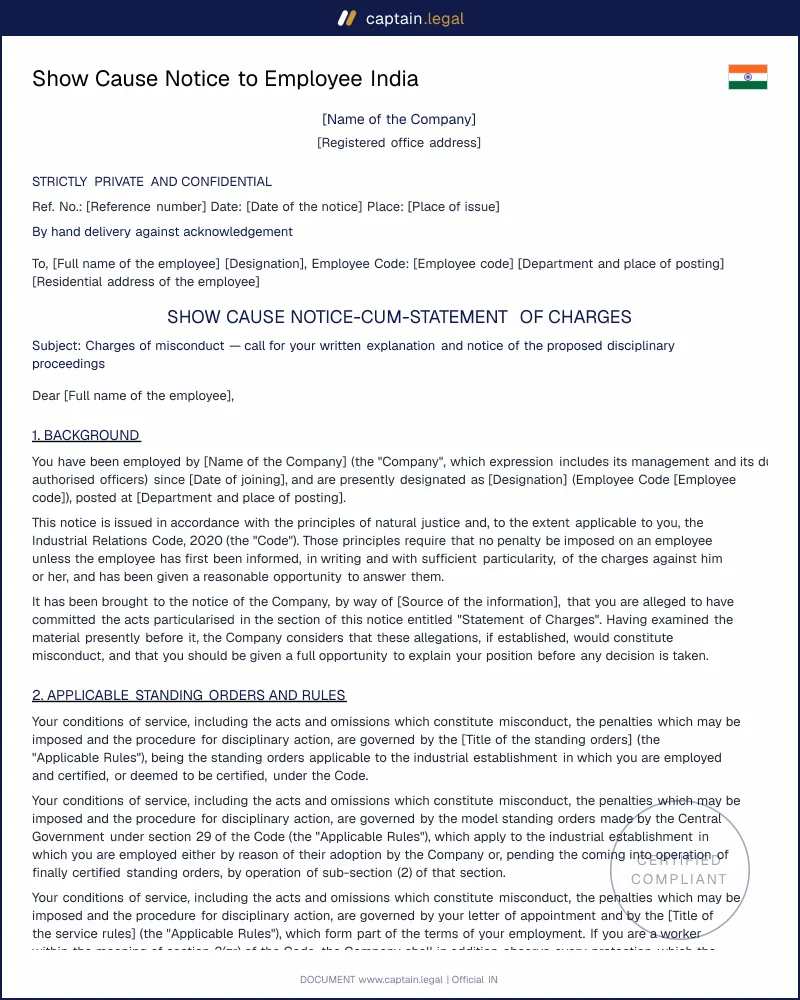
How to fill out this show cause notice

You begin by stating whether the employee is a worker under the Code or managerial and supervisory staff, since that choice decides whether the notice cites standing orders or the appointment letter and the State Shops and Establishments Act. You then select the State of the establishment, which sets the statutory references. Each allegation goes into its own field with date, time and place, and appears in the notice as a separate numbered charge drafted in neutral terms ("it is alleged that", never "you have"). You list the annexed documents, fix the reply deadline, name the officer who will receive the explanation and decide whether to add the suspension clause. The signatory should be senior to the employee and must not be the person who will conduct the enquiry. The finished notice is delivered in Word and PDF, ready for letterhead and service. The related Employment & HR templates drafted for Indian labour practice cover the later stages of the file.

Common mistakes to avoid

The most damaging error is the vague charge: "acts of gross misconduct" tells the employee nothing and gives the tribunal nothing to test. Next comes the pre-judged notice, opening with "you are found guilty" or closing with "your services stand terminated unless you explain", the exact defect that sank the notice in Oryx Fisheries. The third is the illusory deadline, such as a Friday evening notice demanding a reply by Monday morning. The officer who signs the notice must not sit as enquiry officer, because the rule against bias is applied strictly.

The second group concerns evidence and service. Employers cite CCTV footage or an audit report without annexing it, refuse requests for copies, and lose on that point alone. Others wait months before acting and find the delay treated as condonation. Service is left unproven: an unacknowledged email to a personal address is easy to deny. Finally, a notice issued in the wake of union activity or a pending wage claim invites a victimisation finding under the Second Schedule. If the employee's advocate answers with a formal demand, keep your response consistent with the legal notice and reply formats for Indian disputes. Draft every show cause notice as though a tribunal will read it, because one day it may.

Key takeaways

Notice scope

Allegations must be stated, not decided

A show cause notice is only the opening step: it records alleged misconduct, the facts relied on and a fixed time for the employee's written explanation. It should not read like a penalty or a finding. That wording matters because the notice becomes the record against which the domestic enquiry and any later order are tested.

STATUTORY FRAME

Check standing orders before drafting

Chapter IV of the Industrial Relations Code, 2020 applies to industrial establishments with 300 or more workers. Section 29(1) led to the Model Standing Orders, 2026, with separate schedules for mining, manufacturing and services. Older certified standing orders continue under Section 104 until replaced, so HR must match the charge to the applicable misconduct list and procedure.

ENQUIRY RISK

Defects can undo the dismissal

If suspension is ordered, Section 38 says the investigation and inquiry should ordinarily finish within ninety days and subsistence allowance is half wages for the first ninety days, then three quarters unless delay is attributable to the worker. Under Sections 50 and 84, an unfair or disproportionate dismissal can be set aside, reduced or treated as an unfair labour practice.

Frequently Asked Questions

Yes. No statute prescribes a fixed form, stamp duty, notarisation or registration for a show cause notice; its validity depends on its content and on the fairness of the process. The notice must be issued by an officer with disciplinary authority, state specific charges, give access to the material relied on and allow a reasonable time to reply. Where standing orders apply, their procedure must also be followed. A notice meeting those conditions is valid without an advocate's signature, while a dismissal issued with no notice at all exposes the employer to reinstatement under Section 50 of the Code.

The law requires a reasonable opportunity rather than a fixed number of days. Practice runs from 48 hours for a single simple charge to seven days where the charges are several or document-heavy. Add any weekend or public holiday falling inside the window and grant one reasoned request for more time. A short deadline is safe only when every document was supplied with the notice.

Silence is not an admission. Issue a short second notice recording that no explanation was received and fixing the date of the domestic enquiry. If the employee then fails to attend despite proper notice, the enquiry officer may proceed ex parte, record the evidence and submit a report capable of supporting a dismissal. Document and serve every step, because the tribunal will examine the sequence closely before accepting an ex parte finding.

Yes, where the standing orders or the appointment letter provide for suspension pending enquiry. Suspension is not a penalty. In establishments covered by Chapter IV of the Code, Section 38 requires the enquiry to be completed ordinarily within ninety days of suspension and subsistence allowance to be paid at half wages for the first ninety days and three quarters thereafter. Below the 300-worker threshold the obligation comes from the contract and State law, but paying the allowance is the safer course in every case.

Yes. The form asks whether the employee is a worker within Section 2(zr) of the Code. For managerial or administrative staff, and supervisors above the wage ceiling, it replaces the standing orders references with the appointment letter, the HR policy and the State Shops and Establishments Act. The same tests of specific charges, genuine opportunity and absence of bias apply, though the usual remedy here is damages rather than reinstatement.

You download the completed notice as a Word file and a PDF. The Word version is editable for letterhead or a revised charge; the PDF is the version to serve and file. Both versions carry the annexure list and an acknowledgement slip for the employee's signature, which becomes your proof of service. The full catalogue of ready-to-use legal document formats for India is available from the same account.

4.6/5

15 verified reviews · 50 000+ downloads

Show Cause Notice India | IR Code 2020 & Standing Orders
  • Immediate access to the document
  • PDF + Word download
  • Compliant with 2026 legislation
  • Reviewed by lawyers
Fill in the template
Secure payment
Updated on September 28, 2026

You might also like

POSH Policy India Template
Termination Letter India