Real Estate

Mortgage Deed India | Section 58 TPA & Registration Act

Mortgage deed drafted to Section 58 TPA 1882 and the Registration Act 1908: simple and equitable mortgage, Section 69 power of sale, State stamp rules.
4.5/5— 21 reviews50 000+ downloadsInstant download
Share

A mortgage deed is the instrument by which a borrower transfers an interest in specific immovable property to a lender as security for a loan, without giving up ownership. In India it is drafted to Section 58 of the Transfer of Property Act, 1882, stamped under the State stamp law and registered under the Registration Act, 1908. This template is written for private lenders, relatives advancing funds against a flat or plot, partnership firms and NBFCs that need a property loan security document capable of enforcement before a civil court. It covers the simple mortgage and the mortgage by deposit of title deeds (commonly called an equitable mortgage), with the borrower's right of redemption and the lender's remedies on default.

Compliant

2026 Legislation

50,000+ clients

trust us

Affordable

From $4.90 / doc

Secure payment

Instant download

Mortgage Deed India | Section 58 TPA & Registration Act

Secure payment

Fill in the template

What is a mortgage deed?

Section 58(a) of the Transfer of Property Act defines a mortgage as the transfer of an interest in specific immovable property to secure a loan, an existing or future debt, or the performance of an engagement which may give rise to a pecuniary liability. The transferor is the mortgagor, the transferee is the mortgagee, principal and interest together are the mortgage-money, and the written instrument is the mortgage deed. The Act recognises six forms: simple, by conditional sale, usufructuary, English, by deposit of title deeds and anomalous. Each carries its own remedy. A simple mortgagee sues for sale, a mortgagee by conditional sale sues for foreclosure, and a mortgage deed mixing the language of two forms invites years of litigation over which remedy applies.

The mortgage deed must also be kept apart from neighbouring instruments. A registered sale deed transferring ownership passes the entire title, whereas a mortgage passes only a security interest and leaves the equity of redemption with the owner. A charge under Section 100 involves no transfer of interest at all. "Equitable mortgage" is borrowed from English law: the Indian statute speaks of a mortgage by deposit of title deeds under Section 58(f), created by delivering the original title documents with intent to create security, without any conveyance.

When do you need this document?

The most common situation is a private loan within a family or business circle, where the lender wants the borrower's flat to stand behind the debt. A personal loan agreement under the Contract Act records the repayment terms but gives no claim against the property; the mortgage deed supplies that claim. The second is working capital for a proprietor or firm, where a private financier or NBFC lends against a shop, godown or office. Lenders in Mumbai, Kolkata, Chennai and towns notified under Section 58(f) often prefer a deposit of title deeds. A mortgage deed is equally suited to a second or puisne mortgage, where a later lender accepts a subordinate ranking under the priority rule in Section 48.

Two edge cases deserve a warning. Agricultural land is often subject to State land reform statutes restricting transfer to non-agriculturists, and Section 31(i) of the SARFAESI Act excludes it from bank enforcement. Where the property belongs wholly or partly to a minor, the natural guardian needs the court's prior permission under Section 8(2) of the Hindu Minority and Guardianship Act, 1956 before mortgaging it, failing which the mortgage is voidable at the minor's instance.

Key clauses included in our template

  • The parties and recitals of title identify every mortgagor by name, parentage, address and PAN, and trace title back to the document under which the property was acquired. Every co-owner must join, since one co-owner's signature binds only that person's undivided share.
  • The schedule of the mortgaged property gives the survey or CTS number, area, boundaries on all four sides and the village or ward, as Section 21 of the Registration Act requires. An imprecise schedule is a frequent ground for objection at registration.
  • The mortgage-money clause states the principal, the interest rate and method of calculation, and the repayment schedule. It fixes the date on which the money becomes payable.
  • The operative clause uses the words of the chosen form. For a simple mortgage it records the personal covenant to pay and states expressly that the property may be sold on default, closing any argument under Section 58(b).
  • The mortgagor's covenants build on the implied contracts of Section 65: good title, defence of title and payment of public charges, extended to upkeep and fire insurance. They also exclude the statutory leasing power of Section 65A without written consent.
  • The redemption and release clause confirms the right under Section 60, permits early repayment, and obliges the mortgagee to return the title deeds and execute a registered deed of release on full payment.
  • The default and remedies clause lists events of default, accelerates the balance and reserves the remedies of Section 67, with an optional express power of sale under Section 69(1)(c) for property in a notified town. It never replaces that remedy with an irrevocable authority; where the lender needs someone to act on the property, a separate special power of attorney for property matters is the correct instrument.

State-specific considerations

Maharashtra changed the practice of equitable mortgages when its amendments to the Registration Act, 1908 came into force on 1 April 2013. An agreement relating to a deposit of title deeds is now compulsorily registrable, and where no such agreement is executed, Section 89B requires the mortgagor to file a notice of intimation with the Sub-Registrar within thirty days of the mortgage. Missing that deadline is a punishable offence under Section 89C, so the notice is not a formality. The obligation applies even when the mortgage is created outside the State over property situated in Maharashtra. A mortgage deed or deposit agreement is stamped under Article 40 or Article 6 of the Maharashtra Stamp Act, 1958. A lender who lends as a business also needs a licence under the Maharashtra Money-Lending (Regulation) Act, 2014.

Gujarat adopted a comparable regime through the Registration (Gujarat Amendment) Act, 2018, which inserted its own Section 89B. The mortgagor must file a notice of intimation within thirty days with the loan and property details. The sanction targets later dealings: if no notice is filed and the mortgagor transacts with a third party over the property, that transaction is void and the third party recovers its payment with interest and compensation from the transferor. The mortgagee's own security is not invalidated, but the filing creates a public record that deters double financing.

Madhya Pradesh applies a similar Section 89B requirement under the Registration Act as amended for the State, with the same thirty-day window and the same consequence for later transactions. The agreement evidencing the deposit is stamped under Article 7 of Schedule 1-A to the Indian Stamp Act, 1899 as applicable in the State. Registration and e-stamping run through the State's SAMPADA platform.

Tamil Nadu is one of the original jurisdictions named in Section 58(f) itself, through the town of Madras, now Chennai. Outside Chennai, the lender should confirm that the town is covered by a notification before accepting a bare deposit of title deeds. A mortgage deed is stamped there under the Indian Stamp Act, 1899 as amended by the State and presented through the TNREGINET system before the jurisdictional Sub-Registrar. Private lenders should also keep in mind the Tamil Nadu Money-Lenders Act, 1957 and the Tamil Nadu Prohibition of Charging Exorbitant Interest Act, 2003, which makes exorbitant interest a criminal matter.

How to fill out this mortgage deed

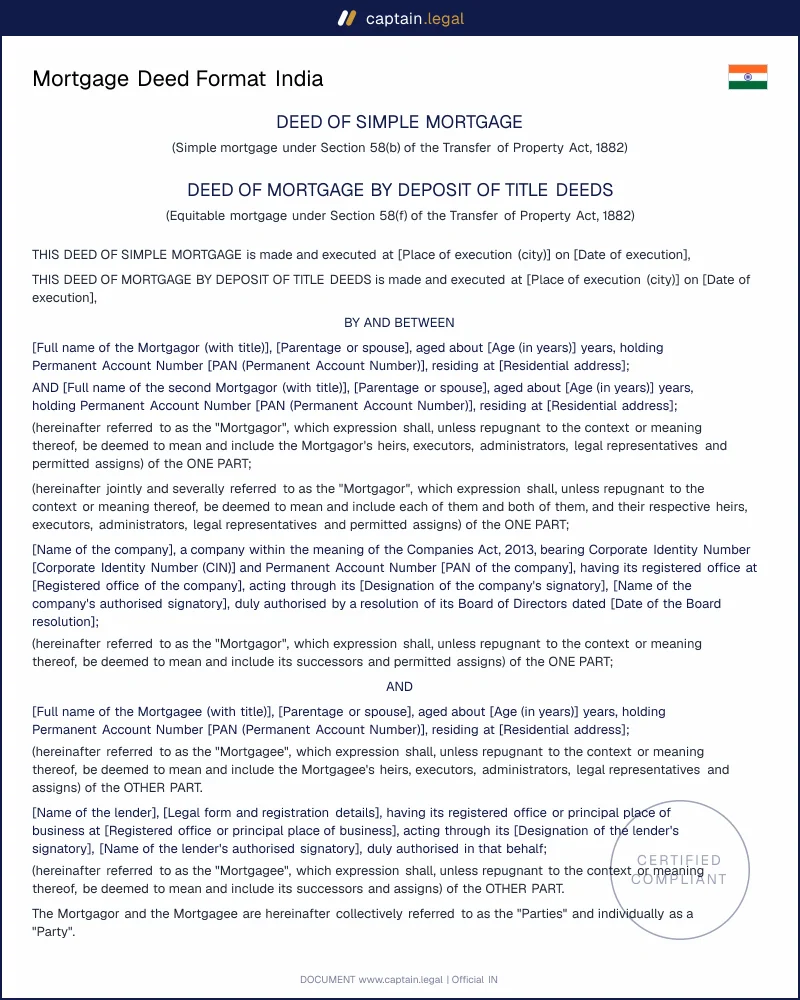
You start by selecting the State where the property is situated, which sets the stamp article and, where relevant, the Section 89B reminder. The form then asks you to choose between a simple mortgage and a mortgage by deposit of title deeds. Next come the parties, each with full name, parentage, address and PAN, and the two witnesses who will attest execution.

The property section follows the Sub-Registrar's logic: survey or CTS number, area, boundaries and the title document through which the mortgagor holds the property. You then set the principal, interest, repayment plan and events of default, and the mortgage deed is generated in Word and PDF.

The mortgage deed is then printed on stamp paper or an e-stamp certificate of the correct value, signed by every mortgagor before two attesting witnesses, and presented at the Sub-Registrar's office with identity proof and photographs within four months. For companion documents on the same property, the India real estate templates for rent, sale and licence share the same statutory base.

Common mistakes to avoid

The error we see most often concerns the memorandum of deposit. In Rachpal Maharaj v. Bhagwandas Daruka (1950), the Supreme Court held that a memorandum recording a past deposit needs no registration, but a document that itself constitutes the bargain does. Lenders routinely draft it as a full contract, leave it unregistered and find it inadmissible. The second mistake is attestation by a single witness, which defeats Section 59 however clean the rest of the deed. The third is a property schedule copied from a builder's brochure instead of the title deed. The fourth is disbursing in cash, which breaches the cash-loan restriction of Section 269SS of the Income-tax Act, 1961, retained under the Income-tax Act, 2025.

Clogs on redemption cause a different kind of trouble. An option for the lender to buy the property, or a "sale agreement" signed alongside the loan, will be struck down, and the proviso to Section 58(c) denies conditional-sale status unless the condition appears in the same document. Some lenders rely instead on a general power of attorney or agreement to sell, which Suraj Lamp & Industries v. State of Haryana (2011) held cannot transfer title. A mortgage is enforced through the mortgage itself and the court or the statute, never through a side document. Finally, serve a written demand notice for recovery of money before filing suit and keep proof of delivery.

Key takeaways

Security type

Choose the mortgage type with care

A mortgage transfers only a security interest in the flat, plot or other immovable property; ownership stays with the borrower. Section 58 of the Transfer of Property Act, 1882 treats a simple mortgage and a mortgage by deposit of title deeds differently. Mixing remedies or language from different forms can push enforcement into long litigation.

Execution

Registration and stamp duty decide enforceability

Except for a mortgage by deposit of title deeds, Section 59 requires a registered instrument signed by the mortgagor and attested by at least two witnesses. Registration must be presented within four months under Section 23 of the Registration Act, 1908. If registration or proper stamp duty is missed, the deed may fail in court.

Default remedies

Default remedies are not automatic

The borrower keeps the right of redemption under Section 60, while the lender usually enforces sale or foreclosure through a civil suit under Order XXXIV of the Code of Civil Procedure, 1908. A Section 69 private sale is limited to specified cases and needs a written demand for three months or three months unpaid interest.

Frequently Asked Questions

No, with one exception. Every mortgage other than one by deposit of title deeds must be effected by a registered instrument under Section 59 of the Transfer of Property Act and Section 17(1)(b) of the Registration Act. An unregistered mortgage deed cannot affect the property under Section 49, leaving the lender unsecured. The exception is a mortgage by deposit of title deeds under Section 58(f), created by delivery of the originals, subject to the State amendments in Maharashtra, Gujarat and Madhya Pradesh. Once stamped, attested and registered, our mortgage deed template is fully enforceable.

In a simple mortgage under Section 58(b), the mortgagor keeps possession, binds himself personally to repay and agrees that the property may be sold on default, and a registered deed is mandatory. The equitable mortgage is the Indian mortgage by deposit of title deeds, created by handing over the original title documents with intent to create security, and valid only in Mumbai, Kolkata, Chennai and notified towns. It is quicker and usually lighter on stamp duty, but depends on proving the intention to create security.

A private lender can sue under Order XXXIV CPC once the mortgage-money is due, within twelve years under Article 62 of the Limitation Act. Where a power of sale under Section 69 is available, the sale cannot take place until three months after a written demand, or three months after interest falls into arrears. Banks, financial institutions and notified NBFCs acting under Section 13(2) of the SARFAESI Act must allow sixty days from their demand notice before taking possession.

The deed must be presented within four months of execution under Section 23 of the Registration Act, 1908. A further delay of up to four months can be condoned on payment of a fine under Section 25; beyond that, the parties must execute a fresh deed. In Maharashtra, Gujarat and Madhya Pradesh, a deposit of title deeds without a registered agreement also requires a notice of intimation within thirty days.

Yes. The questionnaire generates both an editable Word file and a print-ready PDF. The Word version lets your advocate add a bespoke clause before engrossment on stamp paper, while the PDF suits e-stamp printing and presentation at the Sub-Registrar's office. Both files keep the property schedule layout that Section 21 of the Registration Act requires. For other forms you may need alongside the mortgage, browse the full catalogue of Indian legal document templates.

Yes. The right of redemption under Section 60 lets the mortgagor pay once the money is due, and our template extends that right to early repayment. On full payment, the mortgagee must return every original title deed and execute a deed of release, stamped and registered so the encumbrance disappears from the Sub-Registrar's records. The borrower should then obtain a fresh encumbrance certificate, which any future buyer or bank will request.

4.5/5

21 verified reviews · 50 000+ downloads

Mortgage Deed India | Section 58 TPA & Registration Act
  • Immediate access to the document
  • PDF + Word download
  • Compliant with 2026 legislation
  • Reviewed by lawyers
Fill in the template
Secure payment
Updated on September 28, 2026

You might also like

Agreement to Sell Format India
Sale Deed Format India