Business

Joint Venture Agreement India | Companies Act 2013 & FEMA

JV agreement drafted to the Indian Contract Act 1872, Companies Act 2013 and NDI Rules 2019. Reserved matters, Rule 9(5) put options, arbitration. Word/PDF.
4.7/5— 15 reviews50 000+ downloadsInstant download
Share

A joint venture agreement in India is the contract that binds two or more businesses pooling capital, technology or market access into a shared project, whether through a new company, an LLP or a contractual consortium. It fixes contributions, control, profit sharing and exit. This template serves Indian promoters, foreign investors entering India with a local partner and family groups formalising a strategic alliance. It is drafted to the Indian Contract Act 1872 and the Companies Act 2013, with a dedicated FEMA module for non-resident partners, and gives you a JV agreement format that Indian corporate counsel will recognise at first reading.

Compliant

2026 Legislation

50,000+ clients

trust us

Affordable

From $4.90 / doc

Secure payment

Instant download

Joint Venture Agreement India | Companies Act 2013 & FEMA

Secure payment

Fill in the template

What is a joint venture agreement in India?

Indian law has no statute titled "joint venture". The term appears in the Explanation to Section 2(6) of the Companies Act 2013, which describes an arrangement where the parties hold joint control and have rights to the net assets of the business. Three vehicles dominate in practice. The incorporated JV, usually a private limited company, is the most common because it offers limited liability and a clean route for foreign direct investment. The contractual JV, a consortium with no new entity, is standard for infrastructure tenders and EPC work.

The joint venture agreement sits above the constitutional documents of the chosen vehicle. It overlaps heavily with a shareholders agreement for an Indian private company, but the scope differs: a shareholders agreement governs the owners of an existing company, while a JV agreement also covers formation, capital calls and the operating contracts between the venture and its parents. A contractual JV carries two specific risks. Under Section 4 of the Indian Partnership Act 1932, sharing the profits of a business carried on by all can be read as a partnership, with unlimited personal liability. The same arrangement may also be assessed as an association of persons under the Income-tax Act 2025, which is why the agreement separates each member's scope of work and revenue.

When do you need a joint venture agreement?

The most frequent trigger is a foreign company entering a regulated or relationship-driven sector with an Indian partner who brings licences, land, distribution or government access. Defence, broadcasting and multi-brand retail all carry caps that push foreign groups towards a local co-owner. Domestic groups use the same structure for manufacturing tie-ups, where one partner supplies technology and the other plant capacity. Infrastructure is the second large family: NHAI, railway and state utility tenders routinely require a consortium agreement naming a lead member and confirming joint and several liability towards the authority. Most deals start with heads of terms, and a memorandum of understanding for pre-deal negotiations is the right tool at that stage, before the binding JV agreement takes over.

Two edge cases deserve attention. An investor incorporated in Singapore or Mauritius whose beneficial owner sits in China or Hong Kong still falls within Press Note 3, and the approval process can take months. Two purely Indian companies may also choose a foreign arbitral seat after PASL Wind Solutions v GE Power Conversion India (2021).

Key clauses included in our template

  • The structure and business purpose clause records the chosen vehicle, the scope of permitted business and the territory.
  • Capital contributions are set out by party, by instrument and by date, including contributions in kind such as land, plant or intellectual property. Non-cash contributions are tied to a registered valuer's report, and a further funding clause explains what happens when one partner misses a capital call.
  • Board composition and quorum give each partner nominee directors in proportion to its stake. Quorum requires a director from each side, with an adjourned meeting rule so that a boycott cannot freeze the board.
  • Reserved matters list the decisions needing both partners' consent: budget, new borrowing, related party contracts under Section 188, changes to the articles and new lines of business. This list is where most minority protection actually lives.
  • The deadlock resolution ladder moves from escalation to senior management, to mediation, and finally to a buy-sell mechanism such as a Russian roulette or Texas shoot-out, priced in line with FEMA rules.
  • Transfer restrictions cover the lock-in, a right of first refusal, tag-along and drag-along rights, and a ban on transfers to competitors. Each one is mirrored in the articles.
  • Confidentiality and non-compete obligations bind both partners during the term. For early discussions, pair the JV with a non-disclosure agreement enforceable under the Contract Act.
  • Exit and termination provisions define events of default, change of control, put and call options without assured returns, and the exit valuation method.
  • Governing law and arbitration designate Indian law, a seat, an institution and the number of arbitrators. Parent companies are named as parties, since Cox and Kings v SAP India (2023) allows non-signatory group companies to be bound.

Regional and regulatory considerations

Stamp duty rates on agreements are fixed by each state under Entry 63 of List II of the Seventh Schedule to the Constitution, so the place of signature decides how the document is stamped. The seven judge bench in In re Interplay between Arbitration Agreements and the Indian Stamp Act (2023) held that an unstamped agreement is inadmissible in evidence but not void, and the defect can be cured on payment of duty and penalty. Stamp before or at signing, since curing later delays any urgent application.

Maharashtra applies the Maharashtra Stamp Act 1958, and agreements signed in Mumbai are generally stamped under Article 5 of Schedule I, with duty paid online through the GRAS system. The Mumbai Centre for International Arbitration is a frequent choice for ventures with a foreign partner. The Bombay High Court in Messer Holdings v Shyam Madanmohan Ruia (2010) upheld consensual transfer restrictions between shareholders, and that reasoning now sits in the proviso to Section 58(2) of the Companies Act 2013.

Karnataka stamps under the Karnataka Stamp Act 1957, with e-stamp certificates issued through authorised centres. In Bengaluru's technology ventures, the IP licence and assignment schedules carry extra weight. Code and designs created inside the venture should be assigned by a separate signed instrument, since Section 19 of the Copyright Act 1957 requires assignments to be in writing.

Delhi follows the Indian Stamp Act 1899 as applied to the National Capital Territory, with e-stamping handled by the Stock Holding Corporation of India. The Delhi High Court is a frequent forum for interim relief under Section 9 of the Arbitration and Conciliation Act 1996.

Gujarat applies the Gujarat Stamp Act 1958 and hosts the GIFT City International Financial Services Centre, regulated under the International Financial Services Centres Authority Act 2019. Financial institutions set up in the IFSC and recognised by the regulator are treated as persons resident outside India under the FEMA (IFSC) Regulations 2015, so a stake held through such an entity counts as foreign investment for NDI Rules purposes.

How to fill out this joint venture agreement

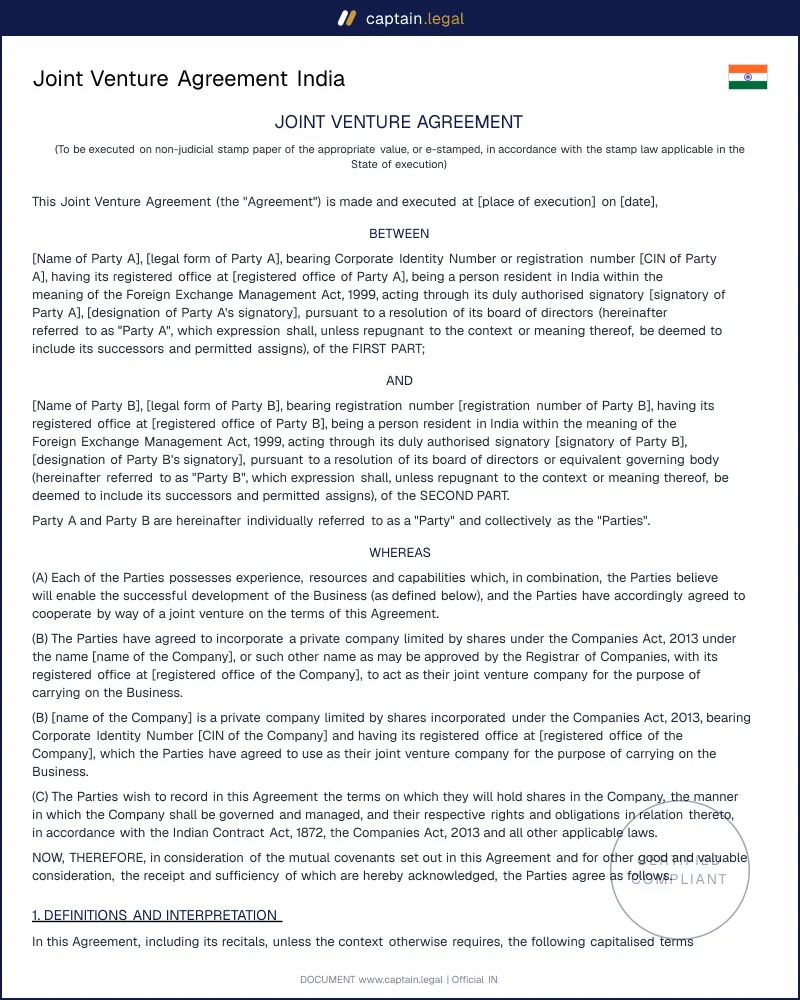
You start by choosing the vehicle: a new private limited company, an LLP or a contractual consortium. The form then adapts the clauses to that vehicle. Next, you enter each partner's details, including corporate identification number and residency status. Marking a partner as non-resident activates the FEMA module, which inserts the pricing, lock-in and reporting provisions automatically. Any in-kind contribution is flagged for a valuer's report.

You set the shareholding split, the nominee directors per side, the reserved matters, the deadlock ladder, the exit mechanism and the arbitration seat. Once generated, the draft downloads in Word and PDF for review and signature in the state where duty will be paid. If the venture is a company, the articles must be amended to mirror the agreement, with the special resolution filed in Form MGT-14 within 30 days under Section 117. Our other company formation and governance templates for Indian businesses cover the resolutions and constitutional documents that follow.

Common mistakes to avoid

The error we see most often is a detailed JV agreement that never reaches the articles of association. Partners negotiate reserved matters and pre-emption rights for months, then incorporate with standard Table F articles. Under V.B. Rangaraj, the company is not bound by those rights, and a transfer made in breach of the agreement can still be registered. The second classic mistake is the assured-return put option, where the foreign partner sells back at its original investment plus a fixed yield. That clause breaches Rule 9(5) of the NDI Rules, and although NTT Docomo v Tata Sons (2017) shows the Delhi High Court may enforce such a foreign award, relying on that outcome is a gamble. A 50:50 venture with no casting vote and no deadlock mechanism will eventually stall.

Vague deadlock language causes the same paralysis in a different way. A clause saying the parties "shall discuss in good faith" resolves nothing, and the fallback becomes an oppression petition before the NCLT. A partner holding less than 10 per cent cannot even file that petition without a waiver under Section 244, so minority exit rights must be written into the contract. Post-exit non-competes are another trap, since Section 27 of the Contract Act voids most of them. Finally, late FEMA reporting is treated as a contravention.

Key takeaways

LEGAL BASE

Choose the vehicle before signing

Indian law does not have a standalone joint venture statute. The agreement works through the Indian Contract Act 1872, especially Sections 10 and 23, and the chosen vehicle: company, LLP or contractual consortium. In a contractual JV, profit sharing can look like a partnership under Section 4 of the Indian Partnership Act 1932, exposing members to unlimited liability.

CONTROL RIGHTS

Put key rights into the articles

For an incorporated JV, reserved matters, transfer restrictions and board controls cannot stay only in the contract. V.B. Rangaraj v V.B. Gopalakrishnan says restrictions not reflected in the articles do not bind the company. Copy the main JV rights into the articles of association, preferably as entrenched provisions under Section 5(3) of the Companies Act 2013.

FOREIGN INVESTMENT

FEMA drives pricing and exits

Where a non-resident partner invests, the FEMA and NDI Rules 2019 module matters as much as the commercial bargain. Press Note 3 needs government approval for investors from land-border countries. Rule 21 requires fair value pricing, and Rule 9(5) permits put and call options, so exit drafting must match exchange control rules from day one.

Frequently Asked Questions

Yes. A joint venture agreement is a contract under the Indian Contract Act 1872 and binds the parties once it meets the conditions of Section 10: free consent, competent parties, lawful consideration and a lawful object. Courts and tribunals can grant specific performance and injunctions. The limit is the company itself, which is bound by transfer restrictions and veto rights only once they appear in its articles of association.

Registration under the Registration Act 1908 is not required unless the agreement itself transfers immovable property. Stamping is mandatory. The stamp act of the state where you sign sets the duty. An unstamped agreement is not void, but it cannot be admitted in evidence until the duty and any penalty are paid.

Schedule I of the NDI Rules lists each sector's cap and entry route. Many manufacturing and services sectors allow full foreign ownership under the automatic route, with no prior approval, while others have lower caps or need government approval. Any investor from a country sharing a land border with India, including through indirect beneficial ownership, needs government approval under Press Note 3 (2020) whatever the sector.

Under the NDI Rules and the RBI Master Direction, shares must be allotted within 60 days of receiving the foreign partner's money, failing which it is refunded within 15 days; Section 42 of the Companies Act 2013 imposes the same window on private placements. Form FC-GPR is then filed on the RBI's FIRMS portal within 30 days of allotment. A later transfer between resident and non-resident partners requires Form FC-TRS within 60 days.

Our template uses a staged ladder. The disputed matter goes first to senior executives of each partner, then to mediation. If both fail, a buy-sell mechanism applies: one partner names a price and the other must either buy or sell at it. Without that ladder, partners usually end up before the NCLT.

Yes. Once you complete the form, the agreement is generated in both formats. The Word file lets your lawyers mark up the draft during negotiation, and the PDF is ready for signature and stamping. The complete catalogue of Indian legal document templates lists the resolutions that usually accompany a JV.

4.7/5

15 verified reviews · 50 000+ downloads

Joint Venture Agreement India | Companies Act 2013 & FEMA
  • Immediate access to the document
  • PDF + Word download
  • Compliant with 2026 legislation
  • Reviewed by lawyers
Fill in the template
Secure payment
Updated on September 27, 2026

You might also like

Share Purchase Agreement India
DPDP Privacy Policy Template