Employment & HR

Employment Bond India: Sections 27 & 74 Contract Act

Service bond drafted to Sections 27 and 74 of the Indian Contract Act and the 2025 Vijaya Bank ruling. Reasonable compensation, not a penalty. Word & PDF.
4.8/5— 15 reviews50 000+ downloadsInstant download
Share

An employment bond agreement is a written undertaking in which an employee agrees to stay in service for a fixed period after the employer has paid for specialised training, a certification or a costly induction programme, and to pay reasonable compensation on leaving early. This template is built for Indian employers, HR teams and startups that want their training investment protected in a form courts actually uphold. It is drafted around Sections 27 and 74 of the Indian Contract Act, 1872, so the commitment runs only during employment and the recovery amount reflects genuine costs, not a punitive figure. Employees reviewing a training bond before signing will also see where Indian law draws the line.

Compliant

2026 Legislation

50,000+ clients

trust us

Affordable

From $4.90 / doc

Secure payment

Instant download

Employment Bond India: Sections 27 & 74 Contract Act

Secure payment

Fill in the template

What is an employment bond agreement?

In Indian practice, service bond, training bond and employment bond describe the same instrument: a promise of minimum service, paired with a compensation clause triggered by premature exit. No statute creates it as a separate category. It is an ordinary contract under the Indian Contract Act, 1872, usually signed with the offer letter or annexed to the employment contract and appointment letter aligned with the Labour Codes. Its defining feature is the employer's consideration: training with a measurable cost that the employee would otherwise have to fund personally. Without that investment, the bond has nothing to protect.

Two clauses are often confused with it. A notice period clause requires 30, 60 or 90 days of notice and usually allows a buy-out, but it recovers no investment. A non-compete covenant restricts what the employee does after leaving, and in India that kind of post-employment restraint is void. A properly drafted employment bond agreement does neither. The employee remains free to resign, and free to join a competitor the following week. What the bond does is attach a price, capped by law, to leaving before the employer has recovered what it spent. The line between a lawful bond and a disguised penalty is therefore a question of drafting, and the wording of each clause matters far more than the title on the first page.

When do you need a training bond?

The clearest case is external certification or specialised training paid by the employer: an aviation type rating, a cloud architecture certification, a clinical fellowship. The cost is invoiced and easy to prove, which is exactly what Section 74 rewards. Next comes overseas training or deputation, where the employer funds travel, accommodation and visas to place someone at a client or parent company site. IT services firms in Bengaluru, Pune and Hyderabad also bond fresh graduates who pass through structured induction programmes. In-house training is harder to value, so the costing must reflect trainer time and material, not a deterrent figure.

Bonds also follow internal promotion to a specialised role, as in the Vijaya Bank case, where the bank had invested in recruiting an officer into a new grade. Sponsored higher education is another classic trigger. An employer funding an executive MBA or a postgraduate diploma typically asks for two or three years of service, with the amount tapering as each year is completed. Hospitals use the same mechanism for nurses and technicians sent on specialised courses.

One edge case deserves a warning. A bond on an ordinary hire with no identifiable training cost, used only to discourage attrition, rarely survives, because without an investment to protect, the compensation figure reads as a penalty. Binding a stipend-paid intern to years of service after a short internship raises the same problem.

Key clauses included in our template

  • The description of the training programme names the provider, course, duration and dates. Vague wording such as "training provided by the company" gives a court nothing to measure.
  • The training cost schedule itemises what the employer actually pays: course and exam fees, travel, accommodation, external trainers. We recommend keeping salary paid during training out of the schedule, since wages for work performed are difficult to present as a recoverable expense.
  • The minimum service period starts when training ends, not on joining, and is sized to the investment. A period of one to three years is the most defensible range for most programmes.
  • The pro-rata reduction formula lowers the amount for every completed month of service after training. It is not a legal requirement, but it ties compensation to the unrecovered investment and makes the bond far easier to defend under Section 74.
  • The trigger events limit liability to voluntary resignation and dismissal for proven misconduct. Retrenchment, closure, termination without cause and exit on medical grounds release the employee, because charging someone for an exit the employer chose is hard to defend.
  • The recovery clause sets a payment window, allows set-off only with written consent and within the Code on Wages, and confirms that relieving and experience letters are never withheld as leverage.
  • Confidentiality and non-solicitation sit in a separate clause, built to work alongside a standalone non-disclosure agreement enforceable under Indian contract law, with no post-employment non-compete.
  • The dispute resolution clause fixes court jurisdiction at the place of work, with optional arbitration under the Arbitration and Conciliation Act, 1996. Arbitration suits senior hires with larger training budgets; for campus programmes, the local civil court is usually quicker and cheaper to use.

State-specific considerations

Contract law is uniform across India, but stamp duty and Shops and Establishments legislation are largely State matters. They change how an employment bond is executed, stamped and challenged.

Maharashtra applies the Maharashtra Stamp Act, 1958. The article of the Schedule that applies depends on how the bond is drafted, as an agreement or as a money bond, so the instrument should be classified before it is stamped. The classification matters because Section 34 makes an insufficiently stamped instrument inadmissible in evidence until the deficit and penalty are paid. Conditions of service fall under the Maharashtra Shops and Establishments (Regulation of Employment and Conditions of Service) Act, 2017. HR teams should also read the bond together with the appointment letter, since State rules under the Labour Codes are still being aligned.

Karnataka is where the Vijaya Bank litigation began, and the High Court's view that the clause was unenforceable did not survive appeal. Bonds signed in Bengaluru are stamped under the Karnataka Stamp Act, 1957. The Karnataka Shops and Commercial Establishments Act, 1961 governs most technology employers, subject to partial exemptions for IT and ITES establishments on working hours and weekly holidays. With so many campus hires joining through bonded induction programmes, employers in the State should expect any dispute to focus on whether the training was real and properly costed.

Delhi applies the Indian Stamp Act, 1899, whose Section 35 bars an unstamped instrument from evidence. Since the seven-judge ruling in In Re: Interplay between Arbitration Agreements and the Indian Stamp Act (2023), insufficient stamping is a curable defect rather than one that voids the agreement, but the deficit and penalty must still be paid before the document is relied on. Conditions of service fall under the Delhi Shops and Establishments Act, 1954. A clear cost schedule, backed by invoices, is the strongest evidence an employer can bring to a recovery claim.

Tamil Nadu employers execute bonds under the Indian Stamp Act, 1899 as amended for the State, with conditions of service under the Tamil Nadu Shops and Establishments Act, 1947. Chennai's automotive and electronics manufacturers often bond diploma holders sent for technical training abroad or at a parent company plant. Keeping travel and course invoices on file is what turns the bond figure into provable loss.

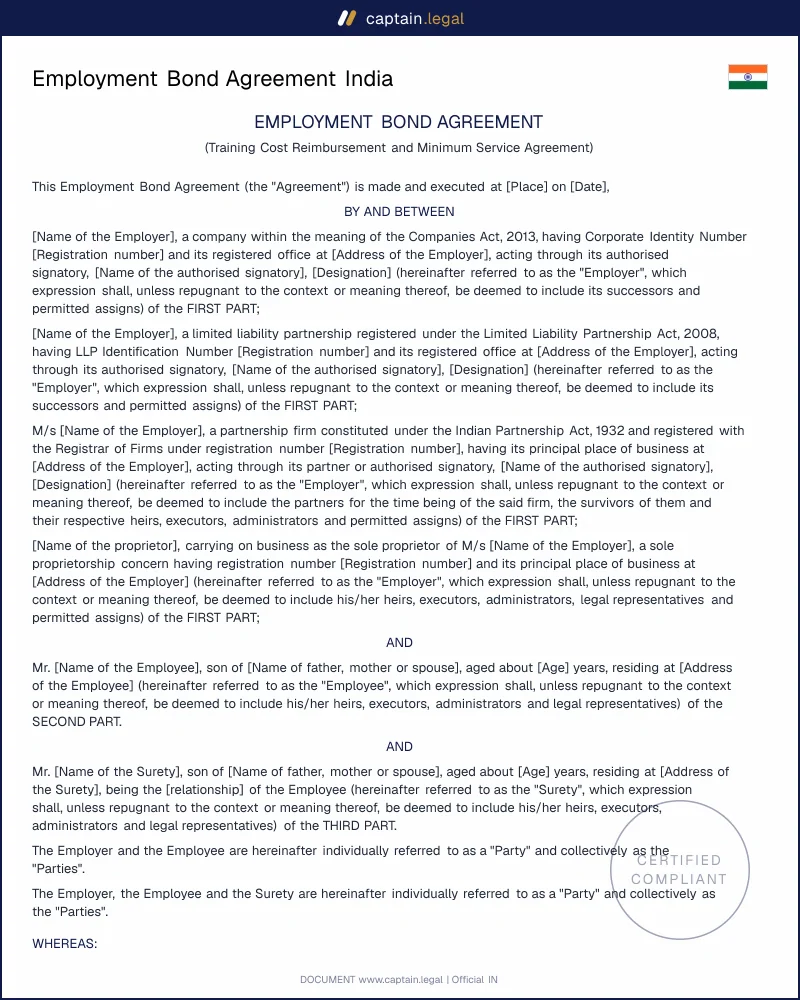
How to fill out this employment bond agreement

You start by choosing the State where the employee works, which sets the stamp duty guidance, the Shops and Establishments reference and the default jurisdiction. The form then takes the employer's legal details and the employee's name, designation and date of joining. The next screen decides enforceability. You describe the training programme and enter each cost item separately, with invoice or quotation references where available. The template totals the recoverable amount and suggests a service period, which you can adjust, remembering that a period out of proportion to the cost is the first thing a judge examines.

You then choose a monthly or quarterly taper and confirm the exit events that trigger liability. Optional sections cover confidentiality, arbitration and a notice period consistent with your other Indian HR and employment document templates. The agreement is generated in Word and PDF, ready for e-stamping and signature in ink or by Aadhaar-based electronic signature under Section 3A of the Information Technology Act, 2000. Keep the signed copy in the personnel file, next to the training invoices you would rely on if recovery ever became necessary.

Common mistakes to avoid

The most frequent error is a round-number bond, the same figure for every hire regardless of what was spent on each. Once challenged, the figure is cut to the proven loss, and sometimes to nothing. The second is a bond with no taper, demanding the full amount from someone who leaves one month short of three years. A court may still accept a fixed sum if it was a genuine pre-estimate, but the employer then carries the burden of justifying it. Third, many employers make the bond payable on any termination, including layoffs they start themselves, which is almost impossible to defend under Section 23.

The last two mistakes concern enforcement. Withholding original certificates, a passport or the relieving letter to force payment invites complaints before the labour authorities and weakens a sound claim. Deducting the bond from final wages without written consent is just as risky: Section 17(2) of the Code on Wages, 2019 requires settlement within two working days of separation, and the employee can challenge an unauthorised deduction under Section 45. Keep the bond claim separate from the full and final settlement letter under the Code on Wages, send a written demand, and allow reasonable time for payment before escalating to a notice or a suit.

Key takeaways

SECTION 27

Bond must not block future work

Under Section 27 of the Indian Contract Act, 1872, a service bond can operate only during employment. It cannot stop the employee from resigning or joining a competitor after exit. The 2025 Vijaya Bank ruling upheld a three-year minimum service clause because it was tied to service and compensation, not a post-employment restraint.

TRAINING COST

Employer investment gives the bond strength

The bond needs a clear business reason: specialised training, certification or a costly induction programme funded by the employer. Without measurable investment, there is little to protect. The agreement should sit with the offer letter or appointment papers and should not be confused with a 30, 60 or 90 day notice period clause.

SECTION 74

Recovery is capped by reasonable loss

Section 74 treats the named bond amount as a ceiling, not an automatic payout. Courts look for reasonable compensation linked to actual or hard-to-measure loss. Documented training costs, reduced for service already completed, are easier to defend. A punitive figure risks being cut down or refused, even if the employee signed it.

Frequently Asked Questions

Yes, provided it is reasonable. In Vijaya Bank v. Prashant B. Narnaware (2025), the Supreme Court held that a minimum service commitment operating during employment is not a restraint of trade under Section 27 of the Indian Contract Act, 1872. What a court will not enforce is any amount beyond reasonable compensation under Section 74. A bond backed by documented training costs, with a proportionate service period and a monthly reduction, holds up well; a flat figure unrelated to any expense usually does not.

Not automatically. The amount in the bond is the maximum a court can award, not a fixed debt. Under Section 74, and following Kailash Nath Associates v. DDA, the employer must show the loss actually suffered where it can be proved, which for a training bond usually means the unrecovered cost of training. Where the bond has a taper, the calculation is simple. Where it has none, the employer must justify the full figure as a genuine pre-estimate, and a court can reduce it.

No statute fixes a maximum, so the answer turns on proportion. The Vijaya Bank clause ran for three years, and one to three years after training is the most defensible range for most programmes. A five-year bond attached to a short in-house induction would struggle under Section 23, whereas three years after a sponsored postgraduate programme is easy to justify. The service period should roughly match the time needed to recover the training value.

The bond sets the payment window, and we recommend thirty days from a written demand, which leaves time to check the calculation. Failing payment, the employer typically serves a legal notice before filing suit. Under Article 55 of the Schedule to the Limitation Act, 1963, a suit for compensation for breach of contract must be filed within three years of the breach, meaning the date the employee left early. A claim filed after those three years is time-barred, however well drafted the bond.

Stamping, yes; notarisation, no. The bond is chargeable with duty under the Stamp Act of the State where it is executed, and an unstamped or understamped copy cannot be relied on in evidence until the deficit and penalty are paid. Notarisation adds no legal validity to a contract between employer and employee, although some employers use it for evidential comfort. E-stamping is available in most States and produces a certificate that can be verified online.

The finished employment bond agreement comes in both Word and PDF. The Word file lets your legal team refine the training description or add company policies before signature, while the PDF suits e-signing or printing on e-stamp paper. Both keep identical clause numbering. If the same hire also needs an appointment letter, a relieving letter or an NDA, the complete catalogue of Indian legal document templates offers them in the same formats.

4.8/5

15 verified reviews · 50 000+ downloads

Employment Bond India: Sections 27 & 74 Contract Act
  • Immediate access to the document
  • PDF + Word download
  • Compliant with 2026 legislation
  • Reviewed by lawyers
Fill in the template
Secure payment
Updated on September 27, 2026

You might also like

Show Cause Notice to Employee India
Salary Slip Format India