Contracts

Software Development Agreement India | Sections 17 & 19

Software development contract built on Sections 17-19 of the Copyright Act 1957 and the IT Act 2000: valid IP assignment, milestones, escrow, warranties.
4.6/5— 9 reviews50 000+ downloadsInstant download
Share

A software development agreement is the contract an Indian business signs with a developer, agency or offshore team before the first line of code is written. It fixes the scope, the milestone payments, the acceptance tests and, most importantly, who owns the source code once the final invoice is paid. Our template is drafted for founders, product companies, IT service firms and independent developers working under the Indian Contract Act 1872, the Copyright Act 1957 and the Information Technology Act 2000. It belongs to our range of contracts and commercial agreements drafted for India, and it is written to hold up before a commercial court or an arbitral tribunal, not simply to look tidy on a shared drive.

Compliant

2026 Legislation

50,000+ clients

trust us

Affordable

From $4.90 / doc

Secure payment

Instant download

Software Development Agreement India | Sections 17 & 19

Secure payment

Fill in the template

What is a software development agreement in India?

In Indian practice, a software development agreement is a contract for service under which the developer builds custom software to the client's specifications in exchange for consideration. The code is a literary work under Section 2(o) of the Copyright Act 1957, which expressly includes computer programmes, and Section 2(ffc) defines a computer programme as a set of instructions, in any form including machine readable form, capable of making a computer perform a task. Because the developer is not an employee, the developer is the author and first owner of the code under Section 17. The commissioned-work rule in clause (b) of the proviso to Section 17 covers photographs, portraits, engravings and films, not software, so paying for development transfers nothing by itself. The software development agreement is therefore two instruments in one: a commercial contract under the Contract Act, and a copyright assignment that must meet the formal conditions of the Copyright Act.

It differs from a general service agreement under the Indian Contract Act, which suits recurring work such as maintenance or support where no valuable deliverable changes hands. It also differs from a software licence, where the vendor keeps ownership and grants a right of use, and from a SaaS subscription, where the client never receives code at all. Where the developer is a salaried employee, clause (c) of the proviso to Section 17 makes the employer the first owner, so an employment contract is the right document.

When do you need a software development agreement?

The most common trigger is a startup commissioning its minimum viable product from an agency. Investors ask for the chain of title during due diligence, and a missing assignment becomes a condition precedent to closing. Companies outsourcing a single module to an IT services firm need the same protection, plus acceptance criteria that tie each payment to working software rather than hours logged. Independent developers use the agreement from the other side, to cap liability and define what counts as a change request. Cross-border work is the next large category: a foreign client engaging an Indian developer needs clear governing law, a neutral arbitral seat and a payment clause that fits export rules, since the service qualifies as a zero-rated supply under Sections 2(6) and 16 of the IGST Act 2017 only when payment arrives in convertible foreign exchange or in rupees where the RBI permits it.

Two edge cases deserve attention. The first is pre-existing code: agencies reuse internal libraries, and assigning them outright would destroy their business, so the template separates background IP (licensed) from foreground IP (assigned). The second is copyleft open-source components under licences such as the GPL, whose terms can collide with an exclusive assignment. Where the project starts with discovery workshops, a non-disclosure agreement for Indian parties should be signed before specifications change hands.

Key clauses included in our template

  • The scope of work and specifications sit in a schedule covering functional requirements, technology stack and hosting environment. Anything outside it goes through a written change request with its own price and timeline, which ends the classic dispute over what was promised.
  • The milestone and payment clause links each instalment to a defined deliverable and its acceptance. GST, tax deducted at source and, for export work, the invoicing currency are allocated expressly, and late payment interest runs from a fixed date.
  • The acceptance testing procedure gives the client a set number of days to test against agreed criteria and report defects in writing. If the client stays silent past the testing window, the milestone is deemed accepted, which stops indefinite withholding.
  • The intellectual property assignment is a present assignment of future copyright, drafted to every limb of Section 19: identified work, all rights under Section 14, the full term of copyright, worldwide territory, stated consideration and an express exclusion of the one-year lapse. The developer also undertakes not to assert the author's special rights under Section 57, which cannot be assigned. Investors who want a separate deed can pair it with our standalone IP assignment and confidentiality agreement.
  • The source code delivery and escrow clause requires the full repository, build scripts, credentials and documentation at each milestone, with optional escrow for critical systems.
  • The warranties and defect liability period cover conformity with specifications, absence of malicious code, originality and disclosure of every open-source licence used.
  • The liability, termination and dispute resolution clauses cap exposure at a multiple of fees, allow termination for material breach after a cure period, and refer disputes to arbitration under the Arbitration and Conciliation Act 1996 with a named seat.

State-specific considerations

Maharashtra applies its own Maharashtra Stamp Act 1958 instead of the central Act. A software development agreement usually falls under the residuary entry for agreements in the Schedule. Duty is paid by franking, e-stamping or the GRAS online payment system. Mumbai disputes above the specified value go to the commercial division of the Bombay High Court on its original side, while Pune disputes go to the district commercial courts. An unstamped agreement is impounded if produced in evidence, so stamp before signing rather than after a dispute arises.

Karnataka governs stamping through the Karnataka Stamp Act 1957, whose schedule has been revised by successive amendments. Duty is paid by e-stamping through authorised centres or by franking. Disputes of specified value go to the designated commercial courts in Bengaluru, with appeals to the Karnataka High Court. Parties preferring institutional arbitration often choose the Arbitration and Conciliation Centre attached to that court.

Telangana applies the Indian Stamp Act 1899 as adapted for the State. Hyderabad's concentration of SEZ and STPI units adds an export layer to many contracts. Software exported in non-physical form is declared on a SOFTEX form certified by the STPI or SEZ authority, and the invoice and currency terms in the payment clause should match that declaration. SEZ developers also need the scope to fall within the authorised operations of their unit under the Special Economic Zones Act 2005. Commercial disputes go to the commercial courts in Hyderabad, with appeals to the Telangana High Court.

Tamil Nadu also applies the Indian Stamp Act 1899 with its own State amendments. The Madras High Court exercises original civil jurisdiction over Chennai and has a dedicated Intellectual Property Division, a practical forum for copyright disputes over code. Outside Chennai, disputes of specified value go to the district commercial courts. Parties seating arbitration in Chennai should name the Madras High Court as the supervisory court.

Delhi applies the Indian Stamp Act 1899 as in force in the National Capital Territory, and e-stamping through SHCIL is the standard route. The Delhi High Court exercises original jurisdiction over commercial suits above its pecuniary threshold. Its IP Division, created after the Tribunals Reforms Act 2021 abolished the IPAB, hears much of the country's high-value software copyright litigation. Pine Labs, the leading authority on the Section 19 defaults, came out of that court.

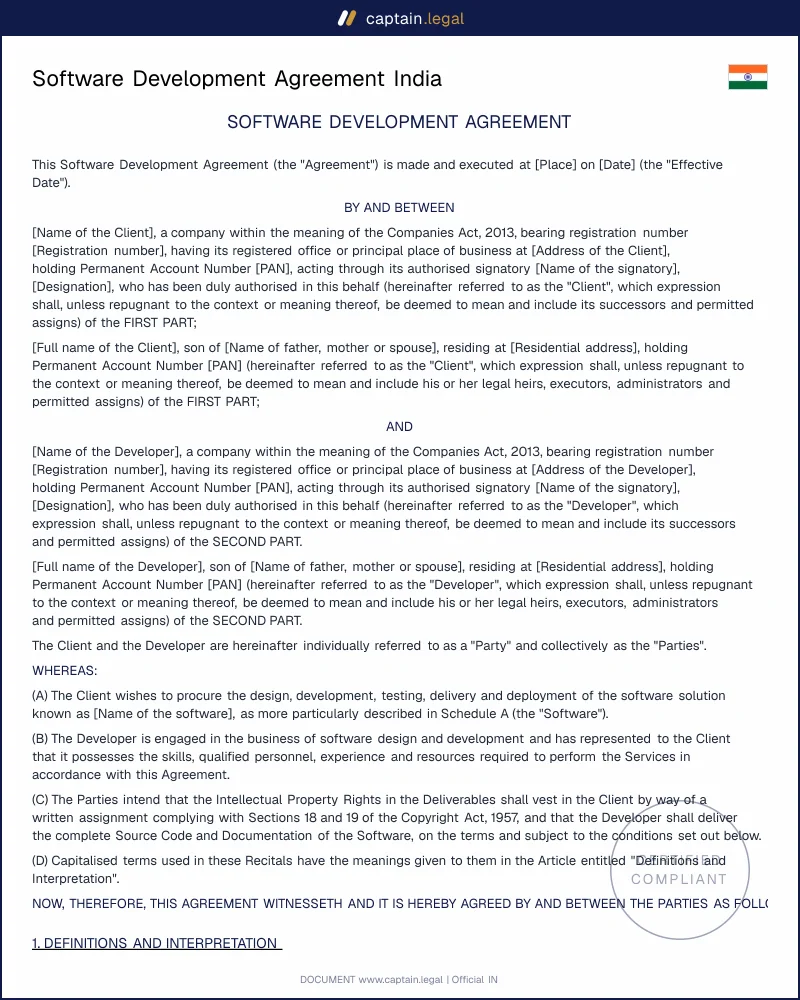
How to fill out this software development agreement

You start by identifying the parties with their legal status, registered address, PAN and, for companies, the CIN or LLPIN. The form then asks whether the developer is an individual, a firm or a company, because signing authority and tax deduction treatment depend on it. From there, you describe the project in plain language and paste the functional specifications, which become the scope schedule. The next screen builds the payment structure: you define each milestone, its deliverable and the testing window, and the template makes each payment due only once the matching deliverable is accepted.

You then choose the IP model, either a full assignment of foreground IP with a licence of background IP, or a licence only if the developer keeps ownership. The form writes the Section 19 particulars automatically, including duration, territory and the exclusion of the one-year lapse. Finally, you select the warranty period, liability cap, governing law, arbitral seat and State of execution, which determines the stamp duty regime. The finished agreement is generated in Word and PDF, ready to stamp and sign with wet ink or Aadhaar eSign.

Common mistakes to avoid

The most expensive mistake is drafting an agreement to assign instead of a present assignment. A clause stating that the developer "shall assign" the code on completion creates only a promise, and if the relationship sours, the client must sue to obtain what it thought it already owned. The second mistake follows: leaving duration and territory blank, which triggers the five-year and India-only defaults of Section 19. Funded startups regularly discover during a Series A that their core product legally reverts to a freelancer. A third error is a vague acceptance clause without deemed acceptance, which lets a client run software in production for months while refusing to pay.

On the commercial side, parties often insert punitive liquidated damages for delay, forgetting that Section 74 only allows reasonable compensation within the stated ceiling. Others rely on a two-year post-term non-compete that Section 27 will strike down, when a narrow non-solicitation of staff and a strong confidentiality clause would have done the job. Many clients also never ask for the repository and discover, when the developer disappears, that the code sits in an account they cannot access. When a party defaults, the first formal step is usually a legal notice for breach of contract under Sections 73 and 74, and a well drafted software development agreement makes that notice far easier to write.

Key takeaways

OWNERSHIP

Payment alone does not buy code

Under Section 17 of the Copyright Act 1957, an independent developer is usually the author and first owner of custom software. Computer programmes are treated as literary works, and the commissioned-work exception does not cover software. The agreement must therefore operate both as a contract under the Indian Contract Act 1872 and as a signed copyright assignment.

ASSIGNMENT TERMS

Silent drafting cuts down your rights

Section 19 of the Copyright Act 1957 requires the assignment to identify the work, rights, duration, territory and consideration. If duration is not stated, the transfer lasts only five years; if territory is not stated, it is limited to India. Rights not exercised within one year may lapse unless the deed says otherwise.

DELIVERY RISK

Missed milestones need precise remedies

Milestones, acceptance tests and payment triggers should match the remedies in the contract. Under Section 55 of the Indian Contract Act 1872, delay supports termination only when time is made of the essence. Sections 73 and 74 also matter: a pre-agreed delay amount is a ceiling, and loss may still need to be proved.

Frequently Asked Questions

Yes, provided it meets Section 10 of the Indian Contract Act 1872: free consent, competent parties, lawful consideration and a lawful object. The IP assignment inside it is valid only if it is in writing and signed by the developer, as Section 19(1) of the Copyright Act 1957 requires. Registration under the Registration Act 1908 is not compulsory because no immovable property is involved. The agreement should still be stamped in the State of execution, since an unstamped instrument remains valid but cannot be relied on in evidence until the duty and penalty are paid.

The developer does. Under Section 17 of the Copyright Act 1957 the author is the first owner, and a freelancer or agency working under a contract for service is the author of its code. Paying for the work does not change that, because the commissioned-work exception does not extend to computer programmes. At most, a court will imply a limited licence to use the software for the purpose it was built for, without any right to resell or license it. This is why the assignment clause is the heart of the template.

Yes. Section 10A of the IT Act 2000 recognises contracts formed through electronic records, and Section 5 gives electronic signatures the same legal recognition as handwritten ones. Aadhaar eSign and certificate-based digital signatures are the safest options, and the signed record can be produced in court with the certificate required by Section 63 of the Bharatiya Sakshya Adhiniyam 2023. The exclusions in Schedule I of the IT Act, such as wills, powers of attorney and property conveyances, do not apply to this contract.

The period is contractual, not statutory, so the agreement must state it. Our template sets a defect liability period of your choice, commonly sixty to ninety days after final acceptance, during which the developer corrects non-conformities at no extra charge within a response time you define. Once that period expires, further fixes become paid maintenance unless a separate support contract exists. A claim for breach must also be filed within three years from the breach under Article 55 of the Limitation Act 1963.

Yes, the completed agreement is generated in both formats. The PDF is ready to print on stamp paper or send for eSign, while the Word version lets your advocate adapt clauses for a specific project, such as a revenue share or a staged escrow release. You can return to your answers and regenerate the document if the scope changes before signature. The same formats apply across our full catalogue of Indian legal templates, so related contracts stay consistent.

Not after the contract ends. Section 27 of the Indian Contract Act 1872 voids any agreement restraining a person from carrying on a lawful trade, and Indian courts apply it strictly to post-termination covenants. Restrictions that operate only during the engagement are treated more favourably. The template therefore relies on confidentiality, ownership of code and a narrowly drawn non-solicitation of staff, which courts uphold more readily when it is limited in time and scope.

4.6/5

9 verified reviews · 50 000+ downloads

Software Development Agreement India | Sections 17 & 19
  • Immediate access to the document
  • PDF + Word download
  • Compliant with 2026 legislation
  • Reviewed by lawyers
Fill in the template
Secure payment
Updated on September 29, 2026

You might also like

Franchise Agreement India
Sale and Purchase Agreement for Goods India