Personal & Family

Family Settlement Deed India | Kale (1976) SC Rules

Drafted on the Supreme Court's Kale ruling and Section 17 Registration Act: antecedent claims, daughters' shares, memorandum vs deed. PDF & Word.
4.6/5— 15 reviews50 000+ downloadsInstant download
Share

A family settlement deed records how members of an Indian family divide ancestral, joint or disputed property among themselves without going to court. Hindu Undivided Families use it to split coparcenary land, siblings to share an intestate parent's estate, and relatives with competing claims to settle rather than litigate. Our template follows the principles laid down by the Supreme Court in Kale v Deputy Director of Consolidation (1976), setting out each party's antecedent claim, the voluntary nature of the arrangement and every allotment. It also lets you record an arrangement already made as a memorandum of family settlement, which in the right circumstances needs neither registration nor ad valorem stamp duty.

Compliant

2026 Legislation

50,000+ clients

trust us

Affordable

From $4.90 / doc

Secure payment

Instant download

Family Settlement Deed India | Kale (1976) SC Rules

Secure payment

Fill in the template

What is a family settlement deed?

In Indian law, a family settlement (or family arrangement) is an agreement among relatives holding present or possible claims to property, by which those claims are acknowledged and the property divided to keep peace in the family. No party acquires property from another. Each takes what the arrangement recognises as already theirs, so courts treat it as recognition of pre-existing title rather than a transfer. It may be purely oral; once written down so that the paper itself creates or declares rights, it becomes a family settlement deed and enters the registration regime.

The line with neighbouring instruments matters at the Sub-Registrar's counter. A partition deed divides property held in common and assumes undisputed shares, whereas a settlement can also resolve doubtful or contested claims. A release deed moves one sharer's interest to another. A gift deed governed by Sections 122 to 126 of the Transfer of Property Act transfers property the donor owns outright and is always compulsorily registrable. A family settlement deed is none of these, though stamp authorities often reclassify it to levy a higher duty, which is why its recitals matter. It sits with the other personal and family legal documents for India that deal with succession.

When do you need this document?

The most common trigger is a parent's death without a will. The Class I heirs under the Hindu Succession Act share the estate, but a house, farmland and a shop rarely divide neatly, and a family settlement deed lets siblings take whole assets instead of fractions of each. The second is the division of an HUF, where coparceners want separate holdings, tax files and khatas. The third is a live dispute over whether an asset was bought with joint family funds, which a signed arrangement resolves years before a partition suit would. Settlements also tidy up history: where land was divided orally a generation ago and each branch has held its portion since, a memorandum records that division for the revenue authorities.

One edge case needs care. A living parent cannot use a settlement to distribute self-acquired property, because the children hold only a hope of succession, which Section 6(a) of the Transfer of Property Act makes non-transferable. That parent needs a gift or a will attested under Section 63 of the Indian Succession Act.

Key clauses included in our template

  • The recital of the family tree and antecedent claims names the common ancestor, every branch and every heir, including married daughters and children of predeceased sons. It supplies the claim Kale requires and the relationship proof Sub-Registrars demand.
  • The property schedules separate ancestral, joint family and self-acquired assets, each identified by survey or municipal number, boundaries and area. Vague descriptions are the usual reason execution fails.
  • The allotment clause assigns each schedule to a named member by metes and bounds, with an owelty provision where one allottee compensates another for an unequal share. A recital acknowledging receipt of that payment also falls under Section 17(1)(c) of the Registration Act, so the template states it separately.
  • The mutual acknowledgement clause records that each party accepts the allotments in full satisfaction of every claim. Drafted as recognition rather than transfer, it decides whether the instrument is stamped as a settlement or a conveyance.
  • The possession and mutation clause fixes the date each member takes possession and authorises every party to apply for mutation. Prompt performance is the best evidence of good faith.
  • The dispute resolution and execution clause provides for mediation and arbitration in the district where most of the property lies, followed by the signatures of every party and two attesting witnesses.

State-specific considerations

Maharashtra applies the Maharashtra Stamp Act, 1958, which charges an instrument of partition under Article 46 of Schedule I on the separated shares, with a nominal duty for agricultural land. A release of ancestral property in favour of blood relations attracts only a fixed duty under Article 52, useful when one sibling steps out. In Balaso Bhimgonda Patil v State of Maharashtra, the Bombay High Court set aside the impounding of an unregistered "noting of partition by way of family arrangement", stressing that stamping and registration are separate questions. The Court also relied on State circulars of 2014 and 2018 stating that registration of a joint family partition is not a condition for mutation. Those circulars govern revenue entries, not marketable title, and banks in Mumbai or Pune still ask for a registered instrument.

Tamil Nadu substituted Article 45 of the Indian Stamp Act through Tamil Nadu Act 31 of 2004. Partitions and settlements among family members pay a concessional capped rate, while non-relatives pay the full conveyance rate. The concession depends on proving that each party is family within the statutory definition. In Ponnakonar v State (2018), the Madras High Court held that a partition among joint family members could not be recharged as a settlement under Article 58, yet the dispute arose because relationship proof was missing. Present legal heirship certificates and patta extracts with the deed on the TNREGINET portal.

Uttar Pradesh is where Kale began, in mutation proceedings under the UP Consolidation of Holdings Act, 1953. A State notification of August 2023 capped stamp duty at a small flat amount for transfers of immovable property to listed relatives, and the Cabinet extended a comparable cap to family partition deeds in 2024. The list of relatives is closed, so a share allotted to a cousin falls outside the concession. Confirm the current notification with the Sub-Registrar before stamping.

Karnataka village divisions are often recorded in a palupatti, a signed list of shares. Courts treat a palupatti recording a completed partition as a memorandum, but it binds only those who accepted it. In Krishnappa v Ashwathamma (2022), the High Court of Karnataka examined a share claimed on a palupatti that not every member had signed, so every sharer should sign. Survey numbers must match the RTC extract, or mutation under the Karnataka Land Revenue Act, 1964 will stall.

How to fill out this family settlement deed

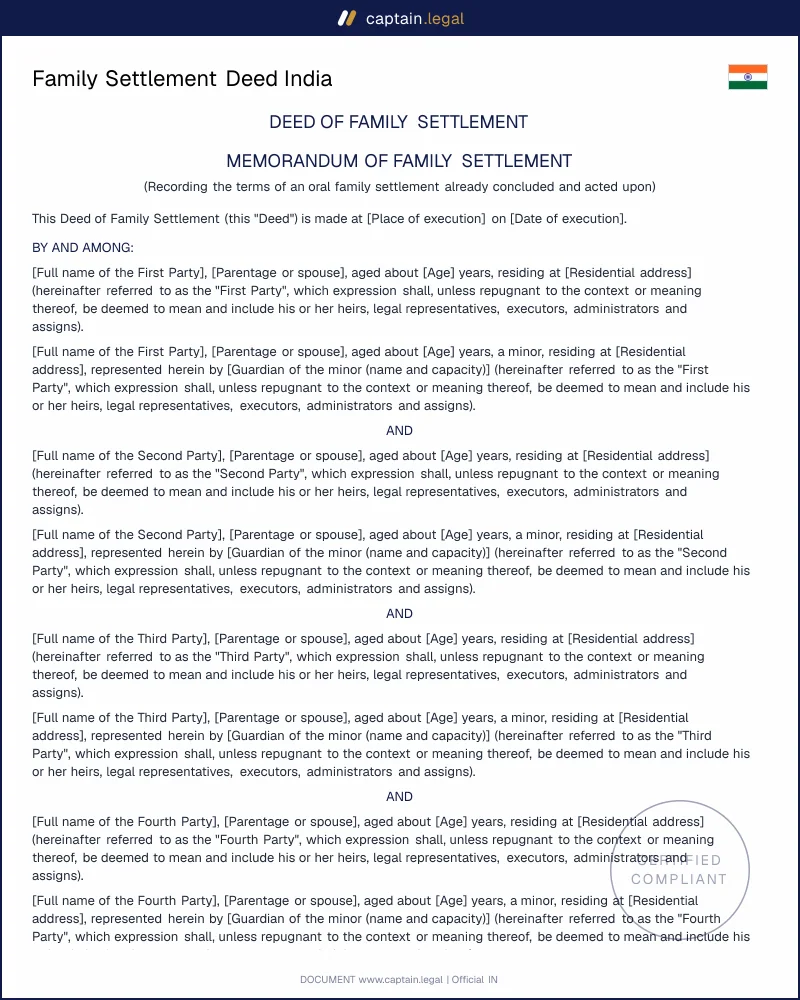
You start by selecting the State where the property lies, since stamp rules and concessions vary. The form then asks whether the family is recording an arrangement already made and acted on, or making the settlement now. The first answer produces a memorandum in the past tense, which can usually be signed on plain paper, though some revenue offices ask for a nominal stamp. The second produces a registrable deed. Next you build the family tree, with prompts for daughters, widows and children of predeceased members. Each property gets its own schedule, followed by allotments, any owelty payment and witnesses, and the document downloads in Word and PDF. A deed is printed on non-judicial stamp paper or e-stamped, signed by every party before two witnesses, and presented to the local Sub-Registrar. A member abroad can act through a power of attorney authorising a relative to execute and present documents.

Common mistakes to avoid

The most frequent error is a memorandum written as though it were creating the division. Words like "the parties hereby partition" or "shall henceforth own" turn a record into an operative instrument, and in Sita Ram Bhama v Ramvatar Bhama (2018) 15 SCC 130 the Supreme Court refused to accept an unregistered document of that kind as proof of partition. A genuine memorandum dates the earlier arrangement and describes the possession that followed. The second error is leaving someone out. A married daughter, the widow of a predeceased son or a grandchild representing a deceased branch is a necessary party, and a settlement binds nobody who did not sign it.

Families also fold a living parent's self-acquired flat into the arrangement, which is then stamped as a gift or conveyance. Others describe land by village and approximate area instead of survey number, which blocks mutation. The last error is selling an allotted plot before mutation, leaving the buyer's title resting on an unregistered paper. Complete mutation first, then prepare a sale deed compliant with Section 54 of the Transfer of Property Act.

Key takeaways

LEGAL BASIS

Antecedent claims make the settlement work

Under Kale v Deputy Director of Consolidation, a family arrangement should be bona fide, voluntary and free from fraud, coercion or undue influence. Each signer needs a present, possible or antecedent claim to the property, not a fresh transfer dressed up as settlement. This sits with free consent principles under the Indian Contract Act, 1872 and helps keep the arrangement enforceable.

REGISTRATION

Deed or memorandum changes everything

Section 17(1)(b) of the Registration Act, 1908 is the dividing line. If the writing itself creates or declares rights in immovable property, it must be registered. If relatives already settled matters orally and the paper only records that past arrangement for mutation or family records, it may operate as a memorandum instead.

COURT RISK

Unregistered papers may not prove title

A family settlement deed that needed registration but was left unregistered cannot prove title because Section 49 of the Registration Act blocks that use. Courts may still read it for a limited collateral purpose, such as showing the nature of possession, but only after proper stamping. That gap can derail mutation, sale or later succession disputes.

Frequently Asked Questions

An oral settlement is binding, and so is a memorandum that merely records an arrangement already made; neither needs registration under Kale. A family settlement deed that itself creates or declares rights in immovable property is different. Unregistered, it cannot prove title under Section 49 of the Registration Act, and even its collateral use depends on paying any deficit stamp duty and penalty. For urban property that will be sold or mortgaged, registration is the safer course.

The difference lies in tense and function. A deed makes the settlement: the division takes effect through the document, so it must be stamped and registered. A memorandum records an earlier settlement, usually oral, for the family's records or a mutation file. Courts look at substance rather than the heading, so a memorandum using operative words such as "hereby" will be treated as a deed. Our template drafts each version in wording that matches its purpose.

Section 23 of the Registration Act, 1908 requires presentation within four months of execution. Where parties sign on different dates, Section 24 runs the period from each execution. If the delay was unavoidable, Section 25 allows acceptance within a further four months on payment of a fine. A party who signs outside India has four months from the document's arrival in India under Section 26. After that, the deed must be executed again.

For Hindu coparcenary property, yes. Since the 2005 amendment to Section 6 of the Hindu Succession Act, a daughter is a coparcener by birth, and Vineeta Sharma v Rakesh Sharma held that her right does not depend on her father being alive when the amendment took effect. She may accept other assets or relinquish her share, but she must sign, and an arrangement made without her can be reopened at her instance.

Yes, on limited grounds. A party may sue to set it aside for fraud, coercion, undue influence or misrepresentation, or for exclusion of a necessary sharer. Article 59 of the Limitation Act, 1963 allows three years from the date the facts entitling the plaintiff to cancellation first became known. Courts rarely disturb settlements acted on for years, and a party who accepted benefits faces estoppel. Clear recitals of voluntariness and of each party's claim make a challenge much harder.

The template downloads in both Word and PDF. Your advocate can adapt the Word file, while the PDF is ready to print on stamp paper or attach to an e-stamp certificate. Both versions keep the schedules, witness blocks and signature pages in the order Sub-Registrars expect. Related affidavits, releases or a will for a surviving parent are in the full catalogue of Indian legal templates.

4.6/5

15 verified reviews · 50 000+ downloads

Family Settlement Deed India | Kale (1976) SC Rules
  • Immediate access to the document
  • PDF + Word download
  • Compliant with 2026 legislation
  • Reviewed by lawyers
Fill in the template
Secure payment
Updated on September 28, 2026

You might also like

Legal Heir Affidavit India
Income Affidavit India