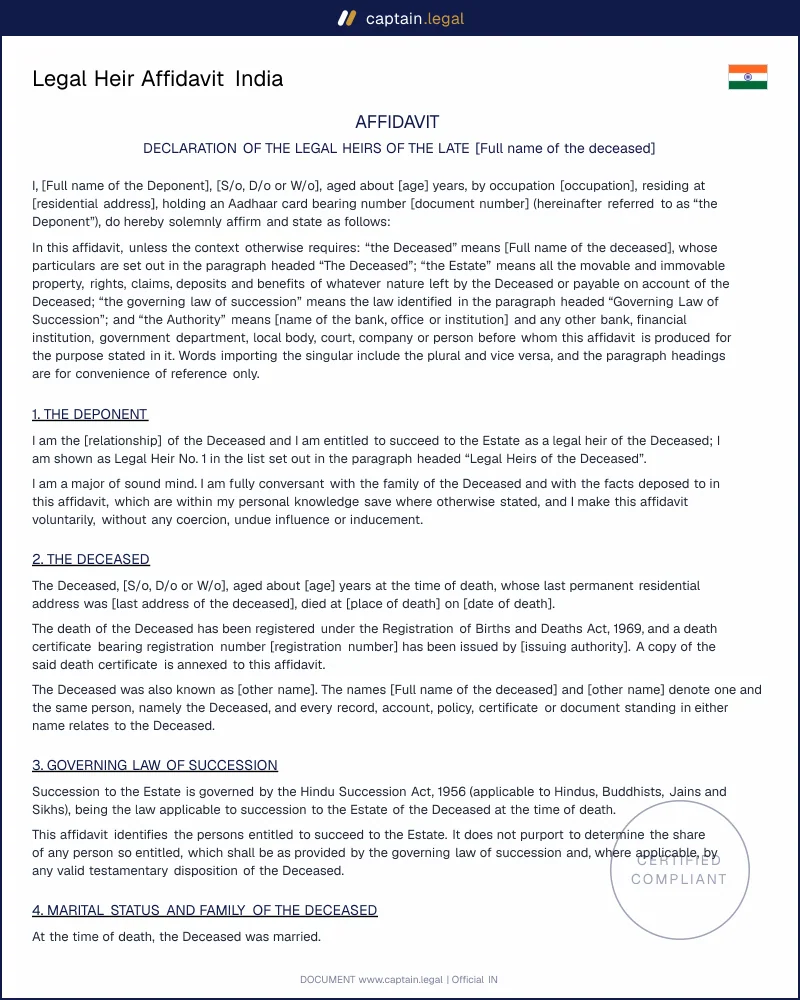
The power to administer oaths comes from section 3 of the Oaths Act 1969, and section 139 of the Code of Civil Procedure 1908 lists notaries and officers appointed by the High Court among those who may swear affidavits. Section 8(1)(e) of the Notaries Act 1952 expressly allows a notary to take an affidavit from any person, and under section 8(2) no act is notarial unless it bears the notary's signature and official seal, with an entry in the register kept under rule 11 of the Notaries Rules 1956. Banks check that seal against the official text of the Notaries Act 1952 setting out notarial functions under section 8. Stamp duty is fixed by Article 4 of Schedule I to the Indian Stamp Act 1899 or by the matching entry in the State stamp statute.
Who counts as an heir depends on personal law. For a Hindu, Sikh, Jain or Buddhist man dying intestate, section 8 of the Hindu Succession Act 1956 and its Schedule define the Class I heirs: widow, sons, daughters and mother, together with the children of predeceased children and the widow of a predeceased son, all taking simultaneously under section 9. A Hindu woman's estate follows section 15, starting with her children and husband. The 2005 amendment to section 6, read with Vineeta Sharma v. Rakesh Sharma (2020) 9 SCC 1, makes daughters coparceners by birth. Muslim succession follows the Muslim Personal Law (Shariat) Application Act 1937, while Christians and Parsis fall under Part V of the Indian Succession Act 1925, with a separate chapter (sections 50 to 56) for Parsis.
A deliberately false statement is punishable under section 236 of the Bharatiya Nyaya Sanhita 2023 (formerly section 199 IPC) as if false evidence had been given. For accounts without a nominee, the Reserve Bank of India (Settlement of Claims in respect of Deceased Customers of Banks) Directions, 2025 accept, within the simplified procedure threshold, either a legal heir certificate or a declaration on legal heirs sworn by an independent person well known to the family but unconnected with it. Disputed claims still require probate, a succession certificate or a court order.