Personal & Family

Personal Loan Agreement India | Contract Act 1872

Loan agreement drafted to the Indian Contract Act 1872, with stamp duty guidance and the section 185 Income-tax Act 2025 cash limit flagged. Word & PDF.
4.8/5— 14 reviews50 000+ downloadsInstant download
Share

A personal loan agreement is a written contract under which one individual lends money to a friend, relative or colleague, and the borrower undertakes to repay it on terms fixed in advance. In India it is an ordinary contract governed by the Indian Contract Act 1872, so the document you sign decides what a court will later enforce. Our template fixes the principal, the rate of interest (or an express statement that the loan is interest-free), the repayment schedule and the consequences of default. It also flags the tax rule most family lenders never hear about: a loan of 20,000 rupees or more must be advanced and repaid through a banking channel, not in cash. The format is valid in every Indian State.

Compliant

2026 Legislation

50,000+ clients

trust us

Affordable

From $4.90 / doc

Secure payment

Instant download

Personal Loan Agreement India | Contract Act 1872

Secure payment

Fill in the template

What is a personal loan agreement?

Legally, the document evidences a contract of loan: money handed over on the understanding that an equivalent sum, with or without interest, comes back. It satisfies section 10 of the Indian Contract Act 1872 when both parties consent freely, pursue a lawful object and are competent, which means adults of sound mind aged 18 or over under the Indian Majority Act 1875. A loan to a minor is void, as the Privy Council held in Mohori Bibee v Dharmodas Ghose, and cannot be recovered on the contract. The advance itself is the consideration, so an interest-free loan between brothers is still an enforceable contract and not a gift. Oral loans are valid too, but proving them years later is where most family recovery cases collapse.

Practitioners separate this document from a promissory note drafted under section 4 of the Negotiable Instruments Act 1881. The pronote is a short, unconditional promise signed by the borrower alone; it carries no schedule, no default mechanics and no security terms, and it cannot be signed electronically, because the First Schedule to the Information Technology Act 2000 excludes negotiable instruments other than cheques. A loan agreement is bilateral, can be e-signed, and accommodates instalments, prepayment, a guarantor and security cheques.

When do you need this document?

The classic case is the family loan: a parent funding a child's flat booking amount, a sibling covering hospital bills, an uncle advancing capital for a small shop. These loans go wrong at a wedding, a death or a partition, when heirs argue about whether the money was a loan or a gift, and a signed agreement settles that argument before it starts. If the transfer is genuinely meant as a gift, record it as one, with a gift deed format under sections 122 to 126 of the Transfer of Property Act where immovable property is involved.

Loans between friends and colleagues form the second large group. Here the risk is memory rather than inheritance. Repayment dates drift, and the borrower later claims half was returned in cash. A dated schedule and a clause requiring every repayment by bank transfer close that gap.

Two edge cases deserve attention. NRI lenders advancing money to a resident relative must respect the Foreign Exchange Management (Borrowing and Lending) Regulations 2018, which attach conditions on relationship, interest and minimum maturity. And an individual who makes interest-bearing loans to many people may slip into State money-lending legislation, which can bar unlicensed lenders from suing at all.

Key clauses included in our template

  • The identification of the parties records full names, addresses, PAN and, for family loans, the relationship between lender and borrower. PAN matters because the borrower may have to prove the identity and creditworthiness of the lender if the tax department treats the credit as unexplained.
  • The loan amount and mode of disbursement clause states the principal in figures and words and names the bank account or UPI reference used. Tying the agreement to a traceable transfer keeps the transaction outside the cash prohibition of section 185.
  • The interest clause fixes a simple or compound annual rate, or declares the loan interest-free in terms. Silence invites a later claim that interest was agreed orally, and a rate far above market invites review under the Usurious Loans Act 1918.
  • The repayment schedule sets instalments, due dates and the receiving account, with a right to prepay without charge. Each repayment of 20,000 rupees or more must also travel through a bank channel under section 188.
  • The default and acceleration clause defines default, grants a cure period after written notice and lets the lender, at his election, call the whole balance. Keeping acceleration optional matters, because an automatic acceleration can start limitation on the entire debt from the first missed instalment.
  • The optional security clause covers a guarantor, pledged gold or post-dated cheques. A dishonoured security cheque supports a Section 138 cheque bounce notice within the 30-day deadline, provided the debt had crystallised on the date of presentation, as the Supreme Court held in Sripati Singh v State of Jharkhand (2021).
  • The dispute resolution clause names the competent civil court and can provide for voluntary pre-litigation mediation under the Mediation Act 2023.

State-specific considerations

Maharashtra applies the Maharashtra Stamp Act 1958 rather than the central Act, and lenders in Mumbai or Pune usually buy an e-stamp certificate before signing. Anyone who advances money at interest to several people should check the Maharashtra Money-Lending (Regulation) Act 2014, which requires a licence for those carrying on the business of money-lending. A single loan to a cousin does not make you a money-lender, but a regular pattern of interest-bearing loans can. A written personal loan agreement supports summary suits under Order XXXVII of the Code of Civil Procedure before the courts to which it applies, which makes a properly stamped agreement a real asset in recovery.

Karnataka stamps loan agreements under the Karnataka Stamp Act 1957 and regulates lenders through the Karnataka Money Lenders Act 1961. The State also enacted the Karnataka Prohibition of Charging Exorbitant Interest Act 2004, under which charging interest above the notified ceiling is an offence. A friend lending at a bank-linked rate is rarely affected, yet informal daily or weekly interest arrangements expose the lender to criminal complaints. Bengaluru parties increasingly sign by Aadhaar eSign, which is valid for a loan agreement, provided stamp duty is paid separately through e-stamping.

Tamil Nadu runs the strictest regime. The Tamil Nadu Prohibition of Charging Exorbitant Interest Act 2003 makes it an offence to collect interest above the rates fixed under State law, and the police act on complaints under it more readily than most lenders assume. The Act reaches private individuals as well as professional financiers, alongside the licensing rules of the Tamil Nadu Money-Lenders Act 1957. Any interest clause for a Chennai or Coimbatore borrower should therefore stay moderate and be stated as a plain annual percentage.

Delhi uses the Indian Stamp Act 1899 as applied to the National Capital Territory, with e-stamp paper issued through authorised centres. Money-lending is governed by the Punjab Registration of Money-lenders Act 1938 as extended to Delhi, which bars recovery suits by unregistered money-lenders; an isolated personal loan between friends falls outside it. A clean personal loan agreement paired with bank records shortens proceedings in Delhi's crowded district courts.

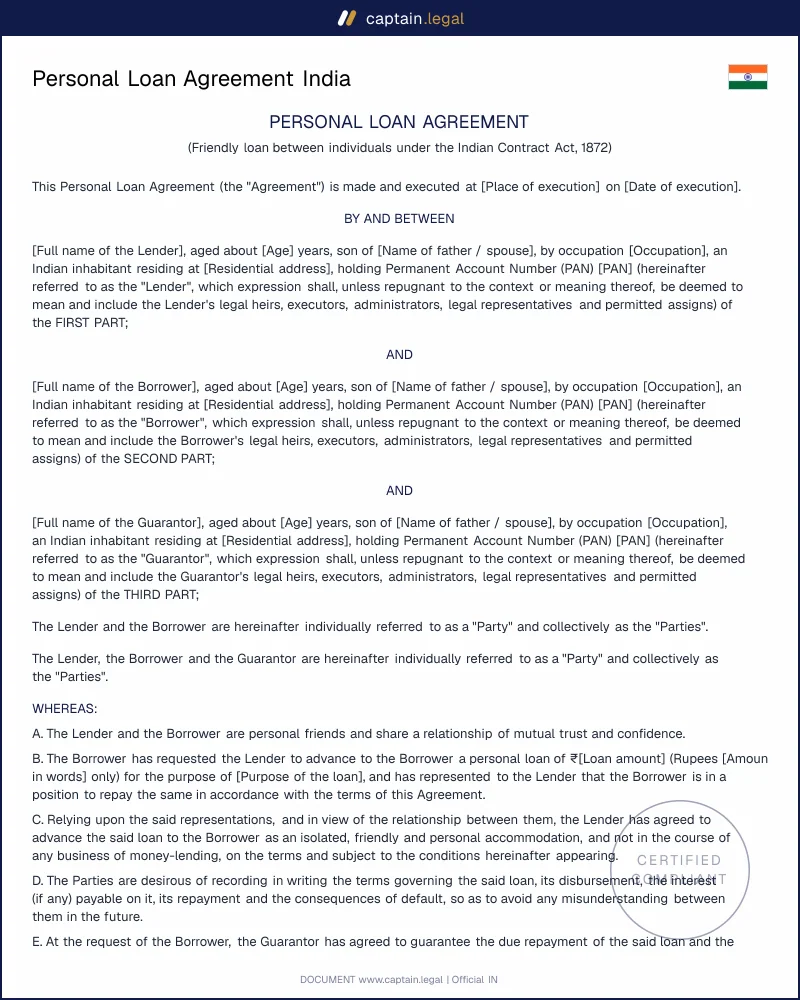
How to fill out this personal loan agreement

You start by choosing the State of signature, which drives the stamp duty reference and the governing law clause. Next come the parties: names, addresses, PAN and, for a family loan, the relationship, which later helps rebut any claim that the money was a gift. You then enter the principal, the disbursement date and the bank transfer reference. The interest step lets you choose an interest-free loan, a simple annual rate or a rate with a separate default rate, and the repayment step builds either a single bullet repayment or monthly or quarterly instalments. Optional steps add a guarantor, security cheques or a mediation clause.

Once you confirm, the agreement is generated in Word and PDF. Print it on stamp paper or attach an e-stamp certificate of the correct value, and have both parties sign every page. Before adding attesting witnesses, check your State's schedule, since attestation can change the stamp article. The same guided approach runs through our other personal and family legal documents for India, from wills to affidavits.

Common mistakes to avoid

The most expensive mistake is handing over cash. The debt remains recoverable, but a cash loan of 20,000 rupees or more exposes the borrower to a penalty equal to the whole amount. The second error is signing on plain paper with a plan to stamp it later; later usually arrives on the day the suit is filed, when the court impounds the document and levies a penalty. Third, many agreements say "interest as mutually agreed" without a figure. A clause without a rate is close to unenforceable, and the court falls back on a rate it considers reasonable.

The fourth error is letting limitation run. Families are patient, and three years pass quickly once repayments stop. A written acknowledgement signed by the borrower before expiry restarts the clock under section 18 of the Limitation Act 1963, and a part-payment acknowledged in writing by the payer does the same under section 19. Finally, lenders often rush to a police complaint for cheating under section 318 of the Bharatiya Nyaya Sanhita 2023. Non-repayment without dishonest intent at the outset is a civil matter, and the right first step is a formal demand notice for money recovery that prepares an Order XXXVII summary suit.

Key takeaways

Contract basis

Write the loan terms clearly

A personal loan between relatives or friends is enforceable as an ordinary contract if it meets section 10 of the Indian Contract Act 1872: free consent, lawful object and competent adult parties. The agreement should record the principal, interest or interest-free status, repayment schedule and default consequences, because oral family loans often fail later for lack of proof.

Stamp duty

Unstamped papers can block recovery

Stamp duty must be handled before or at signing under section 17 of the Indian Stamp Act 1899 or the relevant State law. If the document is insufficiently stamped, section 35 can keep it out of evidence until duty and penalty are paid. Classification also matters, as an attested repayment promise may be treated as a bond in many States.

Cash limit

Use banking channels above Rs 20,000

The document flags the tax rule many private lenders miss. Under section 185 of the Income-tax Act 2025, a borrower must not accept loans of Rs 20,000 or more in cash when existing unpaid loans from the same lender are counted. Section 188 applies the same banking-channel rule to repayment, including interest.

Frequently Asked Questions

Yes. An agreement signed by competent adults, with free consent and for a lawful purpose, is a valid contract under section 10 of the Indian Contract Act 1872, and the lender can enforce it in a civil court. Its practical value depends on stamp duty: an understamped document cannot be relied on in evidence until the deficit and penalty are paid, although the defect is curable. Neither notarisation nor registration is required for an unsecured loan.

Only below the threshold. Under section 185 of the Income-tax Act 2025, the borrower cannot accept a cash loan where that loan, together with anything still unpaid to the same lender, reaches 20,000 rupees. Section 188 imposes the same limit on repayment. The penalty equals the amount involved, although the Supreme Court held in Sanjabij Tari v Kishore S. Borcar that the debt itself stays enforceable. Use an account payee cheque, NEFT, IMPS or UPI, and quote the reference in the agreement.

The default clause applies first: you serve written notice, the borrower gets the contractual cure period, and you may then call the whole balance. If payment still does not come, a legal notice usually precedes a summary suit under Order XXXVII CPC. Where a security cheque bounces, section 138 of the Negotiable Instruments Act 1881 requires your notice within 30 days of the bank's intimation of dishonour. The borrower then has 15 days to pay, and the complaint must be filed within one month after that period under section 142.

Three years under the Limitation Act 1963. For a loan without a fixed repayment date or one payable on demand, Articles 19 and 21 start the period on the day the money was lent, not the day you asked for it back. A written acknowledgement of the debt signed by the borrower before the period expires starts a fresh one, so collect one whenever a loan runs long.

Interest you receive is taxable in your hands under the head income from other sources, even when the borrower is your sibling or parent. An interest-free loan is not treated as a gift, because the principal remains repayable. The position changes if you later waive the debt: a waiver can be taxed as a gift in the borrower's hands, unless the lender is a relative as defined by the Income-tax Act. Keep the personal loan agreement with your bank statements for any tax query.

You receive the completed personal loan agreement in both Word and PDF. The Word file lets you adjust wording before printing, while the PDF is ready to print on stamp paper or attach to an e-stamp certificate. Both files accept Aadhaar eSign as well as a handwritten signature. The wider catalogue of Indian legal templates in Word and PDF follows the same model.

4.8/5

14 verified reviews · 50 000+ downloads

Personal Loan Agreement India | Contract Act 1872
  • Immediate access to the document
  • PDF + Word download
  • Compliant with 2026 legislation
  • Reviewed by lawyers
Fill in the template
Secure payment
Updated on September 28, 2026

You might also like

Family Settlement Deed India
Name Change Affidavit India