Business

Dissolution Deed Under Sections 40-48, Partnership Act 1932

Partnership dissolution deed drafted to Sections 40-48 of the Indian Partnership Act 1932: Section 48 settlement, Section 63 Registrar notice, state stamp duty.
4.7/5— 21 reviews50 000+ downloadsInstant download
Share

A partnership dissolution deed is the written instrument by which the partners of an Indian firm agree to end their partnership, settle the accounts and divide what remains. It fixes the date of dissolution, the order in which creditors and partners are paid, who keeps the books and who files the notice with the Registrar of Firms. Our template is drafted to Sections 40 to 48 of the Indian Partnership Act 1932 and suits trading firms, professional partnerships, family businesses and joint ventures closing a single project. Chartered accountants use it as a first draft; partners closing a small firm use it to avoid gaps that later become recovery suits.

Compliant

2026 Legislation

50,000+ clients

trust us

Affordable

From $4.90 / doc

Secure payment

Instant download

Dissolution Deed Under Sections 40-48, Partnership Act 1932

Secure payment

Fill in the template

What is a partnership dissolution deed?

Under Section 39 of the Indian Partnership Act 1932, the dissolution of the partnership between all the partners is the dissolution of the firm. That wording matters. When one partner retires and the others carry on, the firm survives and is only reconstituted; the right document there is a retirement deed or a fresh partnership deed drafted under the Indian Partnership Act 1932. A partnership dissolution deed is used when the business itself ends and every partner leaves the common enterprise. It is signed by all partners (or the legal heirs of a deceased partner), fixes the effective date and records how assets will be realised and liabilities discharged. Once executed and stamped, it becomes the reference document for banks, tax officers and the Registrar.

The deed also differs from a notice of dissolution under Section 43. The notice is a unilateral act by one partner of a partnership at will; the deed is a settlement that closes the accounts between everyone. Many firms need both: the notice to end the partnership, then the deed to record the settlement. Dissolution by court decree under Section 44 is the third route, used when partners cannot agree, and it ends in a decree for accounts rather than a private deed. In practice, a signed deed avoids years of litigation over who owes what.

When do you need this document?

The most frequent case is a plain mutual decision to close. Two or three partners have run a trading or service firm for some years, margins have thinned or one partner wants out, and nobody will buy the others' shares. A partnership dissolution deed signed under Section 40 is faster than any court route and gives each partner a signed record of what went to whom. The second case is the completion of a joint venture: a firm formed for a single tender dissolves under Section 42(b) once the work is done, yet the partners still need a deed to allocate retention money and warranty exposure.

Death of a partner catches families off guard. Unless the partnership deed provides for continuation, the firm dissolves under Section 42(c), and the survivors must settle with the legal heirs, who sign the deed with succession papers annexed. Insolvency works the same way under Section 42(d). Restructuring is another trigger: partners seeking limited liability often dissolve the old firm and sign an LLP agreement under Section 23 of the LLP Act 2008, although statutory conversion is sometimes better for tax and continuity. One edge case: a firm that was never registered can still be dissolved, because Section 69(3)(a) preserves suits for dissolution and accounts.

Key clauses included in our template

  • The recitals and effective date of dissolution identify the original partnership deed, the registration number if any, and the exact date the partnership ends. Post-dissolution liability and profit accounting run from this date, so it is never left open.
  • The settlement of accounts clause follows the order of Section 48, with a schedule of creditors, partners' loans and capital balances on the date of dissolution. Any agreed departure from the default rule is recorded expressly, and outside creditors always keep their priority.
  • The distribution of assets and liabilities names each asset (stock, debtors, vehicles, deposits, trademarks), the partner who takes it and its agreed value. Where one partner assumes a debt, an indemnity protects the others against later claims.
  • The realisation of outstanding dues authorises a named partner to collect receivables under Section 47 and to serve a money recovery demand notice on defaulting customers in the name of the dissolved firm. Collections are paid into a designated account until final distribution.
  • The goodwill, firm name and restraint clause decides whether goodwill is sold under Section 55 or taken by one partner, restricts use of the firm name as Section 53 allows, and records any non-compete within the limits of Section 54.
  • The records and filings clause names the custodian of the books and the partner responsible for the Section 63 notice, the Section 72 publication and the closure of GST, PAN and bank formalities, with residual disputes referred to arbitration under the Arbitration and Conciliation Act 1996.

State-specific considerations

Maharashtra has made the Registrar filing compulsory. In its application to the state, Section 63 requires notice of the dissolution within 90 days, and Section 69A as amended lets the Registrar accept late filings only against a delay charge for each year or part of a year. Stamp duty falls under Article 47 of Schedule I to the Maharashtra Stamp Act 1958. Where immovable property brought in by one partner is allotted to another, duty is charged at conveyance rates on the ready reckoner value. A fixed duty applies to other dissolutions. The Bombay High Court has confirmed that the ninety-day obligation is mandatory, so firms filing late should budget for the charge.

Karnataka separates property distributions from ordinary dissolutions. Article 40(C) of the Schedule to the Karnataka Stamp Act 1957 charges duty on market value where property contributed by one partner goes to a different partner, and a fixed duty in other cases. The Karnataka High Court explained in Gowri Enterprises v State of Karnataka that this split stops sales disguised as dissolutions. The Karnataka Stamp (Amendment) Act 2023 revised the partnership entries, so the current schedule must be checked before stamping. Where property passes to an outside buyer, a separate sale deed compliant with Section 54 of the Transfer of Property Act is the correct instrument.

Delhi applies the Indian Partnership Act 1932 through its Department of Industries, which maintains the Register of Firms for the National Capital Territory. Stamp duty follows the Indian Stamp Act 1899 as applied to Delhi, with duty on immovable property assessed against circle rates. Deeds are stamped through e-stamp certificates, and any property allotted to a partner is registered before the Sub-Registrar of the district. Firms with branches in neighbouring states should confirm that the principal place of business on record is in Delhi before filing there.

Tamil Nadu routes firm registration through the Registration Department, with the District Registrar acting as Registrar of Firms and filings made online. Stamp duty follows the Indian Stamp Act 1899 as amended by the state, and property values are assessed against the guideline value. The dissolution notice must match the partner names and addresses already on record, otherwise the Registrar will ask for supporting documents before recording it. Heirs of a deceased partner usually file a legal heir certificate with the notice.

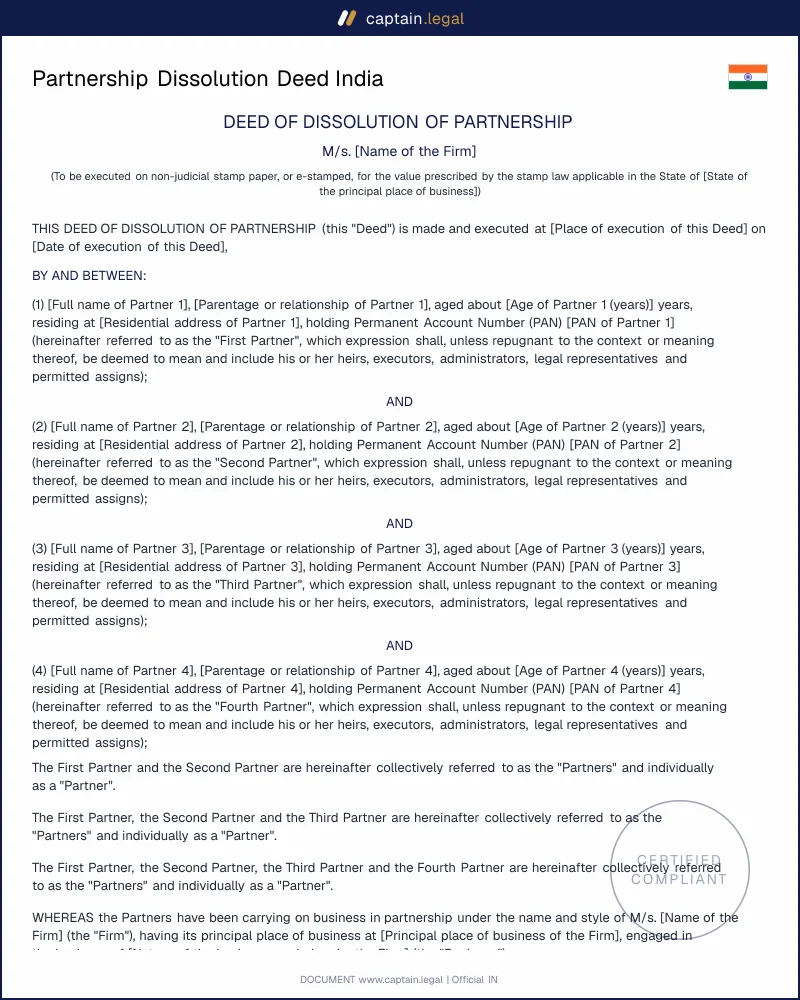
How to fill out this partnership dissolution deed

You start by selecting the state where the firm has its principal place of business. That choice drives the stamp duty article cited, the Registrar named in the filing clause and any local amendment to the registration chapter. The form then asks for the firm name, the date of the original partnership deed and, for a registered firm, its registration number.

Next you enter each partner's full name, parentage, address and PAN, with the capital balance and any loan standing to their credit on the date of dissolution. If a partner has died, the form captures the legal heirs and the succession document relied on. The settlement section follows the default order of Section 48; you accept it or record an agreed variation, and each choice is explained in plain language.

The asset and liability schedule comes last: each asset, the partner taking it and its agreed value, then each creditor and the partner responsible for payment. The deed is then generated in Word and PDF, ready for stamping and signature, customarily before two witnesses and a notary. For a successor company or LLP, our business and incorporation documents for Indian firms cover the next step.

Common mistakes to avoid

The most expensive error is distributing assets before paying creditors. Partners who divide the bank balance on signing day and deal with suppliers later become personally liable for every unpaid invoice, because Section 48 puts third-party debts first and liability for firm debts is joint and several. The second error is treating the signed deed as the end of the matter. Without the public notice required by Section 45 read with Section 72, a bank that deals with one former partner can still hold all of them liable. Publish the notice in the Official Gazette and a vernacular newspaper, and keep the clippings with the deed.

Stamp duty causes the third problem. A deed on plain paper, or stamped on another state's schedule, is liable to impounding under Section 33 of the Indian Stamp Act 1899 and inadmissible in evidence until the deficit and a penalty are paid, usually in the middle of a recovery suit. The fourth mistake is ignoring tax: partners who take over land or a vehicle at book value later find the firm taxed on the gap to fair market value, when it no longer has a bank account. Plan the final GST return before cancelling the registration, since an application in Form GST REG-16 must be followed by GSTR-10 within three months of the cancellation date or order, whichever is later. Vague descriptions are the last trap: "all stock to Partner A" invites a dispute, a dated inventory does not.

Key takeaways

CLOSURE

Use it only when the firm ends

A dissolution deed is for closing the entire partnership, not for one partner retiring while others continue. Under Section 39 of the Indian Partnership Act 1932, dissolution means the firm itself ends. The deed should be signed by all partners, or legal heirs where relevant, and should fix the effective date for banks, tax officers and the Registrar.

SETTLEMENT

Pay creditors before partners share assets

Section 48 sets the payment order after dissolution. Losses are met from profits, then capital, then partners personally. Firm assets go first to third-party creditors, then to partner advances, and only after that to capital balances. This order matters when stock, receivables or equipment are being sold and partners expect a payout.

NOTICE RISK

Public notice limits continuing liability

Partners can remain liable to third parties for post-dissolution acts until public notice is given under Section 45. For a registered firm, Section 72 links this to a Section 63 filing with the Registrar, publication in the Official Gazette and a vernacular district newspaper. State stamp duty and tax on fair market value transfers also need attention.

Frequently Asked Questions

Yes, as between the partners. A deed signed by all partners on adequately stamped paper is a binding contract under the Indian Contract Act 1872 and a valid dissolution under Section 40. Registration under the Registration Act 1908 is generally not compulsory, since the Supreme Court held in Addanki Narayanappa v Bhaskara Krishtappa that a partner's share is movable property. Where immovable property is allotted to a partner, registration is the prudent course, since sub-registrars and lending banks usually insist on a registered instrument.

For a registered firm, yes. Section 63 allows any former partner to notify the Registrar, who records the dissolution against the firm's entry. The central text says "may", but Maharashtra makes the intimation mandatory within 90 days, with a delay charge afterwards. Even where the filing is optional, it completes the public notice under Section 72 and removes the firm from the list of active entities, which matters for later bank and tax checks.

Under Section 45, each partner stays liable to third parties for acts of any partner that would have been acts of the firm until public notice of the dissolution is given. No fixed number of days applies; liability for new dealings ends only when the notice is published and, for a registered firm, filed. Debts incurred before dissolution must still be paid in full, whatever the date of the notice, and creditors can pursue any partner personally for them.

Only in a partnership at will. Section 43 lets any partner dissolve such a firm by written notice to all the others, effective from the date stated or, failing that, from the date of communication. Where the partnership deed fixes a term or requires unanimous consent, a single partner must apply to the civil court under Section 44, and the court then decrees the accounts. A deed signed afterwards can still record the settlement if the partners reach agreement.

Section 48 sets the default order. Losses, including capital deficiencies, are met from profits, then capital, then by the partners in their profit-sharing ratio. Assets pay third-party creditors first, then partners' advances rateably, then capital rateably, and any residue is shared in the profit-sharing ratio. Partners may vary the internal order between themselves, never the priority of outside creditors, and the deed should record any such variation in writing, signed by every partner.

Yes. Once the questionnaire is complete, the deed is generated in both formats. The Word file lets your chartered accountant adjust the asset schedule or add annexures such as the closing balance sheet, and the PDF is ready to print on e-stamp paper for signature. Both versions carry identical clauses and statutory references. Other documents you may need after closing the firm are listed in our full catalogue of Indian legal templates.

Stamp duty is a state subject. Most states charge a fixed duty where no immovable property is involved, and conveyance rates on market value where property brought in by one partner is allotted to another. The relevant entries include Article 47 of the Maharashtra schedule and Article 40(C) of the Karnataka schedule, while other states apply the Indian Stamp Act 1899 with their own amendments. Confirm the current rate with an authorised e-stamp vendor before execution.

4.7/5

21 verified reviews · 50 000+ downloads

Dissolution Deed Under Sections 40-48, Partnership Act 1932
  • Immediate access to the document
  • PDF + Word download
  • Compliant with 2026 legislation
  • Reviewed by lawyers
Fill in the template
Secure payment
Updated on September 27, 2026

You might also like

LLP Agreement India: Template
Joint Venture Agreement India