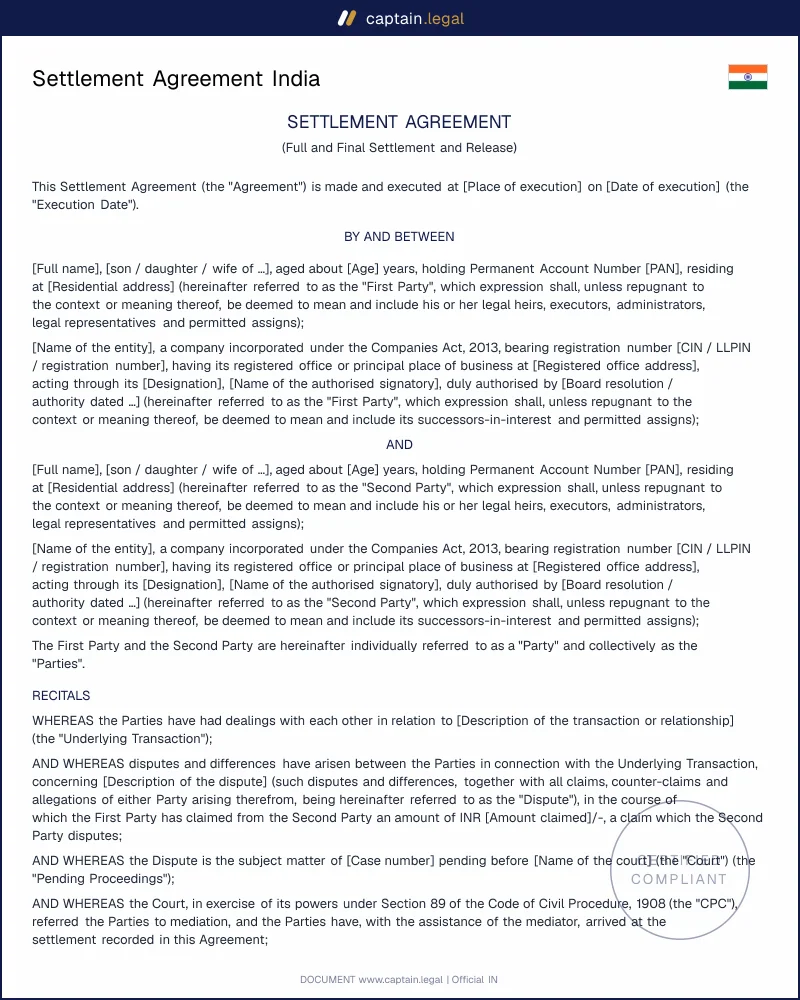
Maharashtra applies the Maharashtra Stamp Act 1958 rather than the central statute, with agreements not otherwise provided for falling under Article 5 of its Schedule I and releases under their own article. Under Section 34 of the Maharashtra Act, an insufficiently stamped settlement cannot be relied on in evidence until the deficit and penalty are paid. Commercial suits in Mumbai must first go through Section 12A mediation, so many settlements are signed at that stage.
Delhi applies the Indian Stamp Act 1899 as in force in the National Capital Territory, with e-stamp certificates issued through authorised collection centres. The Delhi High Court's mediation centre, Samadhan, handles a large volume of referred disputes, and most Section 138 complaints in the capital go to mediation at the first hearing. In Dayawati v Yogesh Kumar Gosain (2017), a larger bench of the Delhi High Court held that breaching an undertaking given in a court-referred mediated settlement can be punished as contempt. Instalment dates must match the undertaking recorded by the court, since a missed date also revives the prosecution.
Karnataka stamps agreements under the Karnataka Stamp Act 1957, which carries its own schedule and impounding provisions. Court-annexed mediation follows the Karnataka Civil Procedure (Mediation) Rules 2005, framed after Salem Advocate Bar Association v Union of India (2005) 6 SCC 344. The Bengaluru Mediation Centre, attached to the High Court, is one of the busiest in the country. Settlements reached there return to the referring court, which records them under Order XXIII Rule 3.
Tamil Nadu applies the central stamp statute with state amendments. The Tamil Nadu Mediation and Conciliation Centre at the Madras High Court was the first court-annexed mediation centre in India, and courts across the state make frequent Section 89 referrals to it. The referring court passes a decree in terms of the recorded compromise, so the text signed before the mediator becomes the operative decree.