
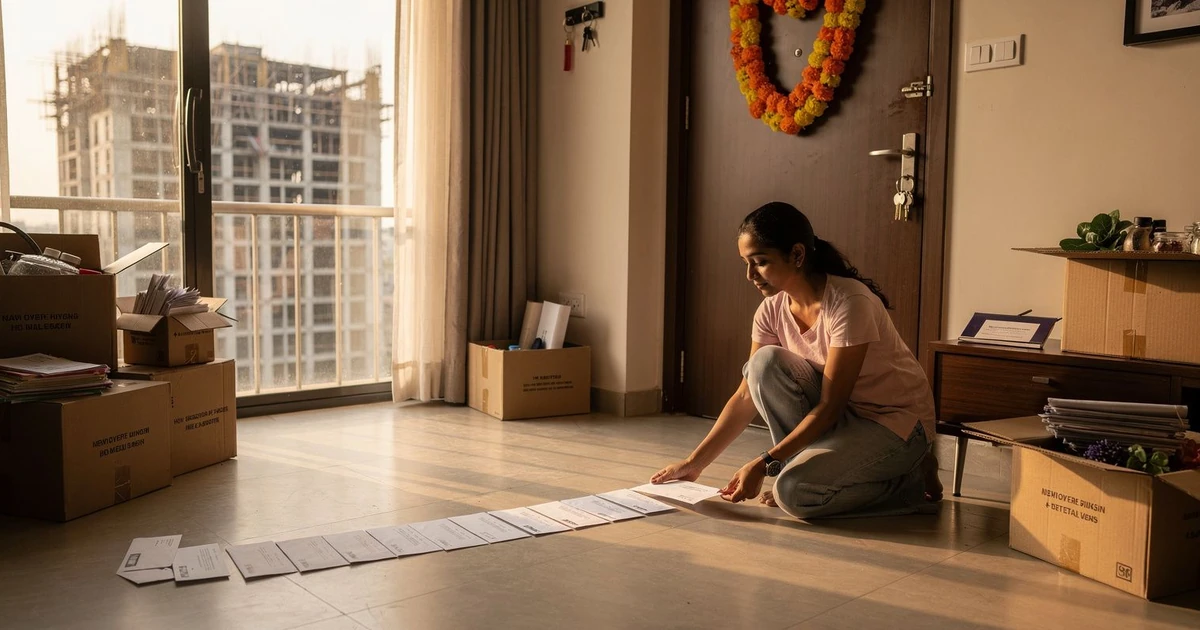
Many Indian homebuyers collect the keys to a flat that arrived years late, sign whatever the handover desk hands them and assume the matter is closed. It rarely is. Delayed possession interest under Section 18 of the Real Estate (Regulation and Development) Act, 2016 survives the handover. Two High Court rulings from August and September 2026 make that much harder for builders to contest. The Allahabad High Court held that accepting a late flat does not extinguish the claim and that RERA sets no specific limitation period for it. The Bombay High Court called the right independent and indefeasible. Here is what that means for allottees already living in their flat, and how to build the claim.
Delayed possession interest under RERA: what the right covers
When a project runs late, RERA gives the allottee a statutory choice. Withdraw, and the builder (the Act's term is promoter) must refund everything received with interest. Stay, and the proviso to Section 18(1) entitles the allottee to interest for every month of delay until possession is handed over, at the rate fixed by the State Rules. That second remedy is what practitioners call delayed possession interest, or DPC (delay possession charges) in Haryana orders. It is not damages: the delay alone triggers the entitlement, with no loss to prove. Compensation for rent paid elsewhere or mental agony is a separate head for the Adjudicating Officer under Section 71.
Section 2(za) makes the builder's rate equal to the rate it charges a defaulting allottee, so a token contract rate per square foot cannot undercut it. Section 2(d) extends the definition of allottee to anyone who later acquires the allotment by sale or transfer, while excluding a tenant. A resale buyer of an under-construction flat does not automatically inherit the full delay claim. In Laureate Buildwell Pvt. Ltd. v. Charanjeet Singh (2021), a three-judge bench of the Supreme Court held that relief for a subsequent purchaser depends on the facts. In that refund case, it ran interest only from the date the builder acknowledged the transfer. The agreement to sell for a resale flat should therefore say who keeps the interest accrued before the transfer.
Legal framework
RERA received presidential assent on 25 March 2016, but Sections 3 to 19, which include Section 18, came into force on 1 May 2017. In Newtech Promoters and Developers Pvt. Ltd. v. State of U.P. (2021), the Supreme Court held that the Act reaches projects still ongoing on that date, which is why a 2010 booking can still end in a RERA order. The same judgment settled competence: the Authority orders refund and interest, while the Adjudicating Officer awards compensation under Sections 71 and 72. Complaints are filed under Section 31. Appeals go to the Appellate Tribunal within sixty days under Section 44, then to the High Court under Section 58, again within sixty days and only on a substantial question of law.
Section 88 keeps other remedies alive, which is why Imperia Structures Ltd. v. Anil Patni (2020) let allottees pursue complaints before a Consumer Commission. Section 89 gives RERA overriding effect over any inconsistent law. The builder's standard defence comes from Section 55 of the Indian Contract Act, 1872. Under it, a promisee who accepts late performance cannot later claim compensation for the delay unless he gave notice of that intention at the time of acceptance. In Wg. Cdr. Arifur Rahman Khan v. DLF Southern Homes Pvt. Ltd. (2020), decided under the Consumer Protection Act, 1986, the Supreme Court rejected the view that purchasers who took possession or executed conveyance deeds had lost their delay claim.
The rate comes from the State Rules, not the Act. Most States use the State Bank of India's highest marginal cost of lending rate (MCLR) plus two per cent. Uttar Pradesh orders, including the Noida case below, apply MCLR plus one per cent. The official text is on the India Code page for the Real Estate (Regulation and Development) Act, 2016.
What the Allahabad and Bombay High Courts decided
The September 2026 ruling came from the Lucknow Bench of the Allahabad High Court, where Justice Prashant Kumar dismissed an appeal by Antriksh Developers and Promoters Pvt. Ltd. over its Antriksh Golf View project in Sector 78, Noida. The allottee had booked in 2010, with possession due by November 2012. Possession was offered only in May 2017 and, according to the court, without the occupancy certificate. The Appellate Tribunal had ordered interest from December 2012 to May 2017 at MCLR plus one per cent. The builder blamed the delay on a National Green Tribunal restraint around the Okhla Bird Sanctuary. The court held that taking possession does not strip a homebuyer of the statutory right to delayed possession interest, and that RERA prescribes no specific limitation period for claiming it. The "zero period" recognised by the Supreme Court, it added, covers only the time a project was actually hit by the restraint.
The Bombay High Court got there first, in August 2026. In Kiyana Estate LLP v. Tina Dharamshey (Second Appeal No. 117 of 2026), Justice N.J. Jamadar met the Section 55 argument head-on: the allottees had accepted a late flat without reserving their claim. Section 89 makes RERA prevail over the Contract Act, the court answered. Relying on Newtech and Imperia Structures, it held that the right to interest for every month of delay is an independent and indefeasible right of the allottee.
Both are High Court decisions, binding on authorities within their own jurisdictions and persuasive elsewhere. Since they rest on Supreme Court reasoning, benches in other States are unlikely to depart from them.
After the keys: conveyance, time limits and insolvency
Nor does the conveyance end the claim. Section 17 obliges the builder to execute a registered conveyance in the allottee's favour within the period set by local law or, failing that, within three months of the occupancy certificate. Builders like to attach a "no claims" declaration. Since Arifur Rahman Khan, Haryana's Real Estate Appellate Tribunal has set aside Authority orders that dismissed complaints merely because the registered sale deed for the flat had already been executed. The safer habit is a short covering letter, sent the day you sign, reserving your claim for delayed possession interest.
The absence of a limitation period is real but narrower than it sounds. It covers the original complaint under Section 31, not the sixty-day appeal windows. An allottee who picks the consumer route faces the two-year limit of Section 69 of the Consumer Protection Act, 2019, subject to arguments about a continuing cause of action. Time also erodes evidence, and some builders slide into insolvency. Once a corporate insolvency process starts, the moratorium under Section 14 of the Insolvency and Bankruptcy Code, 2016 halts RERA proceedings, and the allottee queues as a financial creditor before the resolution professional. Waiting years is legally possible and commercially risky.
How to claim delayed possession interest with Captain.Legal
A formal notice is not a precondition for a RERA complaint, but it fixes the date the builder was put on notice and gives it a last chance to settle. Captain.Legal's delayed possession notice under Section 18 RERA starts with the State where the project is registered, so the notice cites the matching Rules and interest formula. You enter each allottee and the builder exactly as named in the agreement for sale and the RERA registration certificate. The payment schedule follows, instalment by instalment, since interest is computed from each payment. If you already hold the keys, choose the remedy for staying in the project. The period claimed ends at handover, or at a valid offer of possession plus two months if earlier. The notice's reservation of rights keeps every other route open. You then set the compliance period, usually fifteen days from receipt, pick the signatory and download the notice in Word and PDF.
Common mistakes after a delayed handover
The costliest error happens at the handover desk. Builders routinely make the keys conditional on an indemnity or a "no dues, no claims" undertaking, and allottees sign because the movers are booked and the EMI keeps running. If you must sign, send a letter the same day by email and post, stating that possession is accepted without prejudice to your claim under Section 18. The second error is accepting, without comment, an offer of possession unaccompanied by an occupancy certificate. Such an offer is open to challenge, and silence makes the end date of your claim harder to argue.
Other mistakes are quieter. Allottees compute interest on the total sale price instead of the amounts actually paid, or borrow another State's formula, and the builder then disputes the entire figure. NRIs let a relative sign without a power of attorney authorising a relative in India, handing the builder an easy objection on standing. Many allottees also accept a "goodwill" credit note at conveyance worth far less than the statutory interest. Signing it in full and final settlement can genuinely weaken the claim. In Arifur Rahman Khan itself, the Supreme Court held purchasers who had signed specific settlement deeds to those deeds.
Frequently asked questions
Can I still claim delayed possession interest after taking possession?
Yes. Taking the keys is not a waiver. The Bombay High Court held in August 2026 that the Section 55 Contract Act rule on late performance cannot defeat the RERA right. A month later, the Allahabad High Court held that accepting a late flat does not bar the claim. Interest runs from the contractual possession date to handover, at your State's prescribed rate, on the amounts actually paid rather than the total price.
Is there a time limit to claim RERA delay interest?
RERA prescribes no specific limitation period for a complaint claiming delay interest, as the Allahabad High Court confirmed. Appeals are different: sixty days to the Appellate Tribunal under Section 44, then sixty days to the High Court under Section 58. A Consumer Commission complaint must be filed within two years under Section 69 of the Consumer Protection Act, 2019. Filing promptly still matters, because an order obtained before any insolvency is far easier to enforce.
How is RERA delay interest calculated?
The rate comes from your State's RERA Rules, usually the SBI highest MCLR plus two per cent, or plus one per cent in Uttar Pradesh orders. Authorities generally apply simple interest on each amount actually paid, from the contractual possession date plus any genuine grace period. Some authorities, Haryana's among them, stop the clock at a valid offer of possession plus the two months allowed by Section 19(10), or at earlier handover.
Does registering the sale deed end my claim against the builder?
Not by itself. Executing the conveyance is a separate duty of the builder under Section 17, and the Supreme Court refused in Arifur Rahman Khan to treat it as a waiver of the delay claim. The danger lies in what you sign alongside the deed. A settlement for which you received a credit or payment is much harder to reopen, so reserve your claim in writing on the day you sign.
Can I go to a Consumer Commission after taking possession?
Yes. Section 88 of RERA preserves other remedies, as Imperia Structures v. Anil Patni confirmed, and Arifur Rahman Khan was itself a consumer case involving purchasers already in possession. The catch is the two-year limit under Section 69 of the Consumer Protection Act, 2019, which RERA does not impose. If that route suits you, start with a consumer complaint notice for a Consumer Commission filing, and pursue one forum at a time.
Is a notice sent after handover still legally valid?
Yes. Indian law prescribes no statutory form for a pre-litigation notice, and nothing in RERA requires it before possession. The Bombay High Court held that the notice-at-acceptance rule of Section 55 does not govern the RERA right. A sound notice identifies the parties, lists the payments, cites Section 18 and fixes a deadline. Keep the postal receipt: Section 27 of the General Clauses Act, 1897 presumes service only on proof of proper dispatch.
Can I edit the notice in Word before sending it?
Yes. The legal notice to builder for delayed possession downloads in both Word and PDF once the form is complete. The Word file lets you or your advocate adjust the wording, add a letterhead or attach a payment annexure. The PDF is ready to print, sign and dispatch by Registered Post AD or Speed Post. Keep both with your payment receipts, since the RERA complaint will reuse the same figures and any mismatch invites objections.