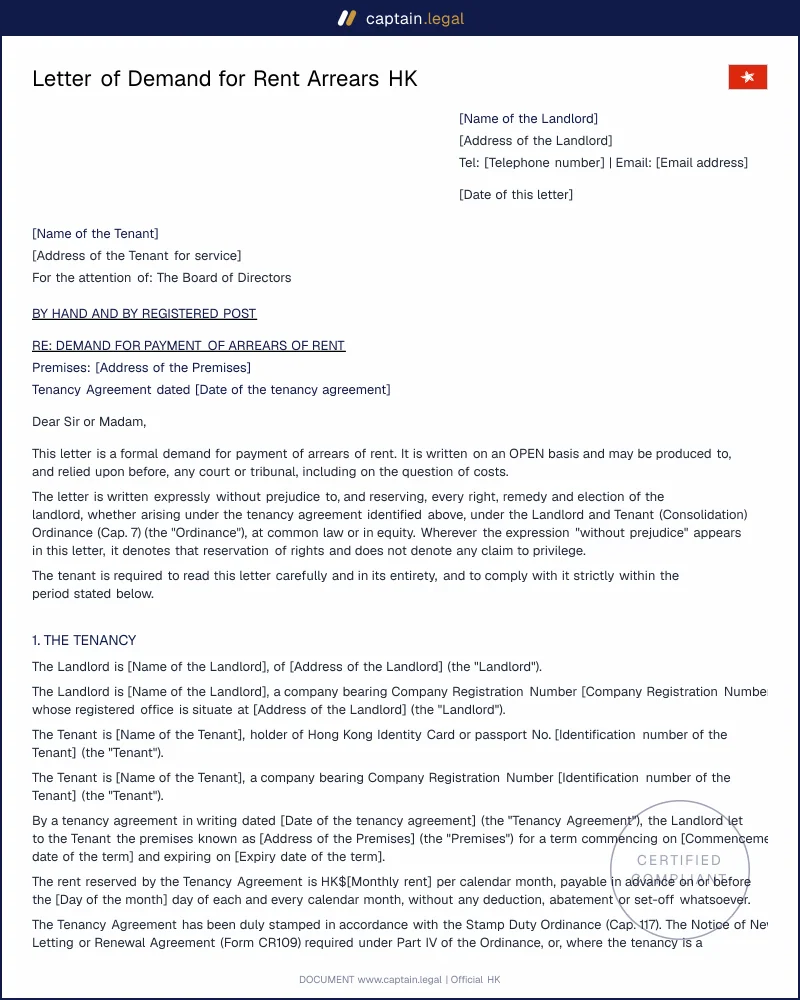
A letter of demand for rent arrears is the formal written notice a Hong Kong landlord serves on a defaulting tenant, recording the sums outstanding, the periods they cover, the date by which payment must reach the landlord and what follows if it does not. Most landlords treat it as a courtesy step before the real action begins. It is the opposite. The letter fixes the amount claimed, keeps the right to distrain alive under Part III of the Landlord and Tenant (Consolidation) Ordinance (Cap. 7), and becomes the first exhibit in the Lands Tribunal possession application that usually follows. This template is drafted for domestic and non-domestic lettings and suits private landlords, corporate owners, property managers and estate agents acting on written authority.
Compliant
2026 Legislation
50,000+ clients
trust us
Affordable
From $4.90 / doc
Secure payment
Instant download
Rent Arrears Demand HK: Cap. 7 Landlord Notice
Secure payment
What is a letter of demand for rent arrears in Hong Kong?
A letter of demand for rent arrears is a private contractual document, not a statutory form. Nothing in Cap. 7 prescribes its wording, which is why so many are drafted badly. Its function is evidential: it proves that a specific sum was demanded, from a named tenant, on a stated date, and that the tenant had a defined chance to pay before enforcement began. Practitioners keep it apart from three neighbouring documents. It is not a statutory demand, which is an insolvency instrument aimed at a company or an individual debtor. It is not a notice to quit, which ends a periodic tenancy rather than claiming money. And it is not a section 58 notice under the Conveyancing and Property Ordinance (Cap. 219), because that procedure covers breaches other than non-payment of rent.
What the letter claims is broader than rent alone. A well drafted demand covers rent together with the rates, Government rent, management fees and air conditioning charges the tenancy makes payable by the tenant, plus contractual interest. Where the tenancy has already been forfeited, the correct label for continuing occupation is mesne profits, not rent. Our tenancy agreements and landlord notices for Hong Kong property show how the demand sits alongside the letting documents.
Legal framework
The starting point is the tenancy agreement, because Hong Kong left most domestic lettings without security of tenure after the Landlord and Tenant (Consolidation) (Amendment) Ordinance 2004. Cap. 7 then supplies terms the agreement may have omitted: section 117(3) for domestic tenancies and section 126 for non-domestic tenancies imply both a covenant to pay rent on the due date and a condition of forfeiture, so the right to forfeit arises once rent has gone unpaid for more than 15 days, even where the agreement is silent.
Two statutory traps sit in front of the money claim. For a domestic tenancy under Part IV, a landlord is not entitled to maintain an action to recover rent unless the Commissioner of Rating and Valuation has endorsed a Notice of New Letting or Renewal Agreement (Form CR109), lodged within one month of the agreement. Late lodgement is still possible on payment of the prescribed charge, but the endorsement must be in hand before proceedings are issued. Separately, section 15 of the Stamp Duty Ordinance (Cap. 117) makes an unstamped instrument inadmissible in evidence, subject to the court receiving it on a solicitor's undertaking to stamp it and pay the penalty under section 9.
Enforcement then splits between two venues, which surprises landlords who assume one forum handles everything. Distress under Part III of Cap. 7 is an ex parte application to the District Court, leading to a warrant executed by the bailiff against goods in the tenant's apparent possession; section 79 bars a warrant where the arrears have been due for more than 12 months. Possession and mesne profits belong to the Lands Tribunal under the Lands Tribunal Ordinance (Cap. 17), as the Judiciary's guide to Lands Tribunal possession applications sets out. A money claim with no possession sought goes to the Small Claims Tribunal, the District Court or the Court of First Instance according to value, within the six years section 18 of the Limitation Ordinance (Cap. 347) allows.
When do you need this document?
The ordinary trigger is a domestic tenant who has missed one payment and is drifting toward a second. Serve the demand as soon as the contractual grace period expires, because a landlord who says nothing for three months invites the argument that late payment had become the accepted pattern. Commercial lettings default differently: the tenant keeps trading, pays part of the rent, and lets management fees and air conditioning charges accumulate behind the headline figure. A demand that itemises every head of claim, period by period, stops that drift.
The letter also earns its place when the deposit is nearly exhausted, when a guarantor needs notice of the principal debtor's default, and when a tenant leaves owing a final month plus reinstatement costs. Two edge cases matter. Where the tenant is a Hong Kong company that has stopped paying several creditors, the demand establishes an undisputed debt before any thought is given to a statutory demand under the winding up provisions of Cap. 32, since insolvency procedure suits no debt the tenant genuinely disputes. Where the defaulter is a principal tenant with sub-tenants in occupation, serving only the principal tenant leaves the sub-tenants paying rent to someone who is no longer entitled to receive it.
Key clauses included in our template
- The identification of the parties names every tenant on the agreement, not only the one who transfers the money each month, and describes the premises exactly as the stamped tenancy agreement does. Joint tenants are jointly and severally liable, and a demand addressed to one of them weakens any later claim against the other.
- The statement of account breaks the arrears down by period instead of presenting one lump figure. Each month lists the rent due, the payments received, the charges payable under the tenancy and the balance, so the tribunal can follow the arithmetic without a witness statement.
- The interest provision is drafted to the rate the tenancy specifies, with a fallback to interest from the date of judgment where the agreement is silent. Inventing a rate that appears nowhere in the tenancy is the fastest way to have the whole account questioned.
- The payment deadline and payment channel give a calendar date, a bank account and a reference rather than a vague period, which removes the excuse that the tenant did not know where to send the money.
- The reservation of rights records that the demand is made without prejudice to the right of re-entry, to distress under Part III and to the application of the security deposit. Without it, a demand for rent falling due after the right to forfeit arose can be read as an election to treat the tenancy as continuing, waiving the forfeiture.
- The service and authority block matches the notice clause in the tenancy and identifies the signatory. Where a managing agent signs, the file should also hold a letter of authorisation naming your managing agent so that authority is never in issue.
Considerations by property type and tenancy category
Domestic tenancies carry the CR109 requirement, most often forgotten by owners who let through a friend rather than an agency. The deposit is conventionally two months' rent, and the tenancy normally lets the landlord apply it against arrears. Domestic tenants are also the ones most often granted relief: where the Lands Tribunal makes a possession order on the ground of non-payment alone, the tenant may be given not less than one week to pay all arrears and costs into the Tribunal, and payment within that window reinstates the tenancy.
Non-domestic and commercial premises fall under Part V of Cap. 7, with the section 126 forfeiture condition mirroring the domestic rule. Distress is far more useful here than in a flat, because a shop, restaurant or office holds seizable stock, fittings and equipment on site. The bailiff cannot touch land fixtures, things in actual use or goods plainly belonging to a third party, so a demand aimed at a corporate tenant, the kind covered by our commercial and incorporation paperwork for Hong Kong companies, should be timed before stock starts leaving the premises.
Regulated tenancies of subdivided units under Part IVA follow their own regime. The landlord submits Form AR2 to the Rating and Valuation Department within 60 days of the term commencing, and enforcing a possession order requires a notice posted at the unit followed by a 60 day wait before leave to issue a writ. A demand drafted on ordinary domestic assumptions will misstate the tenant's position in a regulated tenancy.
Serviced apartments, co-living rooms and bedspaces are often structured as licences rather than tenancies. A licensee holds no estate in the land, distress is unavailable, and the claim rests on contract alone. Read the document before deciding which remedy to threaten, and check who signed, because the demand must go to the contracting entity.
How to fill out this letter of demand
You begin by selecting whether the letting is domestic, non-domestic or a regulated subdivided unit, and the template adjusts the statutory references and the warning language accordingly. From there you enter the parties as they appear on the stamped tenancy agreement, the address of the premises, the commencement date and the monthly rent. The account section takes each unpaid period in turn and totals them as you go. Interest follows the rate you enter, or accrues from judgment if none was agreed.
The final part deals with consequences and delivery. You choose the payment deadline, the remedies you wish to reserve and the method of service that matches the notice clause, then the document generates in Word and PDF. If the tenant asks for time, do not extend the deadline by email: record the arrangement the way a loan agreement recording a private repayment schedule records instalments, so the concession does not later look like a variation of the tenancy.
Common mistakes to avoid
The most expensive mistake is accepting money without thinking about what it does. Where the right to forfeit has already arisen, demanding or accepting rent that fell due afterwards can waive that right and hand the tenant an argument that the tenancy continued. The second is forfeiting first and distraining afterwards: distress belongs to a landlord under a subsisting tenancy, and once the tenancy has been determined the warrant route closes. Third, landlords let arrears run past twelve months and then find that section 79 has closed the distress route, leaving only a money judgment against a tenant with nothing left to seize.
The remaining errors are administrative and just as fatal. Demands go to the flat by ordinary post when the tenancy specifies a different address, so no proof of service exists when it matters. Landlords of domestic premises reach the Lands Tribunal without an endorsed Form CR109 and cannot maintain the rent claim. And tenancy agreements turn out to be unstamped, so section 15 keeps them out of evidence until the duty and the penalty are paid.
Frequently Asked Questions
12 verified reviews · 50 000+ downloads
- Immediate access to the document
- PDF + Word download
- Compliant with 2026 legislation
- Reviewed by lawyers
You might also like