Real Estate & Rental

Commercial Lease HK: Cap. 7 and Stamp Duty Cap. 117

Hong Kong commercial lease drafted to Cap. 7, Cap. 219 and Cap. 117 stamp duty rules. No security of tenure since 2004: renewal must be negotiated.
4.5/516 reviews50 000+ downloadsInstant download
Share

A commercial lease agreement in Hong Kong is the written instrument by which a landlord grants a business exclusive possession of office, retail or industrial premises for a fixed term, in return for rent, rates, management fees and covenants that run until the tenant hands the space back. It governs everything the parties will argue about later: the term, whether any right to renew exists, the permitted use, who pays the outgoings, and what condition the space must be in on the last day. Landlords, retail operators, restaurant groups and incoming office tenants work from the same core structure, drafted to Hong Kong land law and stamped with the Inland Revenue Department.

Compliant

2026 Legislation

50,000+ clients

trust us

Affordable

From $4.90 / doc

Secure payment

Instant download

Commercial Lease HK: Cap. 7 and Stamp Duty Cap. 117

Secure payment

Fill in the template

What is a commercial lease agreement in Hong Kong?

A commercial lease agreement grants a leasehold interest in non-domestic premises for a term certain, at a rent, with the tenant taking exclusive possession. That last element separates a lease from a licence. A licensee has permission to occupy and nothing more; a tenant holds an interest in land that can be assigned, charged and defended against the landlord. The distinction matters because the Landlord and Tenant (Consolidation) Ordinance (Cap. 7) applies to tenancies and not to licences, and a co-working desk dressed up as a lease rarely passes the exclusive possession test.

Hong Kong practice draws a further line between a tenancy agreement and a lease proper. Anything up to three years is documented as a tenancy agreement, takes effect without a deed under section 4 of the Conveyancing and Property Ordinance (Cap. 219), and keeps its priority without registration. Beyond three years the grant must be by deed to create a legal estate, and should be registered at the Land Registry. A four year lease signed as a simple agreement and left unregistered can be defeated by a purchaser of the building, which is the most expensive drafting error in this area. The other property and tenancy documents in our Hong Kong library follow the same split.

2

When do you need this document?

The standard trigger for a commercial lease is a new letting of office space on a two or three year term, usually a fixed period with an option to renew at prevailing market rent. Retail lettings run longer because the tenant is sinking money into shopfront and fitting out works and needs time to recover it. Restaurant operators sit at the difficult end: the lease must be signed before the Food and Environmental Hygiene Department will process a general restaurant licence, yet the licence may never be granted, so an F&B lease needs a licensing condition rather than a bare commencement date.

Industrial space brings its own trigger. Occupiers taking floors in Kwun Tong or Kwai Chung need a permitted user clause matching the Occupation Permit and the land grant, because office use in a building consented for industrial use is a breach the landlord will not waive. Two edge cases deserve attention. Group companies sharing premises need a licence to occupy in favour of the associate, since alienation clauses prohibit parting with possession. A tenant taking assignment of an existing lease should insist on a fresh reinstatement schedule, because it inherits the duty to strip out works it never carried out.

3

Key clauses included in our template

  • The term and commencement provisions fix a date certain and separate the fitting out period from the rent commencement date. Landlords grant a rent free allowance measured in weeks or months, during which management fees and rates remain payable, and recording both dates keeps the duty computation correct.
  • The permitted user clause ties occupation to a specific trade, described precisely enough to satisfy the Deed of Mutual Covenant and the Occupation Permit. Vague drafting such as "commercial purposes" produces disputes with the incorporated owners and refusals from the licensing authority.
  • The rent, rates, government rent and management fees clause allocates each outgoing by name. Non-domestic rates run at 5 per cent of rateable value and government rent at 3 per cent under the Government Rent (Assessment and Collection) Ordinance (Cap. 515), and the template states who bears each, with air conditioning and promotion levies in managed centres.
  • The security deposit and guarantee provisions set three months' rent, the commercial norm, with top up on any rent review. Where the tenant is a start up or a special purpose company, a director's guarantee is added, supported by the powers of attorney and declarations in our personal documents range.
  • The option to renew is drafted as a genuine option with a market rent determination mechanism and an independent surveyor, not an agreement to agree. Notice must be served inside a defined window, and time is of the essence.
  • The reinstatement and yielding up clause states the condition the premises must be returned in, bare shell or as handed over, and lets the landlord carry out the works and charge the cost against the deposit. The forfeiture and distraint wording reserves re-entry and deems rent to be in arrears if not paid in advance, which is what makes Part III of Cap. 7 available.
4

District and premises considerations

Central, Admiralty and Sheung Wan office lettings are quoted on gross floor area, a figure with no statutory definition in the leasing context that can differ sharply from usable space. Check the efficiency ratio against the building's own measurement practice before agreeing the rent, since duty and management charges follow the stated area. Grade A towers also impose fitting out deposits, contractor approval and after hours air conditioning charges that belong in the lease, not a side letter.

Causeway Bay, Mong Kok and Tsim Sha Tsui retail units frequently carry turnover rent on top of base rent, plus a promotion levy and mandatory trading hours. Turnover rent needs an audit and reporting clause, otherwise the landlord cannot verify the figures. Shopfront and signage rights should be granted expressly, because the Deed of Mutual Covenant usually reserves the external wall to the incorporated owners.

Kwun Tong, Kowloon Bay and Kwai Chung industrial and revitalised buildings turn on user restrictions in the government land grant. Office or showroom use in a building held under industrial conditions needs a waiver from the Lands Department, and floor loading limits under the Buildings Ordinance (Cap. 123) constrain heavy equipment. Do not rely on the landlord's assurance that other tenants are already doing the same thing.

Food and beverage premises anywhere in the territory face the Food Business Regulation (Cap. 132X) and the Fire Safety (Commercial Premises) Ordinance (Cap. 502). The lease should oblige the landlord to sign the owner's consent required for the licence application, and should suspend rent or allow termination if the licence is refused for reasons connected with the building. Ventilation routes and grease trap access are negotiated at lease stage, never afterwards, and our full catalogue of Hong Kong document templates covers the supporting paperwork.

5

How to fill out this commercial lease agreement

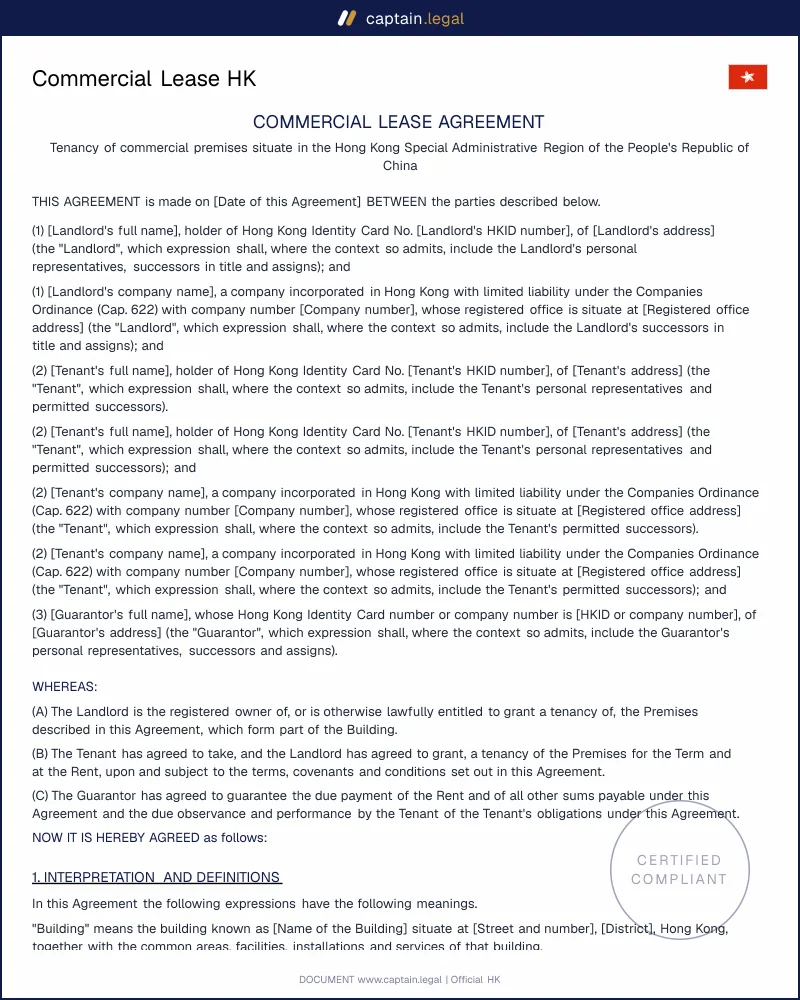
You begin by identifying the premises and the type of use, because that choice drives the permitted user wording, the reinstatement standard and the licensing conditions the template inserts. Corporate parties are identified by company number and registered office, and the execution block adjusts to signature by two directors, by a director and company secretary, or under seal where a deed is required. You then set the term, the fitting out period and the rent commencement date, which the document keeps separate so the rent free allowance is written down rather than assumed.

The financial section takes rent, deposit, rates, government rent, management fees and any turnover rent, and allocates each between the parties. Renewal, break rights and notice periods follow, with the notice window expressed in days rather than by a term of art. The finished document is signed and submitted for stamping within thirty days. Tenants employing staff at the premises will also want the contracts in our Hong Kong employment and HR templates.

6

Common mistakes to avoid

The first is treating a provisional agreement as a placeholder. In World Food Fair Ltd v Hong Kong Island Development Ltd, the Court of Final Appeal confirmed that a preliminary document containing the essential terms binds and that one missing them cannot. Parties sign casually, then discover they are committed or that they have no contract at all. The second is late stamping: the penalty escalates from two times the duty to four times after two months and ten times beyond that. The third is drafting an option to renew as a promise to negotiate, when a court will not fix a rent the parties never agreed a method for calculating.

The fourth trap is reinstatement. Tenants accept an obligation to return the premises to bare shell without pricing the strip out, then lose the whole deposit and face a further claim. Photograph the condition on handover and annex the schedule. The last is assuming hardship excuses performance. In Vember Lord Ltd v The Swatch Group (Hong Kong) Ltd the court held that expense, delay and commercial difficulty do not frustrate a lease. Rent relief in a downturn has to be written into the document before signature.

Key takeaways

TENURE

No automatic renewal after lease expiry

Since the Landlord and Tenant (Consolidation) (Amendment) Ordinance 2004 took effect on 9 July 2004, commercial premises in Hong Kong come with no security of tenure. If you want to stay beyond the end date, you only get what the lease expressly grants and what the landlord agrees to negotiate. Plan your renewal strategy early, because expiry can mean a clean break.

FORMALITIES

Over three years needs deed and registration

Hong Kong practice splits documents by term. Up to three years can be a tenancy agreement effective without a deed under section 4 of the Conveyancing and Property Ordinance (Cap. 219). Beyond three years, the grant must be by deed to create a legal estate and should be registered under the Land Registration Ordinance (Cap. 128). A four-year lease left as a simple agreement and unregistered can be defeated by a purchaser.

STAMP DUTY

Unstamped lease is unusable in court

Stamp duty under the Stamp Duty Ordinance (Cap. 117) is charged on the yearly or average yearly rent: 0.25% up to one year, 0.5% for over one to three years, and 1% beyond, with key money charged separately. If the lease is not stamped, it cannot be received in evidence in civil proceedings, so even a rent arrears claim stalls until stamping and any penalty are paid.

Frequently Asked Questions

Yes, once both parties sign and the formalities are met. A term of three years or less binds as a written tenancy agreement without a deed under section 4 of the Conveyancing and Property Ordinance (Cap. 219). A longer term must be executed as a deed and registered at the Land Registry to protect priority against a future purchaser or mortgagee. Stamping is the other half of enforceability, because an unstamped lease will not be received in evidence.

Duty is charged on the yearly or average yearly rent and rises with the term: 0.25 per cent for one year or less, 0.5 per cent for more than one year up to three years, and 1 per cent for anything longer. The deposit is excluded, and a rent free period reduces the average yearly rent used in the calculation. Each counterpart attracts a small fixed duty. Stamping is due within thirty days of execution, counting from the signature date, with landlord and tenant jointly liable.

No, not unless the lease grants one. Security of tenure for non-domestic tenancies disappeared when the operative provisions of Part V of the Landlord and Tenant (Consolidation) Ordinance (Cap. 7) were repealed with effect from 9 July 2004. A tenant whose term expires must vacate, and a landlord who lets it hold over risks creating a periodic tenancy by conduct. An option to renew is therefore negotiated at the outset, with an exercise window and a market rent mechanism.

Whatever the lease says, and nothing is implied in your favour. A fixed term lease with no break clause runs to expiry, and a tenant who walks out early stays liable for the balance of the rent, subject to the landlord's duty to mitigate. Where a break right is negotiated, three to six months of written notice is usual, often exercisable once and conditional on the rent being paid up to date. Serve it in the exact form the lease prescribes: a late notice, or one served on the wrong party, is ineffective.

No. The Notice of New Letting or Renewal Agreement, Form CR109, is endorsed by the Commissioner of Rating and Valuation for domestic premises only, and the bar on recovering rent without an endorsed notice applies to domestic lettings alone. A commercial landlord has no equivalent filing, but cannot skip stamping, which conditions the admissibility of the lease in any action for arrears or possession.

Yes, in both formats. The Word version is editable, which matters here because the schedule of premises, the fitting out specification and the reinstatement plan are annexed as bespoke documents that must sit inside the lease. The PDF is the version to print for signature and to attach to the electronic stamping application. Keep one stamped original per party, as our Hong Kong non-profit and association templates also apply where a society takes premises.

4.5/5

16 verified reviews · 50 000+ downloads

Commercial Lease HK: Cap. 7 and Stamp Duty Cap. 117
  • Immediate access to the document
  • PDF + Word download
  • Compliant with 2026 legislation
  • Reviewed by lawyers
Fill in the template
Secure payment
Updated on August 21, 2026

You might also like

Letter of Demand for Rent Arrears HK
Tenancy Agreement Hong Kong