Business & Incorporation

Master Services Agreement HK: Cap. 457 and Cap. 71

Framework services contract under Hong Kong common law, aligned with Cap. 457 implied terms, Cap. 71 liability limits and Cap. 623 third party rights.
4.8/521 reviews50 000+ downloadsInstant download
Share

A master services agreement is the umbrella contract a Hong Kong business signs once with a supplier, then draws on for every engagement that follows. It settles the terms that rarely change, from payment and confidentiality to intellectual property, liability and termination, so each new project needs only a short statement of work covering deliverables, timing and fees. Companies here use it for software development, marketing retainers, consultancy and outsourced back office work, where a fresh contract for every assignment wastes weeks and invites inconsistency. Hong Kong contract law rests on common law rather than a civil code, so almost everything turns on what the parties wrote. This template gives you a Hong Kong law framework agreement with the provisions commercial counsel here expect to see, in Word and PDF.

Compliant

2026 Legislation

50,000+ clients

trust us

Affordable

From $4.90 / doc

Secure payment

Instant download

Master Services Agreement HK: Cap. 457 and Cap. 71

Secure payment

Fill in the template

What is a master services agreement in Hong Kong?

A master services agreement is a framework contract. It does not itself commit either side to buy or supply anything: it sets the legal architecture, and the commercial commitment arrives later through statements of work signed under it. Each statement of work incorporates the master terms by reference and adds only what is specific to that engagement. The structure earns its keep where a supplier serves several entities in a group, or delivers unrelated projects across a year.

That distinguishes it from a one-off services agreement, which holds scope and legal terms in a single instrument and expires when the work is done. It also differs from a supply agreement for goods, which engages the Sale of Goods Ordinance (Cap. 26), and it belongs with the commercial contracts and company documents for Hong Kong businesses rather than the incorporation papers. The line that causes most trouble in practice separates services from employment. A contractor who works fixed hours under your direction, uses your equipment and has no other clients may be held to be an employee whatever the paperwork says, with consequences under the Employment Ordinance (Cap. 57) and the provident fund regime. Where the relationship is genuinely employment, use a Hong Kong employment contract or appointment letter instead.

2

When do you need a master services agreement?

The classic trigger is a supplier relationship that has outgrown purchase orders. An agency that started with one campaign now runs paid media, content and events under three budget owners, and nobody can say which terms apply. Software engagements follow the same arc: discovery, build, then support on entirely different economics. A master agreement fixes ownership of code and confidentiality once, then varies scope and fees through statements of work a project manager can sign.

Group procurement is the second scenario. A Hong Kong holding company negotiates the master terms and its subsidiaries order under them as permitted affiliates, which demands careful drafting of who carries liability. Outsourced functions form the third category: payroll, bookkeeping, customer support, warehouse operations, anything where the supplier touches your systems over a long period. Charities and incorporated societies engaging fundraising or IT vendors need the same discipline alongside their governance documents for Hong Kong societies and charitable bodies. One edge case: where the customer is a licensed corporation or authorised institution, regulators expect outsourcing contracts to grant audit rights and regulator access, and a standard template will not survive a supervisory review.

3

Key clauses included in our template

  • The scope, change control and order of precedence provisions define deliverables, acceptance criteria and how each is varied. The master agreement prevails unless a statement of work expressly identifies the clause it changes, which stops a project sheet from quietly rewriting the liability cap. Acceptance runs on a deemed acceptance period, since open ended testing is the commonest cause of unpaid invoices in technology work.
  • The fees, invoicing and tax clause covers rates, milestone or monthly billing, expenses, interest on late payment and set off. Hong Kong imposes no value added tax, so the drafting deals with profits tax responsibility and withholding on royalties paid to a non-resident under the Inland Revenue Ordinance (Cap. 112).
  • The intellectual property clause assigns deliverables to the customer and licenses back the supplier's pre-existing materials. Under section 15 of the Copyright Ordinance (Cap. 528), the author of a commissioned work keeps the copyright unless the parties agree otherwise, and the customer receives only an implied exclusive licence for purposes contemplated at the time.
  • The confidentiality and personal data provisions survive termination and impose processing obligations where the supplier handles personal data for you, matching the controls the Privacy Commissioner expects under Data Protection Principles 2(3) and 4(2) of the Personal Data (Privacy) Ordinance (Cap. 486).
  • The liability and indemnity clause caps aggregate liability by reference to fees paid, carves out death and personal injury, fraud and breach of confidentiality, and excludes indirect loss. It is drafted symmetrically, which improves its prospects under the Cap. 71 reasonableness test.
  • The termination and dispute resolution clauses cover termination on notice, termination for material breach, exit assistance, and a choice between the Hong Kong courts and HKIAC arbitration.
4

Cross-border and sector considerations

Mainland China counterparties. The dispute resolution calculation changed on 29 January 2024, when the Mainland Judgments in Civil and Commercial Matters (Reciprocal Enforcement) Ordinance (Cap. 645) came into operation. Hong Kong judgments in civil and commercial matters can now be registered and enforced in the Mainland without the old exclusive jurisdiction requirement, making the local courts a more realistic choice than they were. Arbitration keeps one advantage: under the 2019 arrangement on interim measures, parties to an HKIAC arbitration seated in Hong Kong can apply to Mainland courts for asset preservation before any award.

Offshore and regional suppliers. Where a Singapore, Indian or Philippine provider processes personal data for you, the Personal Data (Privacy) Ordinance holds you responsible as data user for what your processor does. Section 33, the cross-border transfer provision, has never been brought into force, so there is no statutory bar on export, but the Privacy Commissioner published recommended model contractual clauses in 2022 and expects them in the contract itself.

Premises and affiliates. On site technology work and facilities management raise access, insurance and reinstatement questions that overlap with the occupier's lease, so read the services scope against your tenancy agreements and Hong Kong property documents. Decide too whether subsidiaries contract in their own name or whether the Hong Kong entity contracts as principal and recharges, because leaving that implicit creates the third party problem Cap. 623 addresses.

5

How to fill out this master services agreement

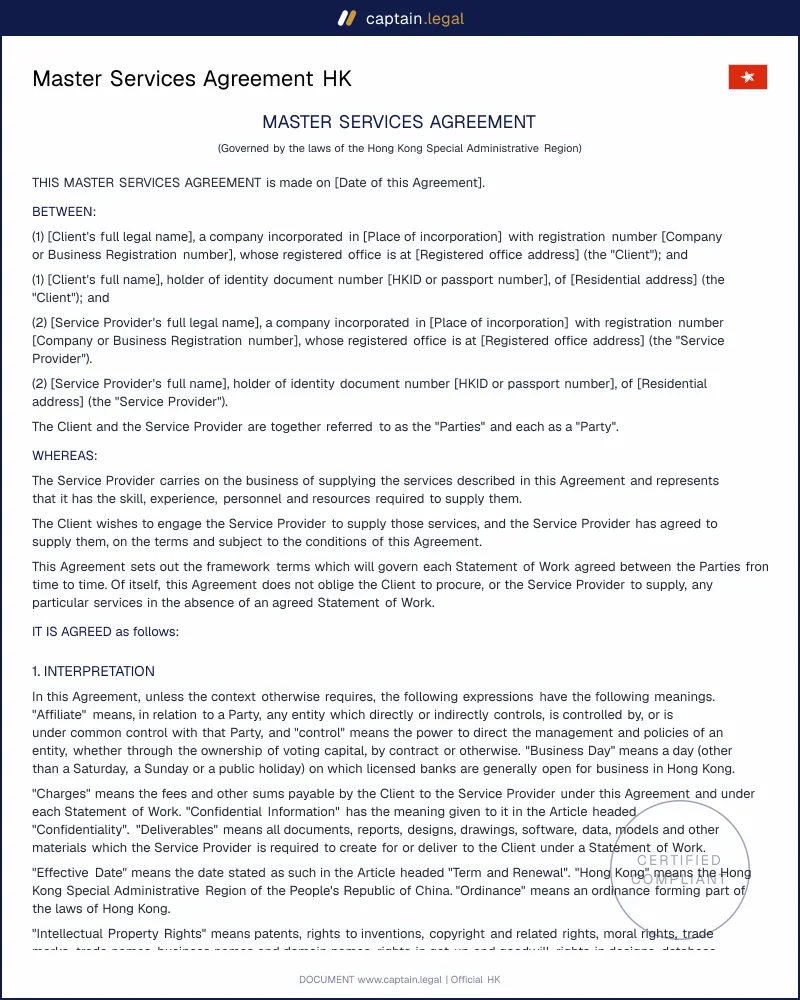
You start by identifying both contracting entities with their full registered names and Companies Registry numbers, since a trading name alone does not bind a Hong Kong company. The form asks whether affiliates may place orders. Then comes the commercial layer: billing frequency, payment period, whether expenses are reimbursed at cost, and whether interest runs on overdue sums. The intellectual property section offers a choice between full assignment of deliverables and a licence model, the right option where the supplier reuses a proprietary platform across clients.

The liability section lets you set the cap as a multiple of fees and select the carve outs, then pick your forum, courts or arbitration, with seat and language pre-populated. The document generates with a first statement of work attached as a schedule, so the opening engagement can start immediately. Check the signature block against your articles before execution, because section 127 of the Companies Ordinance (Cap. 622) prescribes how a Hong Kong company signs, a point the whole catalogue of Hong Kong legal templates follows.

6

Common mistakes to avoid

The most expensive drafting error concerns intellectual property. A clause saying the supplier "shall assign" or "agrees to assign" the deliverables creates only an equitable interest and needs a further document later; the operative wording is "hereby assigns". The second recurring error is a statement of work written by delivery teams that contradicts the master agreement with no precedence rule, which surfaces in a dispute over acceptance. Third, parties leave Cap. 623 untouched, then find that a subcontractor named in a benefit clause can sue on the contract, and that varying the agreement needs that person's consent.

Commercially, suppliers routinely propose a cap that excludes everything and limits the rest to a nominal sum, imposed on a smaller counterparty in a standard form. That is what the reasonableness test in Cap. 71 catches, and failure means no protection rather than a reduced cap. Two smaller traps close the list. Long term individual contractors on exclusive full time arrangements attract employment and provident fund exposure whatever the label. And parties sign electronically without checking the route: the Electronic Transactions Ordinance (Cap. 553) validates electronic signatures for ordinary commercial contracts, but it excludes deeds, so an agreement executed as a deed for the twelve year limitation period needs wet ink.

Key takeaways

STRUCTURE

One master agreement, many statements of work

A master services agreement sets the legal ground rules once, then each new job is placed under a short statement of work covering deliverables, timing and fees. The master document usually does not commit either side to buy or supply anything on its own, so the statement of work is where the commercial obligation lands. Keep that incorporation-by-reference tidy to avoid mismatched terms across projects.

IMPLIED TERMS

Cap. 457 fills gaps you leave

Under the Supply of Services (Implied Terms) Ordinance (Cap. 457), business-to-business service contracts pick up default terms unless you draft around them. Section 5 implies reasonable care and skill, section 6 implies a reasonable time where no deadline is stated, and section 7 implies a reasonable charge where price is not agreed. Service levels and pricing mechanics are how you replace those defaults with something measurable.

LIABILITY

Bad exclusions can leave unlimited exposure

Limitation and exclusion clauses are constrained by the Control of Exemption Clauses Ordinance (Cap. 71). You cannot exclude liability for death or personal injury caused by negligence, and other exclusions must pass the statutory reasonableness test, including looking at bargaining strength. If a clause fails, it is struck out rather than rewritten, which can leave the supplier facing uncapped claims instead of the intended cap.

Frequently Asked Questions

Yes, provided the ordinary requirements of contract formation are met: offer, acceptance, consideration, an intention to create legal relations and sufficient certainty of terms. Hong Kong law imposes no registration, notarisation or witnessing requirement on a commercial services contract, and no stamp duty attaches to it. The framework structure does not weaken enforceability: courts read the master agreement and the statement of work together as one contract for that engagement, which is why the incorporation language and the precedence clause carry real weight.

The master agreement holds the legal terms, the statement of work holds the commercial detail. Scope, deliverables, milestones, named personnel, acceptance criteria, fees and the timetable belong in the statement of work; confidentiality, intellectual property, liability, termination and governing law belong in the master. Separating them lets a new project launch on a two page document rather than a renegotiation. The risk is drift, where successive statements of work introduce inconsistent payment terms, which the precedence clause controls.

Not automatically you. The Copyright Ordinance (Cap. 528) gives first ownership to the author, and for commissioned works the commissioner receives only an exclusive licence to exploit the work for purposes the parties could reasonably have contemplated. Ownership passes through an assignment in writing signed by or on behalf of the assignor, drafted in present tense operative language. Moral rights cannot be assigned in Hong Kong, though they can be waived, so a template written for another jurisdiction usually leaves a gap.

That depends on what you agreed. No statutory notice period applies to a commercial services contract in Hong Kong, so the contract governs, and our default drafting gives a termination for convenience right on a stated number of days' notice, plus immediate termination for material breach left unremedied after a cure period. Where the agreement is silent a court will imply reasonable notice, and what counts as reasonable turns on the length of the relationship and the supplier's committed investment. Name the period and remove the argument.

Both work. Litigation is generally cheaper for straightforward debt claims and travels better to the Mainland since Cap. 645 took effect. Arbitration under the Arbitration Ordinance (Cap. 609) offers confidentiality, a neutral forum where the counterparty is foreign, enforcement in New York Convention states, and access to Mainland interim relief for Hong Kong seated HKIAC cases. If you arbitrate, specify the seat, the number of arbitrators and the language.

For an ordinary master services agreement, yes. The Electronic Transactions Ordinance (Cap. 553) gives electronic records and signatures the same effect as paper for most commercial contracts. The exclusions matter: deeds, powers of attorney and negotiable instruments fall outside the regime, so a document you intend to execute as a deed still needs a physical signature. Where an agent signs for a party, check the authority document too, using our powers of attorney and authorisation letters for Hong Kong as a reference.

The agreement downloads in both Word and PDF. The Word version is editable, so your counsel can adjust the liability cap, add sector obligations such as regulator audit rights, or attach further statements of work as schedules. The PDF is formatted for signature and circulation, and both files carry the same clause numbering.

4.8/5

21 verified reviews · 50 000+ downloads

Master Services Agreement HK: Cap. 457 and Cap. 71
  • Immediate access to the document
  • PDF + Word download
  • Compliant with 2026 legislation
  • Reviewed by lawyers
Fill in the template
Secure payment
Updated on August 20, 2026

You might also like

E-commerce Terms and Conditions Hong Kong
Partnership Agreement Hong Kong