Business & Incorporation

Significant Controllers Register: Cap. 622 Div. 2A, s. 653H

Register drafted to Division 2A of the Companies Ordinance (Cap. 622): Schedule 5B particulars, Schedule 5C wording, section 653ZC representative. Word and PDF.
4.5/515 reviews50 000+ downloadsInstant download
Share

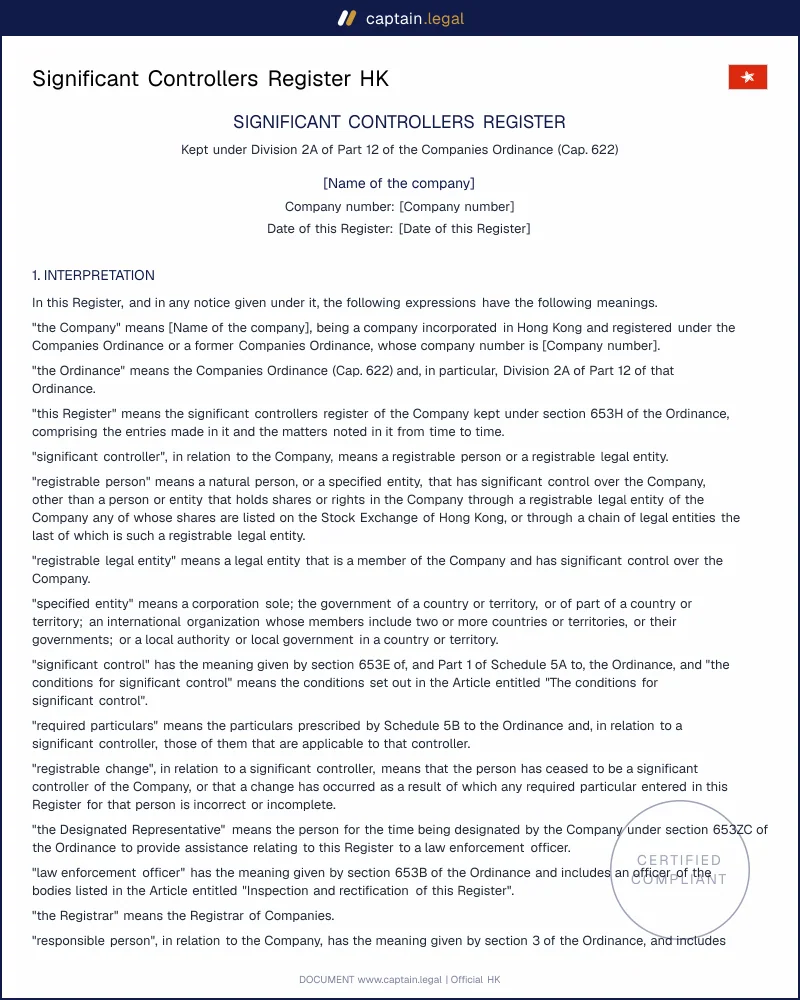
A significant controllers register is the internal register in which a Hong Kong company records the individuals and legal entities that ultimately own or control it. It is never delivered to the Companies Registry and closed to the public, but it must sit at the registered office or another Hong Kong address and be produced to a law enforcement officer on demand. Every company formed and registered under the Companies Ordinance (Cap. 622) keeps one, listed companies aside, from the day of incorporation. This pack contains the register in the statutory format, the enquiry notices you serve on suspected controllers, the designation of your representative and the keeping note for the registered office file, in Word and PDF.

Compliant

2026 Legislation

50,000+ clients

trust us

Affordable

From $4.90 / doc

Secure payment

Instant download

Significant Controllers Register: Cap. 622 Div. 2A, s. 653H

Secure payment

Fill in the template

What is a significant controllers register?

The register lists two categories. A registrable person is a natural person with significant control over the company; a registrable legal entity is a body corporate that is a member of the company and has significant control over it. Control is defined by Schedule 5A to the Companies Ordinance through five conditions: holding, directly or indirectly, more than 25% of the issued shares; holding more than 25% of the voting rights; holding the right to appoint or remove a majority of the board; exercising, or having the right to exercise, significant influence or control over the company; and having that right over a trust or firm whose trustees or members meet any of the first four. One condition is enough, and indirect holdings count: 24% held directly plus 20% through two intermediate companies makes that person registrable.

Three records get confused. The register of members shows legal ownership, this one shows beneficial control. The annual return in Form NAR1 goes to the Registry every year, this register goes nowhere, and unlike the British PSC register it stays closed to public search. Control can also sit outside the shareholding, in veto rights or board appointment rights written into a shareholders agreement drafted for Cap. 622 companies, which is why the review has to go beyond the share register.

2

When do you need this document?

Incorporation is the first trigger. A newly formed private company needs it in place immediately, with the founders entered and a representative named. Dormant companies, shelf companies and holding vehicles sit inside the regime too. The second and much larger group is companies incorporated before March 2018 that never created one, because nothing had to be filed and the point never reached the top of the list. A bank onboarding review or a TCSP compliance check exposes that gap quickly.

Changes in ownership are the third trigger. A transfer that pushes a member above the 25% threshold, or drops a controller below it, is a registrable change under section 653T, and the instrument of transfer with bought and sold notes should not be executed without updating the register in the same sitting.

Two edge cases are worth flagging. Shares held by a nominee are treated as held by the person behind the nominee, so the beneficiary is entered and the nominee is not. And a subsidiary of a listed company is not exempt: only the listed company sits outside the regime, and the subsidiary still traces upwards to anyone holding a majority stake in the parent.

3

Key clauses included in our template

  • The schedule of registrable persons captures the Schedule 5B particulars: full name, correspondence address, Hong Kong identity card number or, failing that, passport number and issuing country, the date control began and its nature. The correspondence address cannot be a post office box.
  • The schedule of registrable legal entities covers the corporate side: name, legal form and governing law, registration number, and the address of the registered or principal office, with the effective date and nature of control recorded separately from the individuals traced above it.
  • The statement of the nature of control ties each entry back to a numbered condition in Schedule 5A instead of describing the relationship loosely. An entry that reads "shareholder" tells a law enforcement officer nothing, and it is the commonest defect in registers drafted in house.
  • The additional matters block carries the prescribed Schedule 5C wording for the nine defined situations, including the company with no controller, the investigation still running and the notice that went unanswered.
  • The enquiry notices come in two versions: the section 653Q notice to a person believed to be a controller, and the section 653R notice to a person believed to know the identity of one, both stating the one month reply period and the offence that follows silence.
  • The designation of the designated representative records the name, the contact details and the eligibility ground demanded by section 653ZC, so a law enforcement officer knows who to call and the company can show the appointment was valid.
4

Structure-specific considerations

Single shareholder companies get the lightest version of the regime, not an exemption from it. Where the sole owner has already told the company that he or she is the controller and supplied every required particular, section 653S removes the need to serve a notice. The register and the designated representative stay compulsory, and this is the profile found in default most often.

Groups held through an offshore holding company carry the heaviest tracing burden. If a Hong Kong company is wholly owned by a BVI company which is itself owned by one individual, both go into the register, the entity as a registrable legal entity and the person as a registrable person. Tracing does not stop at the first corporate layer, and a parent that refuses to answer produces a noted entry, not a blank.

Companies limited by guarantee apply the same conditions differently. With no share capital, the tests that bite are the right to share in more than 25% of the capital or profits, more than 25% of the voting rights and the power to appoint or remove a majority of the board, which puts the focus on the constitution. Charities and societies incorporated under Cap. 622 keep one on the same terms, so the register belongs beside the articles for a company limited by guarantee.

Trust and nominee structures rely on the fifth condition in Schedule 5A, which reaches anyone controlling a trust or firm whose trustees or members meet the first four tests. Where no significant controller exists at all, the company still keeps a register and states that fact in it using the prescribed wording.

5

How to fill out this significant controllers register

You start by identifying the company: name, Companies Registry number, registered office and the date of incorporation or re-domiciliation. The form then asks how ownership is structured. A direct holding by individuals produces registrable person entries. A corporate member produces a registrable legal entity entry plus a tracing question about who sits above it, repeated for each layer until the answer is a natural person or a listed company.

The questions then turn to the nature of control, and each entry is matched to a numbered condition rather than left as free text. Where a particular is missing, the form generates the matching section 653Q or 653R notice and adds the Schedule 5C note that records it while you wait. The last step names the designated representative, confirms the eligibility ground and asks where the register will be kept, settling the Form NR2 point. You get a Word file to update at each change and a PDF for the registered office file, alongside the rest of the incorporation and company governance templates for Hong Kong.

6

Common mistakes to avoid

The most frequent failure is treating the significant controllers register as a filing rather than a record. Nothing goes to the Registry, so the work gets deferred, and the gap surfaces when a bank, an auditor or an officer asks to see it. Close behind is copying the register of members straight across, which captures nominees and misses everyone holding through an intermediate company. A nominee entered as a controller is wrong twice over: the nominee does not belong there and the beneficial owner is missing.

The second cluster concerns maintenance. Companies name a designated representative who fails the eligibility test, usually an overseas director or a provider without a TCSP licence. Others build the register once and never touch it again, which breaches section 653T the moment a shareholding changes. Notices get served then discarded instead of noted, leaving no evidence of reasonable steps. And a register kept at the company secretary's office needs a Form NR2 within 15 days, unless it sits at the same address as a register of members already notified.

Key takeaways

WHO IS COVERED

You must keep an SCR from day one

Every local company incorporated under the Companies Ordinance (Cap. 622) must keep a Significant Controllers Register from the day of incorporation, listed companies aside. The SCR is an internal document (it is not filed with the Companies Registry) but it must exist and be ready. If you re-domicile into Hong Kong under Part 17A, the obligation starts from the re-domiciliation date.

CONTROL TEST

A single 25%+ trigger can apply

A person or entity is registrable if any one Schedule 5A condition is met, including holding more than 25% of issued shares or voting rights, appointing/removing a majority of the board, or exercising significant influence or control. Indirect ownership counts, so you must look past the register of members. Even veto rights or board appointment rights in a shareholders agreement can create registrable control.

COMPLIANCE RISK

Keep it in Hong Kong and up to date

The SCR must be kept at the registered office or another Hong Kong address and produced to specified enforcement bodies on demand (including the Police, IRD, SFC and ICAC). If you keep it away from the registered office, you must file Form NR2 within 15 days. Section 653H makes non-compliance an offence, with a level 4 fine and daily fines while the breach continues.

Frequently Asked Questions

The template follows Division 2A of Part 12 of the Companies Ordinance (Cap. 622), reproducing the particulars in Schedule 5B and the wording in Schedule 5C in the layout of the examples annexed to the Registrar's guideline. Nothing is signed or certified, because the register is a company record and not a filing. What counts on inspection is content that is complete, current and legible in English or Chinese, and a representative who can be reached.

Yes, the register, the notices and the designation come as an editable Word file and a PDF. The Word version does the daily work, since every change in shareholding or particulars has to be entered within seven days. The PDF goes into the registered office file, in the same two formats used across the full catalogue of Hong Kong legal documents.

Seven days, counted from the moment the company first knows or has reasonable cause to believe that a person is a significant controller, under section 653P(2). The same period applies to a notice sent to someone believed to know a controller's identity, under section 653P(3). The addressee has one month from the date of the notice to comply, and confirmed particulars go into the register within seven days.

No, the register stays with the company and is produced on demand. What may need filing is the location: if it is kept anywhere other than the registered office, Form NR2 must reach the Registrar within 15 days of the register first being kept there or of a later move. A company in existence on 1 March 2018 that keeps it with its register of members, already notified on a Form NR2, does not file again.

Section 653ZC requires at least one, and the choice is limited. The person must be a member, director or employee of the company who is a natural person resident in Hong Kong, or an accounting professional, a legal professional or a licensed trust or company service provider. A significant controller can hold the role provided one of those conditions is met. A non-resident director does not qualify on that basis alone.

The register is still compulsory. Where the company knows, or has reasonable cause to believe, that it has no significant controller, it enters that statement in the prescribed Schedule 5C wording rather than leaving the register blank. The same applies while an investigation runs, and where a notice has gone unanswered for over a month, each with its own note. A blank register and a register recording an absence read very differently to an officer.

4.5/5

15 verified reviews · 50 000+ downloads

Significant Controllers Register: Cap. 622 Div. 2A, s. 653H
  • Immediate access to the document
  • PDF + Word download
  • Compliant with 2026 legislation
  • Reviewed by lawyers
Fill in the template
Secure payment
Updated on September 1, 2026

You might also like

Partnership Agreement Hong Kong
Letter of Demand for Unpaid Invoices HK