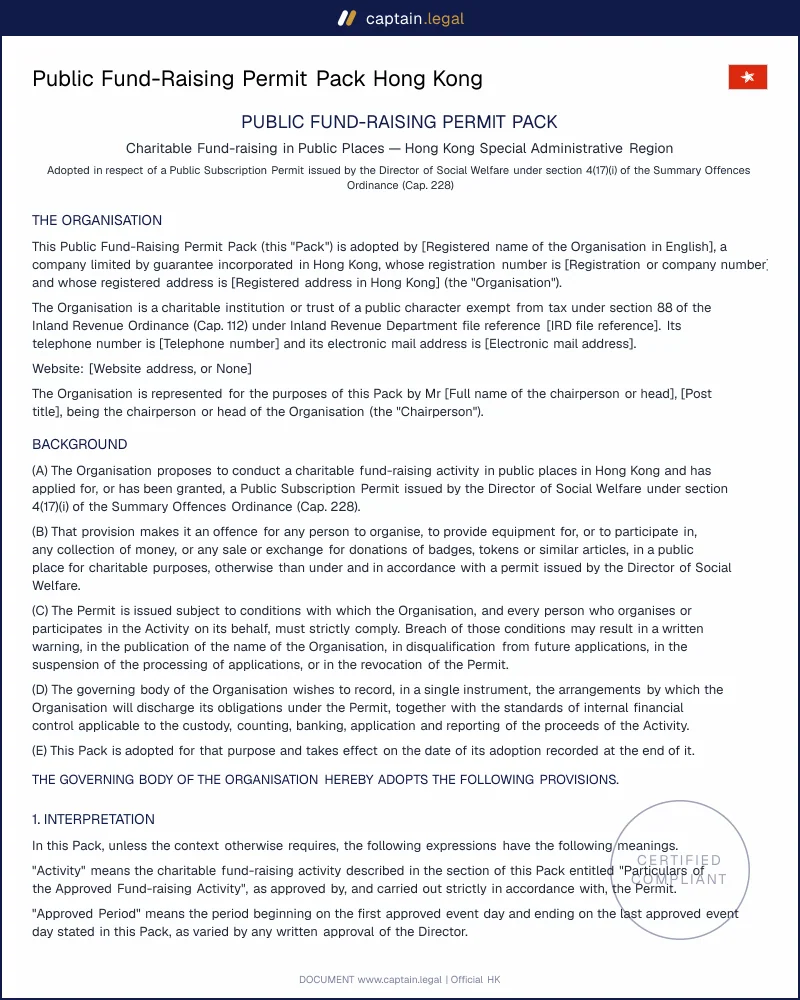
A public fund-raising permit pack is the bundle a Hong Kong charity builds around a single instrument: the Public Subscription Permit granted by the Director of Social Welfare. The permit authorises the collection. Everything else in the pack shows that the collection was run cleanly, from the accreditation letters carried by collectors to the sealed counting record and the income and expenditure account filed afterwards. Committees of registered societies, companies limited by guarantee and section 88 tax-exempt bodies use it whenever they intend to collect money, or sell flags, badges or tokens, in a public place. The permit takes months to obtain. The paperwork is what keeps it.
Compliant
2026 Legislation
50,000+ clients
trust us
Affordable
From $4.90 / doc
Secure payment
Instant download
Fund-Raising Permit HK: Collect Legally in Public Places
Secure payment
What is a public fund-raising permit pack?
The Public Subscription Permit, or PSP, is the permission required by section 4(17)(i) of the Summary Offences Ordinance (Cap. 228) before any person organises, supplies equipment for, or takes part in a collection of money, or a sale or exchange for donations of badges, tokens or similar articles, in a public place for charitable purposes. The Social Welfare Department issues three species of permit: for flag days, for general charitable fund-raising activities such as stationed donation counters, roving collection with bags, door-to-door appeals in public housing estates and charity sales, and for the solicitation of signed authorisation forms, covering face-to-face recruitment of donors who sign up to pay by autopay or credit card.
The pack is the private counterpart to that public instrument. No department issues it; the charity drafts it, and the department assumes it exists. The application form tells you what to send in, not how to run the collector authorisation letters, the numbered bag register, the counting certificate or the banking memorandum that the conditions take for granted. One distinction matters before you start. Where the funds are destined for a purpose that is not charitable, the permit comes from the Secretary for Home and Youth Affairs rather than the Director of Social Welfare. The constitutional documents behind that choice sit in our Hong Kong society constitutions and charity governance documents.
Legal framework
Everything begins with section 4(17)(i) of Cap. 228, a short provision that turns unpermitted street collection into a summary offence prosecutable by the Police. Eligibility is narrow. An applicant must be a charitable institution or trust of a public character exempt from tax under section 88 of the Inland Revenue Ordinance (Cap. 112), and must have organised charitable activities in each of the three years following that exemption by the closing date. The department also weighs integrity, management capability, financial position and any record of past non-compliance, which is why one late filing shadows an organisation for years. Guarantee companies should check that the objects clause in their articles of association for a company limited by guarantee still matches the purpose stated on the permit.
The permit conditions do the real work. Donations must be voluntary, nobody other than the designated beneficiary may take a benefit from the proceeds, and the funds may be applied only to the purpose written on the permit. Bags and boxes must be numbered and sealed, and collectors sign on issue and return. For flag days, expenses in connection with the flag day must not exceed ten percent of gross receipts. Proceeds reach the designated bank account within sixty days of the event or before the reviewing accountant starts work, whichever falls first. The income and expenditure account, reviewed by a practice unit within the meaning of section 2(1) of the Accounting and Financial Reporting Council Ordinance (Cap. 588) and reported on under Practice Note 850 of the Hong Kong Institute of Certified Public Accountants, reaches the Director within ninety days of the last event day and is then published on GovHK for twelve months. Permits also carry a revocation clause tied to national security. The Social Welfare Department guidance on public subscription permits and their conditions sets out the current forms and explanatory notes.
When do you need this document?
The clearest trigger is a flag day allocation. An organisation that succeeds in the annual ballot receives its permit around December for a date in the following financial year, and from that moment it runs a regulated operation with hundreds of volunteers, thousands of numbered bags and a selling window that closes at half past twelve. Preparing the control documents three weeks out is how committees improvise.
General charitable fund-raising is the second trigger and the most common. A donation counter in a shopping centre concourse, a district walked with collection bags, a charity ride, badges sold at a bazaar: each falls inside the permit regime once it happens in a public place. So does door-to-door collection in public housing estates, where residents may ask the collector for identification and to see the permit.
Two edge cases justify the extra paperwork. A collection held wholly on private premises with the owner's consent sits outside section 4(17)(i), but the boundary is thinner than committees assume: an MTR concourse and a civic centre are public places even though each has a landlord. And where the money will be spent outside Hong Kong, the accounts must be in Chinese and English, which changes the letter sent to the accountant.
Key clauses included in our template
- The permit application covering resolution records the committee decision to apply, names the officer authorised to sign, and states the charitable purpose in the words that will appear on the permit. Departments compare it against the objects in the constitution, and a mismatch is the commonest ground for a request for further information.
- The collector accreditation letter identifies the bearer, quotes the permit number and validity period, and instructs the collector to produce it on request. It is drafted alongside a letter of authorisation template built for Cap. 31 and PDPO practice, so it holds up when a police officer asks who the collector acts for.
- The bag and box control register lists every numbered bag or sealed box against the collector who signed for it, with the times of issue and return. It turns a vague loss into a traceable one, and the assurance provider asks for it first.
- The sealed counting record governs how bags are opened. Seals break only in the counting room, never on the street, with two named persons present and both signing the tally sheet against each bag number. Corrections are initialled and dated by the same two people, and a missing bag is reported to the department and the Police the same day.
- The banking memorandum links the counted total to the deposit slip and the designated account, and records the date the last of the proceeds was credited. It is the source of the note the conditions require in the accounts.
- The instruction letter to the reviewing accountant sets out the permit numbers, the event dates and the split between street collections and other appeals, and asks for a report under Practice Note 850. Sending this letter late is the single most frequent cause of a missed ninety-day deadline.
Regional and activity-specific considerations
Territory-wide and regional flag days work differently. One organisation sells across the whole territory on a territory-wide day, while on a regional day three sell concurrently, one each on Hong Kong Island, in Kowloon and in the New Territories. Regional permittees carry extra conditions: the approved region must appear on every piece of promotional material, including volunteer recruitment letters, with the prescribed message about the other two organisations selling that day. Colour and design of flags and bags need departmental approval, submitted at least four months ahead. Two charities that turn up with similar orange bags on the same Saturday will not both be approved, and priority follows the order of submission.
Public streets against government land changes the lead time. An application that touches no government land administered by the Lands Department must reach the department at least four weeks and not more than eight weeks before the activity starts. Where any part of it sits on Lands Department ground, the window moves to at least ten weeks and not more than sixteen, because the department applies for temporary occupation of government land on the applicant's behalf.
Public places that are not public streets, such as MTR stations, stadia and civic centres, need the permit plus the venue owner's written approval, whose conditions on volunteer numbers and positioning sit on top of the permit rather than replacing it.
Charity sales and lotteries pull in other regulators. On-street sale of goods may need a temporary hawker licence, or a waiver, from the Food and Environmental Hygiene Department, while a raffle is a lottery under section 22 of the Gambling Ordinance (Cap. 148) licensed by the Office of the Licensing Authority. Where an agency runs the appeal, its commercial terms belong in an independent contractor agreement for an outsourced fund-raising team rather than in the permit file.
How to fill out this public fund-raising permit pack
You start by choosing the permit type, because the pack branches from there: a flag day file, a general charitable fund-raising file, or a signed authorisation forms file. The template then asks for the registered name exactly as it appears on the section 88 approval letter, the permit number once issued, the beneficiary organisation where the appeal is run for another body, and the event dates and locations as approved. From those answers the accreditation letters generate in a consistent format, with the permit number carried across so no volunteer holds a letter contradicting it.
The counting documents come next. You set the number of bags and boxes and name the two persons who will witness each count, and the register and tally sheets adopt your numbering scheme. The final section prepares the accountant instruction letter and the note recording the banking date. Everything downloads in Word for adaptation and in PDF for signature.
Common mistakes to avoid
The classic error is treating the permit as the end of the exercise. A committee spends months on the application, wins the allocation, then hands volunteers unnumbered bags with no signature on issue and no record of return. When the assurance provider asks how the total was arrived at, there is nothing to show, and a qualified report reaches the department as fast as a clean one. The second recurring failure is the count: bags opened by one person in an office, seals broken on the way back from the street, tallies written in pencil and revised later. Two witnesses and a signed sheet per bag number settle that.
Timing accounts for the rest. Committees underestimate the ninety-day deadline, forget that proceeds must be banked within sixty days, and instruct an accountant who is not a practice unit under Cap. 588. Late filing brings graded warnings, publication of the organisation's name on the departmental website for at least six months, disqualification from future permits, and revocation of permits already issued. An organisation that misses the deadline once should assume the next application will be scrutinised. Where a declaration of fact is needed to close a gap in the records, use a statutory declaration in the jurat form required by Cap. 11 rather than an unsworn letter.
Frequently Asked Questions
23 verified reviews · 50 000+ downloads
- Immediate access to the document
- PDF + Word download
- Compliant with 2026 legislation
- Reviewed by lawyers
You might also like