Business & Incorporation

Partnership Agreement HK: Cap. 38 ss. 26, 27 and 35

Partnership agreement aligned with Cap. 38, sections 26, 27 and 35, plus business registration under Cap. 310. Reviewed for Hong Kong practice.
4.7/518 reviews50 000+ downloadsInstant download
Share

A partnership agreement is the private contract that two or more people sign before they carry on a business in common with a view of profit in Hong Kong. It fixes who contributes what, how profits are divided, who can sign for the firm, and what happens when a partner joins, retires or dies. Skip it and the Partnership Ordinance (Cap. 38) fills every gap with defaults most founders would never have chosen: equal profit shares whatever the capital, no salary for the partner running the business day to day, and dissolution of the whole firm the moment one partner gives notice. This template is drafted for Hong Kong general partnerships registered with the Inland Revenue Department, and downloads in Word and PDF.

Compliant

2026 Legislation

50,000+ clients

trust us

Affordable

From $4.90 / doc

Secure payment

Instant download

Partnership Agreement HK: Cap. 38 ss. 26, 27 and 35

Secure payment

Fill in the template

What is a partnership agreement in Hong Kong?

Section 3(1) of the Partnership Ordinance (Cap. 38) treats a partnership as the relation that exists between persons carrying on a business in common with a view of profit. Nothing else is needed: no filing at the Companies Registry, no minimum capital, no written instrument, not even a conscious decision to become partners. Two people who share the profits of a venture can find themselves in partnership by conduct alone, because section 4 makes receipt of a share of profits prima facie evidence of the relationship. The partners collectively are the firm under section 6, but the firm is not a separate legal person: it sues and is sued through the partners, and each partner is personally exposed to every liability it incurs.

The partnership agreement overrides those defaults. It is not a shareholders agreement, which regulates the owners of a company incorporated under the Companies Ordinance (Cap. 622) and sits alongside articles of association; both routes are compared in our business and incorporation documents for Hong Kong. It is equally distinct from a limited partnership registered under the Limited Partnerships Ordinance (Cap. 37) and from the limited liability partnership that only solicitors may use under the Legal Practitioners Ordinance (Cap. 159). A general partnership agreement does not cap anyone's liability, whatever the drafting says. It allocates money, control and exit rights between the partners; the outside world still sees people jointly liable for the firm's debts.

2

When do you need this document?

Two professionals opening a consultancy, a design studio or an accounting practice are the classic case. They put in unequal money, expect unequal time, and want the split to reflect that rather than the flat equality of section 26(a). The second recurring scenario is the food and beverage venture where one partner funds the fit out and the other runs the kitchen: without a written agreement the operating partner draws no salary, and the investor holds an equal vote on every operational decision. Family trading businesses run on a handshake for years form a third group, formalising when a second generation joins or when a bank asks for papers.

Corporate partners are common too. Two Hong Kong companies pooling resources for a single project often prefer a partnership to a joint venture company because it avoids incorporation. Watch the premises there, since the lease is normally taken by individual partners or by one company, and the terms in our Hong Kong tenancy and commercial lease templates must align with the partnership's own term.

Two edge cases justify getting this on paper early. The silent investor taking a percentage of turnover rather than a fixed return may be treated as a partner under section 4, with unlimited liability attached, and only clear drafting rebuts that presumption. The other is conversion of a sole proprietorship, where the incoming partner needs section 19(1) protection recorded explicitly.

3

Key clauses included in our template

  • The identification of the partners and the firm records each partner's name and identity document reference alongside the trading name on the business registration certificate. Where a company joins, the agreement names the corporate entity and the individual authorised to act for it.
  • The capital contributions and capital accounts clause separates true capital from loans. The distinction matters because section 26(c) awards 8 per cent annual interest on advances beyond agreed capital, and section 46 repays advances ahead of capital on a winding up.
  • The profit and loss sharing clause replaces the equal split imposed by section 26(a) with agreed percentages, and deals separately with losses, which need not follow the profit ratio. Drawings and retained working capital are settled here rather than argued at year end.
  • The management and remuneration clause fixes which decisions a managing partner takes alone, which need a majority and which need unanimity. It sets any partner salary, since section 26(f) gives a working partner nothing unless the agreement says otherwise, and it addresses deadlock in a two partner firm.
  • The admission, retirement and expulsion provisions give partners what Cap. 38 withholds. Under section 27 no majority can expel a partner unless that power was expressly agreed in advance, and section 28 lets any partner in a partnership at will dissolve the firm by notice. The template substitutes a notice period, a buy out mechanism and a valuation method.
  • The confidentiality and non-compete clause builds on sections 30, 31 and 32, which require partners to render true accounts and account for private profits and for the proceeds of a competing business. The drafted version adds a defined restricted period and a client non-solicitation covenant.
  • The dissolution and continuation clause is the one partners regret omitting. Section 35(1) dissolves the whole partnership on the death or bankruptcy of any partner, so the template adds a continuation mechanism, a settlement order consistent with section 46, and a process for realising partnership property under section 41.
4

Registration, tax and sector considerations

Business registration comes first in practice. The Inland Revenue Department issues the certificate under Cap. 310, and the particulars must be kept current: a change of partners, firm name or business address is notifiable within one month. The certificate is displayed at the place of business and renewed on its cycle. The Companies Ordinance (Cap. 622) also caps a partnership carrying on business for gain at twenty partners, and a venture pursuing charitable aims falls outside section 3(1) of Cap. 38 altogether, which is why societies and guarantee companies sit in our Hong Kong non-profit and association documents.

Profits tax follows a distinctive route. Under section 22 of the Inland Revenue Ordinance (Cap. 112) the firm is assessed in one lump sum rather than partner by partner, the precedent partner files the return on Form BIR52, and the first tranche of assessable profits is charged at half the standard unincorporated rate under the two tiered regime. All partners are jointly and severally liable for the firm's tax, so the partner who never touched the books is still exposed if the precedent partner disappears. The agreement should say who prepares the accounts, who signs the return and how an assessment is funded.

Licensed trades need extra care. A restaurant licence from the Food and Environmental Hygiene Department or a licence under the Money Lenders Ordinance (Cap. 163) is issued to named holders, so a change of partner can require a fresh application. Where the aim is passive investment, the limited partnership under Cap. 37 may fit better, since a limited partner keeps limited liability only while staying out of management. Contributions of property carry their own trap: transferring Hong Kong immovable property into the firm can trigger duty under the Stamp Duty Ordinance (Cap. 117), and succession to a deceased partner's share belongs with the will drafted from our Hong Kong personal and family document templates.

5

How to fill out this partnership agreement

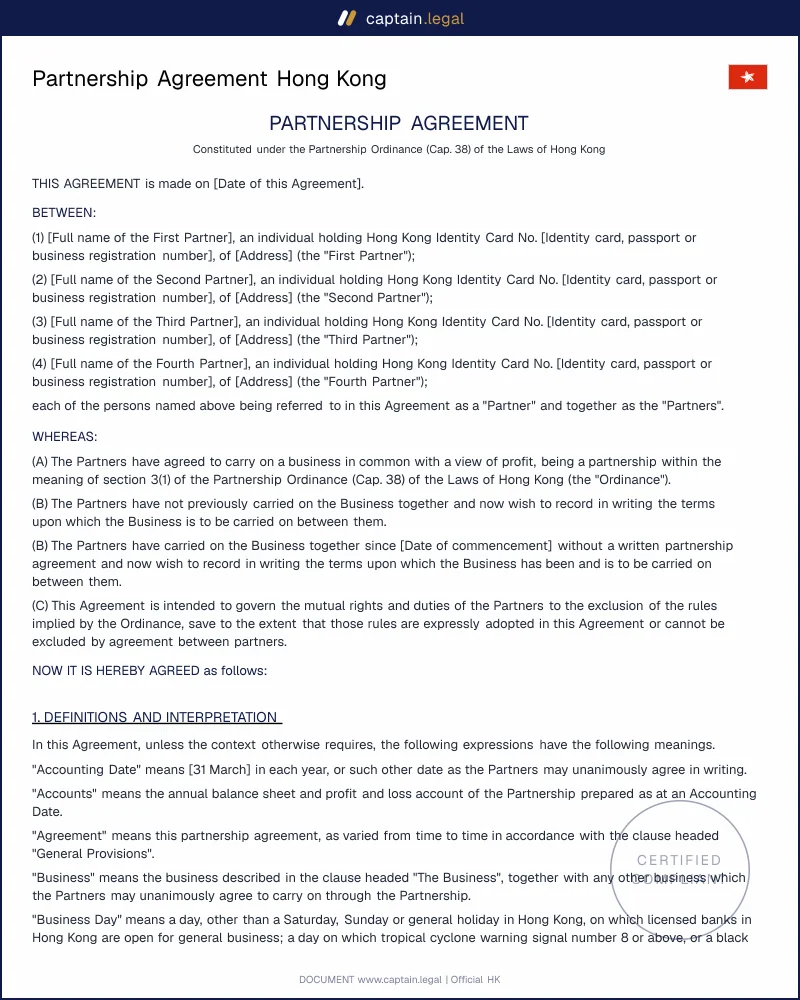
You begin by choosing whether the partnership runs for a fixed term, for a single venture, or at will with no end date, because that one choice changes the dissolution mechanics under section 34. The form then asks for each partner's details and, where a company joins, its Hong Kong company number and signatory. Capital contributions come next, split between cash, assets and services, with a separate field for money advanced as a loan so the 8 per cent statutory interest never applies by accident.

The questionnaire then moves to economics: profit percentages, loss percentages, drawings and any management salary. Governance follows, with thresholds for trading decisions, capital expenditure, borrowing and admission of a partner. The exit section covers notice periods for retirement, expulsion grounds, the valuation formula for an outgoing share and whether the survivors continue after a death. You review the assembled draft, adjust the wording, then download it in Word to keep editing or in PDF for signature. Each partner signs, and the original stays at the firm's principal place of business, where section 26(i) says the partnership books belong.

6

Common mistakes to avoid

The most expensive mistake is lifting a precedent from another jurisdiction. English and Singapore partnership statutes descend from the same 1890 Act, so the drafting looks familiar, but the numbering differs: the default rules sitting at section 24 there sit at section 26 in Hong Kong. An agreement cross referring to the wrong provision is not void, though it invites argument about what the partners intended. The second recurring error is treating capital and loans as one thing, which hands the funding partner 8 per cent statutory interest under section 26(c) and reorders the payout queue under section 46. The third is silence on expulsion: partners assume a majority can remove a defaulting colleague, and section 27 says the opposite unless the power was agreed in advance.

Two more mistakes surface at the end of the relationship. Partners forget that section 35(1) dissolves the firm automatically on a death or bankruptcy, which can strand a lease, a licence or a half finished contract at the worst moment. And retiring partners walk away without notifying the Inland Revenue Department and the firm's regular counterparties. A retiring partner who lets the market keep treating him as a partner can be fixed with liability for debts incurred after he left, and the cure is simple: update the business registration particulars and write to every supplier and bank.

Key takeaways

DEFAULT RULES

Without an agreement, Cap. 38 decides

If you start trading together and share profits, you can become partners by conduct under the Partnership Ordinance (Cap. 38) ss. 3(1) and 4, even without paperwork. If you have no agreement, the statutory defaults in s. 26 apply: equal profit and loss sharing regardless of capital, no remuneration for a working partner (s. 26(f)), and 8% annual interest on extra advances (s. 26(c)).

LIABILITY

One partner can bind everyone

A general partnership does not cap liability, whatever the document says. Under Cap. 38 s. 7, each partner is an agent of the firm, so a signature in the usual course of business can commit all partners. Liability is personal: partners are jointly liable for debts (s. 11) and may be jointly and severally liable for wrongful acts in the ordinary course (ss. 12 and 14).

OPERATIONS

Control, new partners, and exit mechanics

Your agreement should spell out who can sign, how decisions are made, and what happens on entry or exit, because Cap. 38 sets blunt baselines. Ordinary matters are decided by majority, but changing the nature of the business or admitting a partner requires unanimity. Limits on a partner’s authority only protect you against a counterparty who knows the restriction (s. 10), so internal rules need practical implementation, not just drafting.

Frequently Asked Questions

Yes. It is an ordinary contract under Hong Kong common law, and section 21 of the Partnership Ordinance (Cap. 38) expressly allows partners to vary the statutory default rules by agreement. It needs no witness, no notarisation and no filing to take effect between the partners. What matters is signature by every partner, since a term agreed by only some cannot bind the rest. The limit worth knowing is that it operates internally: it cannot reduce the joint liability that sections 11 and 14 impose towards third parties.

No. Unlike a company's articles of association, a partnership agreement stays private and is never filed with the Companies Registry. What must be registered is the business itself. Section 5 of the Business Registration Ordinance (Cap. 310) requires application to the Business Registration Office within one month of starting business, on Form 1(c), with identity documents for every partner. Keep the two apart: the certificate proves the business is registered, the agreement proves what the partners agreed.

Both formats come with the document. The Word file is the practical choice when your accountant or solicitor wants to adjust a valuation formula or add a sector specific clause, and the PDF is what you circulate for signature and keep with the firm's records. You can return later for a revised version when partners change, which is exactly when a firm needs fresh paperwork rather than an amended photocopy. Other Hong Kong contracts that pair with it sit in our full catalogue of Hong Kong legal document templates.

That depends on what the agreement says. In a partnership at will with no fixed term, section 28 lets any partner dissolve the whole firm by notice to the others, effective from the date stated in the notice or, if none is stated, from the date it is communicated. There is no statutory minimum, so a partner can in theory end the business overnight. Where the partnership was constituted by deed, written notice signed by the retiring partner is enough. A drafted agreement replaces this with a notice period of several months plus a buy out.

Without a contrary agreement, section 35(1) dissolves the partnership automatically on the death or bankruptcy of any partner, even in a firm of five where four wish to continue. The survivors move into winding up: partnership property goes to the firm's debts under section 41, and accounts are settled in the order set by section 46, outside creditors first, then partner advances, then capital, with only the surplus divided in profit sharing proportions. A continuation clause avoids that by letting the survivors buy the deceased partner's share at an agreed valuation.

Yes, because the two answer different questions. The certificate tells the Inland Revenue Department and the public that a business exists and who its partners are. It says nothing about profit shares, decision rights, capital, salaries, expulsion or what an outgoing partner receives. Absent a written agreement those points default to section 26 of Cap. 38, which splits profits equally regardless of contribution and pays a working partner nothing. Most Hong Kong partnership disputes turn on exactly those gaps.

4.7/5

18 verified reviews · 50 000+ downloads

Partnership Agreement HK: Cap. 38 ss. 26, 27 and 35
  • Immediate access to the document
  • PDF + Word download
  • Compliant with 2026 legislation
  • Reviewed by lawyers
Fill in the template
Secure payment
Updated on September 1, 2026

You might also like

Founders Agreement HK
Significant Controllers Register HK