Personal & Family

Deed Poll HK: Name Change, Form ROP 73 and Cap. 177

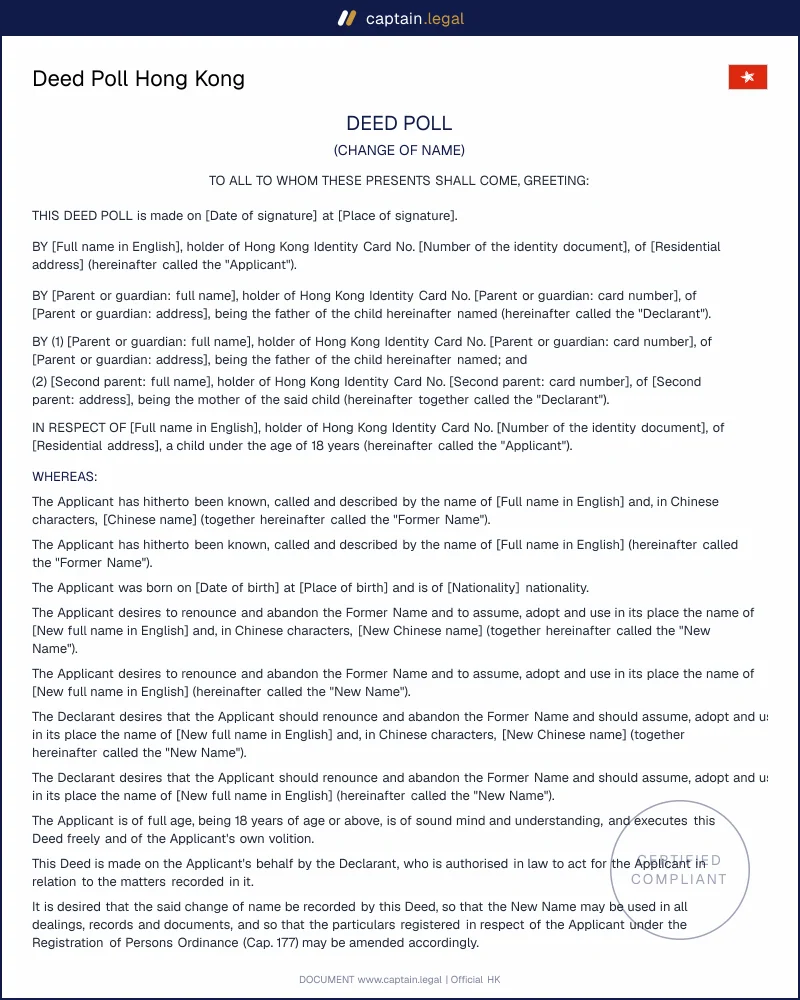
Deed poll drafted to Hong Kong practice: executed as a deed under Cap. 219 and accepted with Form ROP 73 to amend HKID particulars. Word and PDF.
4.8/526 reviews50 000+ downloadsInstant download
Share

A deed poll is the short instrument a Hong Kong resident signs to abandon a former name and adopt a new one, and it is the document the Immigration Department expects to see before it will amend the name printed on an HKID. This change of name deed poll is drafted to be signed in front of a Hong Kong solicitor and lodged with a Form ROP 73 application at any Registration of Persons Office. It covers English names, Chinese characters, added or deleted given names and changes of romanisation, for an adult acting alone or for parents acting for a child.

Compliant

2026 Legislation

50,000+ clients

trust us

Affordable

From $4.90 / doc

Secure payment

Instant download

Deed Poll HK: Name Change, Form ROP 73 and Cap. 177

Secure payment

Fill in the template

What is a deed poll in Hong Kong?

A deed poll is a unilateral deed: one party makes promises and nobody signs on the other side. In the change of name context it records three declarations. You renounce and abandon your former name, you assume and adopt the new one for all purposes, and you authorise and require everybody to address you by the new name alone. Nothing more is needed, because Hong Kong follows the common law position that a person may take any name at will, provided the purpose is honest.

The confusion starts with what the deed does not do. It is not a court order and it does not create your new name. It evidences a change that has already happened in law, which is why banks and government departments accept it: they want one dated, witnessed page tying the old identity to the new one. That separates it from a statutory declaration under the Oaths and Declarations Ordinance (Cap. 11), which swears to the truth of a fact rather than effecting an intention. Nor is it an alteration of the birth register. The related instruments sit in our Hong Kong personal and family document templates.

2

When do you need a change of name deed poll?

The commonest situation has nothing dramatic about it. An adult has used an English given name at school and at work for twenty years, but the HKID carries only the Chinese characters and their romanisation. Adding Jonathan in front of Chan Tai Man requires a deed, because a registration officer cannot enter a name that no document supports. Close behind is the reverse case, a different romanisation of the same characters, usually to match a spouse's spelling or a pinyin form used on a mainland passport.

Family events supply the next tranche. After a divorce, a spouse who took the husband's surname socially wants the card to revert, and the marriage certificate proves nothing about that return. Parents come in when a child has passed eleven and the birth entry is closed to them. Both parents must consent to a change of a legitimate child's surname, and that stays true after divorce and after sole custody has been granted, which surprises a great many applicants.

One edge case derails more applications than any other: non-permanent residents are generally expected to change their name in their home jurisdiction first, and a Hong Kong deed alone rarely moves that file. Owners updating title paperwork will find what they need in our Hong Kong tenancy and property document templates.

3

Key clauses included in our template

  • The full recital of the former name reproduces the name exactly as it appears on the HKID, including the Chinese characters, the romanisation and any second given name. Officers compare the two character by character, and wording that reads Chan Tai Man where the card reads CHAN Tai-man invites a query.
  • The renunciation clause states that the declarant absolutely renounces, relinquishes and abandons the former name and undertakes on all occasions to use and subscribe the new one. That triple wording is the traditional Hong Kong formula, and it makes the instrument a deed poll rather than a bare statement of intention.
  • The authorisation clause requires all persons to designate, describe and address the declarant by the new name alone. Banks and pension trustees rely on that sentence when they update a mandate.
  • The execution and attestation block describes the instrument as a deed, records that it has been signed, sealed and delivered, and lays out space for the witnessing solicitor. A block missing the solicitor's firm address is the commonest reason a deed is sent back.
  • The parental consent block, used only for a minor, identifies both parents with their HKID numbers, states the custody position and records that each consents in the interests of the child.
  • The certified copy endorsement supplies the wording a solicitor or notary uses to certify a true copy, which you need because several institutions keep what they are given.
4

Updating your records after signing

The deed is the first hour of the process, not the whole of it. Everything in Hong Kong hangs off the HKID, so the Form ROP 73 application goes in first, by post, by fax, in person at a Registration of Persons Office or through the Immigration Department website. You bring the original deed to the interview rather than a copy, and a replacement card is arranged if the application is approved. Only when the new card is in your hand does the rest become straightforward.

The HKSAR passport follows, and an amendment of particulars generally has to be made in person rather than at a self service kiosk. The Home Return Permit is handled by China Travel Service on its own requirements, so allow separate time. Banks, the Mandatory Provident Fund trustee and the Inland Revenue Department come next, each usually satisfied by the new card plus a certified copy. Keep the original deed for life. A name change does not affect ownership of property, but the assignment at the Land Registry still carries the old name and a purchaser's solicitor will raise a requisition on it years later.

Directors and shareholders should notify the Companies Registry, and the resolutions sit with our Hong Kong company and incorporation paperwork. Office bearers of a registered society will find the equivalent records in our Hong Kong society and charity governance documents, and staff file amendments belong with our Hong Kong employment and HR templates.

5

How to fill out this deed poll

You begin by telling the form whether the deed is for an adult or a child, because that single answer changes the parties, the consent block and the signature panel. It then asks for the former name in both scripts, transcribed from the HKID rather than from memory, and for the new name in the exact form you want printed on the card. Chinese characters are entered as characters; no commercial code is required, since the Immigration Department assigns it.

Where a minor is involved, the form collects both parents' particulars and asks about custody, and it will not let you finish a surname change with only one parent named. The date is left blank on purpose, because it should be dated on the day the solicitor watches you sign it. You then print the file single sided and take it unsigned to your solicitor with your HKID. He witnesses the signature, completes the attestation, and certifies the copies you will need for the banks.

6

Common mistakes to avoid

The mistake that costs the most time is signing at home. A deed executed in the kitchen and shown to a solicitor afterwards has not been witnessed, and no goodwill fixes it; the deed has to be signed again. Almost as common is the mismatch between deed and card, usually a hyphen, a capitalised surname or a missing given name, each of which stops the application at the interview. A third error is treating the deed as sufficient on its own: people change a bank mandate on the strength of it, then find the account name no longer matches the HKID. Do the identity card first, always.

Parents make a distinct set of errors. They assume sole custody carries the right to change a legitimate child's surname unilaterally, and it does not. They also assume the birth certificate will follow, when the birth entry closes at eleven and stays closed. The last mistake belongs to everybody: keeping one original and no certified copies. Several institutions retain what you hand over, so leave the solicitor's office with copies already certified.

Key takeaways

HKID UPDATE

Deed poll plus Form ROP 73

A Hong Kong deed poll is the document the Immigration Department expects before it will amend the name shown on your HKID. In practice you sign it before a Hong Kong solicitor, then lodge it with Form ROP 73 at a Registration of Persons Office under the Registration of Persons Ordinance (Cap. 177) and Regulations (Cap. 177A). Be ready to attend with originals when called.

LEGAL STATUS

It records a change, not creates it

A change of name deed poll is a unilateral deed: you renounce the old name, adopt the new one for all purposes, and require others to use it. It is not a court order and it does not alter the birth register; it simply evidences a lawful change recognised at common law. It also differs from a statutory declaration under the Oaths and Declarations Ordinance (Cap. 11).

RISK

False identity details can be criminal

Name changes are assessed through the HKID system, and the Commissioner of Registration (the Director of Immigration) can ask for supporting evidence, including a statutory declaration before a registration officer. Supplying false information to obtain an identity card is a criminal offence, so a solicitor may refuse to witness a deed poll where the circumstances suggest an improper purpose, such as choosing a name to avoid a creditor.

Frequently Asked Questions

Yes, provided it is executed properly. Hong Kong law lets you adopt any name honestly, and the deed evidences that decision in the form the Conveyancing and Property Ordinance (Cap. 219) recognises: an instrument that describes itself as a deed, is signed by you and is delivered. What makes it work in practice is the attestation. Once a solicitor has witnessed your signature and completed the block with his firm details, the Registration of Persons Office and the banks treat it as proof.

In strict theory no, because the sealing and delivery presumptions in Cap. 219 do the heavy lifting. In practice yes. Every institution asked to act on the deed expects a solicitor's attestation, and a registration officer confronted with a deed witnessed by a colleague or a relative will normally refuse it.

Yes, in both formats. The Word version matters more than people expect, because a solicitor occasionally wants a line adjusted before witnessing and because parents sometimes bring two children to one appointment. Print it single sided on white A4, since some offices retain the original. Anything else you need sits in the full catalogue of Hong Kong legal document templates.

The deed itself takes minutes at the solicitor's office. The card is slower. After you submit Form ROP 73 with copies of the supporting documents, the office calls you in to produce the originals, and a replacement card is arranged only if the application is approved. Allow several weeks from submission to collection, and longer if you are also amending your passport and Home Return Permit.

Yes, and it is the usual route once a child has passed eleven, because the birth entry can no longer be altered then. The deed is signed by the parents rather than the child, and both parents must consent to any change of a legitimate child's surname, whether or not they are divorced and whether or not one holds sole custody. Where the parents disagree, the welfare principle in the Guardianship of Minors Ordinance (Cap. 13) decides it.

No. The Hong Kong birth register records the facts as they stood at registration and is not rewritten because you changed your name later. Parents may apply to a births registry to add or alter a child's name, but no alteration may be made once the child has reached eleven. For an adult applicant the birth certificate keeps the original name permanently, and the deed becomes the link between the two.

Yes. Permanent residents abroad execute the deed before a notary public in their country of residence, and an apostille is worth obtaining even where nobody has asked for it. The application to amend the identity card can then be submitted from overseas.

4.8/5

26 verified reviews · 50 000+ downloads

Deed Poll HK: Name Change, Form ROP 73 and Cap. 177
  • Immediate access to the document
  • PDF + Word download
  • Compliant with 2026 legislation
  • Reviewed by lawyers
Fill in the template
Secure payment
Updated on August 19, 2026

You might also like

Enduring Power of Attorney Hong Kong
Loan Agreement Between Individuals Hong Kong