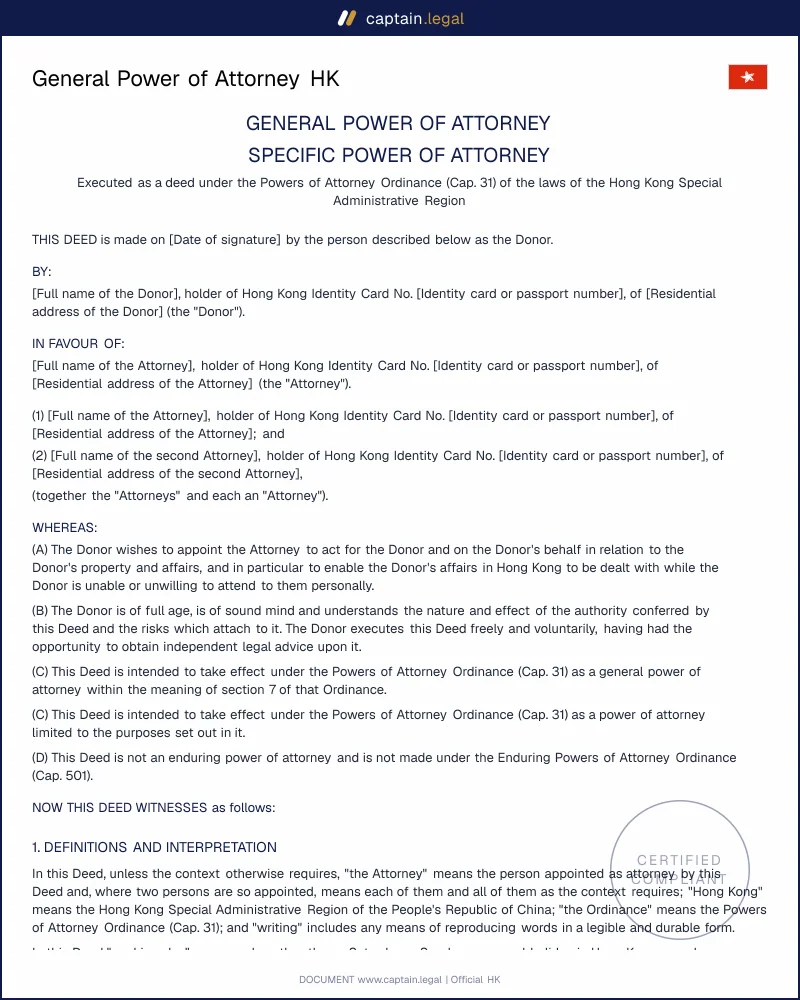
Execution is where most powers fail. The deed is signed in wet ink, sealed and delivered, and while Cap. 31 does not force a witness where the donor signs personally, Law Society guidance and conveyancing practice make an attesting witness the norm. Never let the appointed attorney, or the attorney's spouse, act as the witness. A bank or a purchaser's solicitor will treat the deed as tainted and ask for a fresh one.
Donors who sign overseas need a second layer. The practical standard is signature before a notary public in the country of residence, followed by an apostille under the Hague Apostille Convention where that country is a party, a system Hong Kong applies through the High Court. Local banks rarely accept a foreign deed with no notarisation at all. Build in three to six weeks for notarisation, apostille and courier before the date your attorney actually needs to sign.
Institutions then add their own step. HSBC, Bank of China and Hang Seng each register a power internally before the attorney may operate an account, asking for the original or a copy certified by a Hong Kong solicitor under section 3. Where the power touches land, the deed is registered at the Land Registry against the property under the Land Registration Ordinance (Cap. 128), within one month of execution to preserve priority from the date of the deed. Companies follow another route, executing under sections 127 and 128 of the Companies Ordinance (Cap. 622) with a board resolution behind it, using the paperwork in our Hong Kong business and incorporation documents.