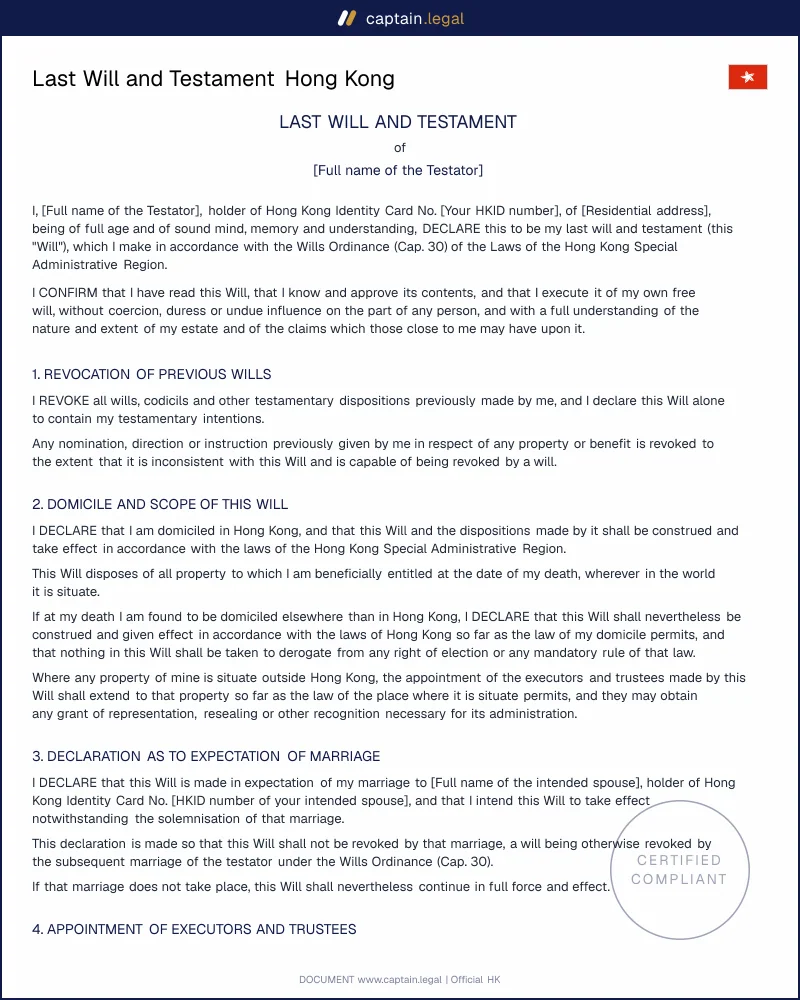
Section 5(1) of the Wills Ordinance (Cap. 30) sets the formalities, and they are unforgiving. The document must be in writing and signed by the testator, or by another person in the testator's presence and at their direction; the signature must be intended to give effect to the will; it must be made or acknowledged before two or more witnesses present at the same time; and each witness must then sign in the testator's presence. No form of attestation is prescribed, yet a proper attestation clause is standard practice, because without one the Probate Registry usually calls for an affidavit of due execution before issuing the grant. Section 5(2) lets the court admit a document embodying testamentary intentions despite defective execution, as in Choi Cheung Hung v Leung Fung Ha [2023] HKCFI 2822. That route means contested proceedings, so it is a rescue, never a plan.
Witnesses and revocation take up the rest. Section 10(1) voids any gift to an attesting witness or that witness's spouse while leaving the will valid, which is why both witnesses must be independent of every beneficiary; section 12 confirms an executor may witness. A later will, a written revocation executed with the same formalities or deliberate destruction revokes an earlier will under section 13, and marriage revokes it unless it was made in contemplation of that marriage to a named person under section 14.
Administration sits outside Cap. 30. The Probate and Administration Ordinance (Cap. 10) governs the grant issued by the Probate Registry, and a spouse, child, cohabitant or dependant left without reasonable provision may claim under the Inheritance (Provision for Family and Dependants) Ordinance (Cap. 481). Estate duty was abolished for deaths on or after 11 February 2006, so a Hong Kong estate carries no death tax. The full text of the Wills Ordinance (Cap. 30) on the Hong Kong e-Legislation database sets out each provision in English and Chinese.