Employment & HR

Mutual Separation Agreement HK: Cap. 57 s.70 Deed

Separation deed drafted to the Employment Ordinance (Cap. 57). Section 70 release, seven day payment rule under section 25 and post 2025 MPF offsetting.
4.9/518 reviews50 000+ downloadsInstant download
Share

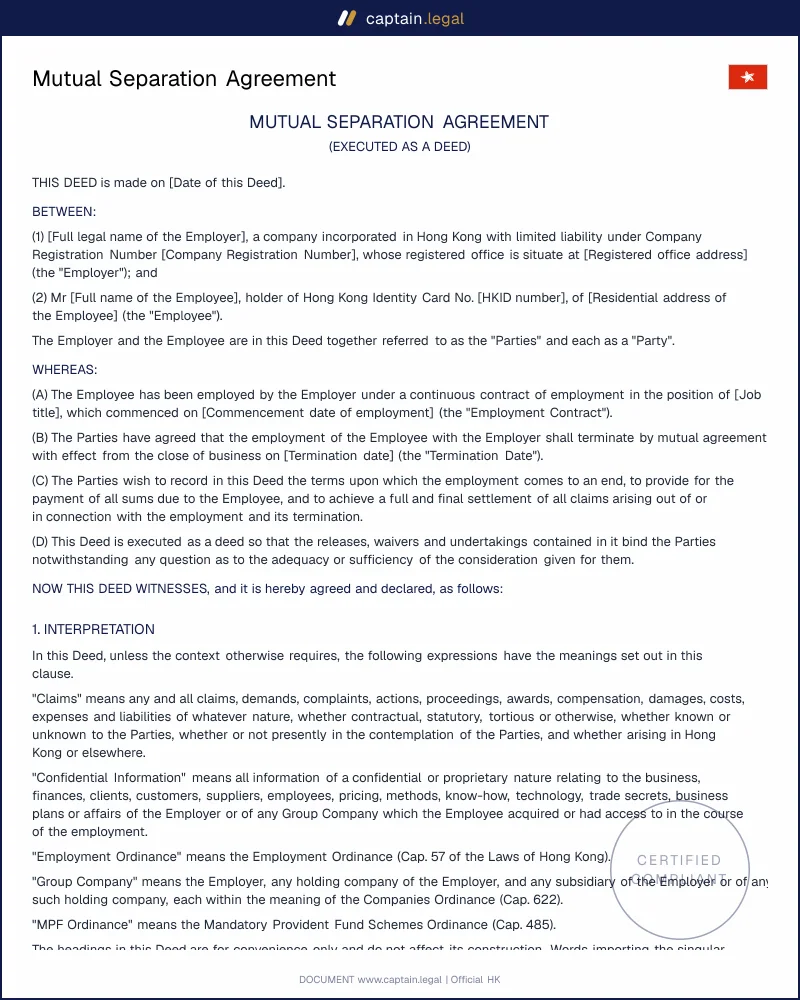
A mutual separation agreement is the document a Hong Kong employer and employee sign when they end the employment relationship by agreement rather than by notice, dismissal or resignation. Executed as a deed, it fixes the last day of employment, records the ex gratia payment made on top of statutory entitlements, releases the employer from claims before the Labour Tribunal, and settles the return of company property, share awards and MPF accrued benefits. HR managers, in-house counsel and departing senior staff use it to close a file cleanly instead of exchanging letters for months. The template is drafted to the Employment Ordinance (Cap. 57) and current Labour Department practice, and downloads as an editable Word file and a print ready PDF.

Compliant

2026 Legislation

50,000+ clients

trust us

Affordable

From $4.90 / doc

Secure payment

Instant download

Mutual Separation Agreement HK: Cap. 57 s.70 Deed

Secure payment

Fill in the template

What is a mutual separation agreement in Hong Kong?

It is a bilateral contract, usually executed as a deed, under which employment ends on an agreed date and the employee gives a full and final release of claims in exchange for a payment beyond what the law already requires. Practitioners here also call it a separation deed. The label matters less than the mechanics: the employer buys certainty, the employee takes a known sum now rather than an uncertain claim in eighteen months.

Two neighbouring documents get confused with it. A termination letter is unilateral, gives notice under section 6 or section 7 of the Employment Ordinance and settles nothing. A receipt for final payments, the short acknowledgement HR slides across the desk on the last day, is not a release at all; the Court of First Instance made that plain in Dock Brian v Pacific Gourmet Holdings, where an employee who had signed a confirmation that nothing further was owing still ran his statutory claims. The separation deed sits before both, and its value lies in being negotiated at the point of departure rather than buried in the contract of employment.

2

When do you need this document?

Restructuring is the commonest trigger. A team is cut, the roles are genuinely redundant, and the employer would rather pay a premium over the severance payment than defend a selection exercise two years later. Second is the performance exit, where a manager has lost confidence in an employee whose file will not support a defensible dismissal. Hong Kong has no general unfair dismissal regime, but an employee with twenty four months of continuous service can seek remedies for unreasonable dismissal under Part VIA, and that prospect is usually what funds the ex gratia number. Senior departures form a third group, where the real negotiation is the announcement wording, the reference and the restrictive covenants, all of which the deed carries at once alongside the other Hong Kong employment and HR document templates a company keeps on file.

Two edge cases trap employers who move fast. An employee on a paid sickness day cannot be terminated by notice under section 33(4B), and a pregnant employee who has given notice of pregnancy is protected by section 15. A negotiated exit is one of the few clean routes out, but the file must show the employee freely accepted the terms and had a real chance to take advice.

3

Key clauses included in our template

  • The identification of the parties and the separation date names the employing entity as registered, not the group brand, and states whether the last day is worked, spent on garden leave or bought out. Secondees need both entities named, since the release binds only the parties to the deed.
  • The schedule of statutory entitlements itemises wages to the last day, pro rata annual leave pay, any end of year payment, payment in lieu of notice and, where applicable, severance or long service payment. Keeping these apart from the ex gratia sum preserves the consideration for the release.
  • The ex gratia payment is expressed as compensation for loss of office and for the abrogation of the employee's contractual rights, with the payment date inside the statutory seven day window. That characterisation is not cosmetic, since the Inland Revenue Department reads both the wording and the surrounding facts.
  • The full and final release covers claims arising from the employment and its termination, whether before the Labour Tribunal, the Minor Employment Claims Adjudication Board or the courts, with express carve outs for accrued MPF benefits, employees' compensation for an injury already sustained and anything that cannot lawfully be released.
  • The return of property and confidentiality clause lists devices, access cards, keys and customer records, and requires deletion of company data from personal equipment. Where the employee occupies a company let flat, cross refer the surrender date to the tenancy documents drafted for Hong Kong property practice.
  • The equity, benefits and reference provisions state what happens to vested and unvested awards, when medical cover ends, and what the company says if a future employer calls. Group level awards sit under separate plan documents, which is why the deed is read against the shareholders and commercial agreements used by Hong Kong companies.
4

Sector considerations

Financial services employers carry a regulatory layer the deed cannot displace. A licensed corporation must tell the Securities and Futures Commission that a representative has ceased to be accredited, and the reason given has to be accurate. No separation deed can validly require an employer to withhold from a regulator a reason it is obliged to report. Banks face the parallel position with the Hong Kong Monetary Authority, where an agreed neutral reference cannot be stretched into a false one.

Listed companies have a disclosure problem before a drafting problem. A director's departure triggers announcement obligations under the Listing Rules, so the deed and the announcement are produced together, the deed carrying an agreed form of words and an undertaking not to depart from it.

Charities and NGOs terminate on tighter budgets and with more governance sensitivity, since an ex gratia payment to a departing chief executive may need board approval and will attract questions from funders. Trace the authority to sign through the constitution held with the society and charity governance documents.

Retail and catering employers should recheck continuous contract status first. Since 18 January 2026 the Employment (Amendment) Ordinance 2025 replaced the four weeks and eighteen hours test with a seventeen hour weekly threshold plus an alternative aggregate of sixty eight hours over four weeks, so part-time staff previously outside the statutory benefits may now be inside them.

Foreign nationals raise immigration and tax questions together. An employment visa under the Immigration Ordinance (Cap. 115) is tied to the sponsoring employer, so record the last day for immigration purposes and who notifies the Immigration Department. Where the employee leaves Hong Kong, the employer files Form IR56G one month before departure and, under section 52(7) of the Inland Revenue Ordinance (Cap. 112), withholds payments for one month from filing. That withholding obligation collides with the seven day payment rule, so the deed needs a clause reconciling the two.

5

How to fill out this mutual separation agreement

You start by identifying the employing entity and confirming whether the employee is on a continuous contract, because that answer drives the whole statutory schedule. The form then asks for the separation date and how notice is handled, and adjusts the payment provisions. Next comes the entitlement schedule, with the MPF position recorded separately so the pre and post transition split stays visible. The ex gratia figure goes in its own clause with its own rationale.

From there the document moves through the release, the carve outs, confidentiality, return of property, references and the announcement. Restrictive covenants are optional and belong in only where there is a legitimate proprietary interest to protect. Signature is the last step and the one people rush. An individual signs before a witness who attests, following Law Society practice, and the company signs under sections 127 and 128 of the Companies Ordinance, the same formalities you meet in Hong Kong powers of attorney and statutory declarations.

6

Common mistakes to avoid

The most expensive mistake is treating the statutory entitlements as the price of the release. An employee who receives only what was already owed has given a release for nothing, and the Tribunal will hear the claim anyway. Close behind sits the over broad release. Employees' compensation for an injury sustained during employment cannot be signed away under the Employees' Compensation Ordinance (Cap. 282), accrued MPF benefits belong to the employee, and discrimination claims under the Sex Discrimination Ordinance (Cap. 480), the Disability Discrimination Ordinance (Cap. 487) and the Race Discrimination Ordinance (Cap. 602) run to the District Court, so a release drafted only against Employment Ordinance claims leaves that door wide open.

The remaining errors are procedural and just as damaging. Signing a plain agreement where the parties intended a deed halves the limitation period and, absent fresh consideration, may leave the release unsupported. Missing the Form IR56F filing, due one month before cessation, exposes the employer to penalty even where the money was paid on time. Never let the employee sign on the spot without a real chance to take advice, because pressure at the signing table is the first thing raised when a release is attacked.

Key takeaways

SECTION 70

Release works only at separation

Section 70 of the Employment Ordinance (Cap. 57) voids terms in an employment contract that extinguish or reduce statutory rights. The separation deed relies on the distinction that the parties are already parting, so a fresh agreement at exit can support a release of pre-termination claims (including Labour Tribunal claims). Put the release in the contract and it is worthless.

PAYMENTS

Seven days to settle most sums

Timing is not negotiable. Under section 25 of the Employment Ordinance (Cap. 57), termination payments other than severance payment fall due within seven days after the contract ends, with interest on anything outstanding and criminal liability for wilful default. Severance payment runs differently: the employee must claim in writing within three months, and the employer pays within two months of receiving that claim.

MPF

Post-2025 offsetting is restricted

Since 1 May 2025, employers can no longer use accrued benefits from mandatory MPF contributions under the Mandatory Provident Fund Schemes Ordinance (Cap. 485) to offset severance or long service payment for service after that date. The separation deed should reflect the split clearly so the statutory schedule is defensible. Voluntary contributions and service based gratuities can still offset where applicable.

Frequently Asked Questions

Yes, provided it is properly formed. The release holds because it is an ad hoc agreement made at the end of the relationship rather than a term of the contract of employment, which is what section 70 strikes down. Three things keep it standing: the employee receives all statutory entitlements in full, the ex gratia payment is genuinely additional, and consent is real rather than extracted at the door. A mutual separation agreement that fails any of the three is worth little more than the paper it is printed on.

Not for the claims you have released, if the deed is valid. The Tribunal has jurisdiction over monetary claims arising from breach of an employment contract or from the Employment Ordinance, and it looks behind any document purporting to shut that jurisdiction down. Where the employee received nothing beyond the statutory minimum, or signed a bare acknowledgement of receipt rather than a negotiated release, it can proceed. Claims that cannot lawfully be released survive whatever the deed says.

Within seven days of the last day of employment for everything except severance payment. That covers outstanding wages, annual leave pay, any end of year payment, payment in lieu of notice and, in practice, the ex gratia sum where the deed fixes it to the same date. Interest accrues on anything unpaid after the seventh day, and wilful failure without reasonable excuse is an offence. Severance payment runs on its own clock: a written claim within three months, payment within two months.

It depends on what the money is genuinely for. Following Fuchs v Commissioner of Inland Revenue and Commissioner of Inland Revenue v Poon Cho-ming, a sum paid as a reward for past, present or future services is chargeable, while a sum paid for something else, such as compensation for loss of office, is not. Severance and long service payments made strictly under the Employment Ordinance are not assessable, and the characterisation in the deed carries real weight with the Inland Revenue Department.

MPF accrued benefits stay with the trustee and belong to the employee, and no deed releases them. Since 1 May 2025 an employer cannot use its mandatory contributions to offset severance or long service payment for service after that date, so long tenured employees should see the pre and post transition split set out explicitly. Options and restricted share units follow the plan rules, which normally lapse unvested awards on cessation, so any acceleration or extended exercise window must be agreed expressly.

The document downloads in both Microsoft Word and PDF. The Word version is fully editable, so HR or counsel can adjust the entitlement schedule, switch restrictive covenants on or off and add group company releases before circulating for signature. The PDF is formatted for printing and wet ink execution, which stays the safer route for a deed given the limits the Electronic Transactions Ordinance (Cap. 553) places on electronic signatures. Other instruments come in the same formats across the full library of Hong Kong legal documents.

4.9/5

18 verified reviews · 50 000+ downloads

Mutual Separation Agreement HK: Cap. 57 s.70 Deed
  • Immediate access to the document
  • PDF + Word download
  • Compliant with 2026 legislation
  • Reviewed by lawyers
Fill in the template
Secure payment
Updated on August 21, 2026

You might also like

Termination Letter Hong Kong
Severance & Long Service Payment HK