Real Estate & Rental

SDU Tenancy Agreement HK: Cap. 7 Part IVA Template

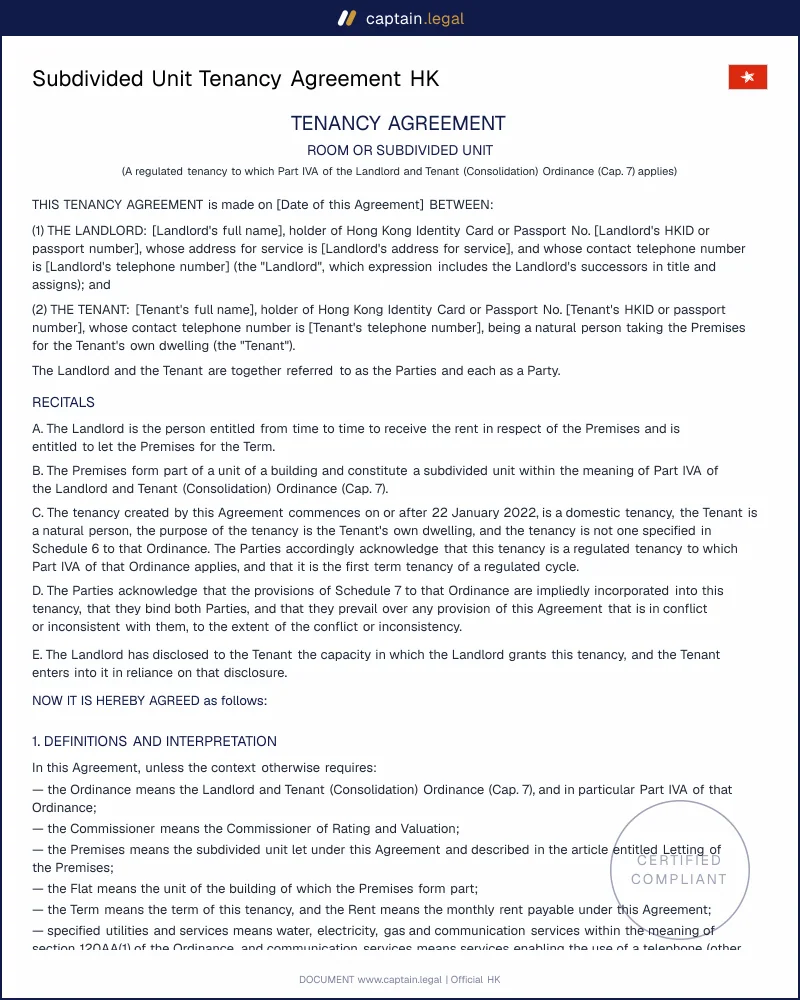
Subdivided unit tenancy agreement drafted to Part IVA of Cap. 7: two year regulated cycle, Form AR2 within 60 days, Schedule 7 repair obligations.
4.7/519 reviews50 000+ downloadsInstant download
Share

A subdivided unit tenancy agreement is the written contract governing the letting of a room, cubicle, rooftop structure or bedspace carved out of a larger flat. Since January 2022 it has sat inside a statutory regime that leaves almost no room for improvisation: Part IVA of the Landlord and Tenant (Consolidation) Ordinance (Cap. 7) fixes the term at two years, entitles the tenant to a second term, caps the renewal increase, limits the deposit and turns several long standing landlord habits into offences. This room rental agreement is drafted for Hong Kong landlords and tenants who need a compliant first term tenancy, a defensible utilities apportionment and a document that supports the Notice of Tenancy filed with the Rating and Valuation Department.

Compliant

2026 Legislation

50,000+ clients

trust us

Affordable

From $4.90 / doc

Secure payment

Instant download

SDU Tenancy Agreement HK: Cap. 7 Part IVA Template

Secure payment

Fill in the template

What is a subdivided unit tenancy agreement?

A subdivided unit tenancy agreement is a domestic tenancy over premises that form part of a flat rather than the whole of it. The statutory definition is deliberately wide: a room, a cubicle, a loft, a bedspace, a rooftop house and even a space capsule all qualify, provided the premises are let to a natural person as that person's own dwelling. Most Notices of Tenancy processed by the Rating and Valuation Department concern rooms, which is why the market calls this a room rental agreement although the Ordinance never uses the phrase.

Two documents get confused constantly. An ordinary tenancy over a whole flat is a creature of contract, and the parties are broadly free to fix the term, the rent and the exit. A regulated tenancy is not. Six conditions must be satisfied: the tenancy commences on or after 22 January 2022, it is a domestic tenancy, the premises are a subdivided unit, the tenant is a natural person, the letting is for the tenant's own dwelling, and the tenancy is not excluded by Schedule 6. Where all six are met, the statutory terms apply whether or not anything is signed. An oral letting of a room is still a regulated tenancy, and the mandatory terms are read into it by force of law.

2

When do you need this document?

The ordinary case is a fresh letting of a room in a subdivided flat, where the landlord needs a first term tenancy that will survive scrutiny and produce a clean Form AR2. Close behind sits the regularisation of a handshake arrangement: a tenant paying rent without paperwork can demand a written agreement, and the landlord then has 30 days to serve one, failing which the tenant may withhold rent or terminate on notice. Documenting the second term tenancy is the third scenario, and it is more technical than it looks, because the terms must mirror the first term in everything but the period and the rent.

Two situations reward attention. Subdivided units in industrial and commercial buildings fall within Part IVA whenever the letting is genuinely domestic, and where the parties disagree, either can apply to the Lands Tribunal or seek a certificate of primary user under section 120AAZQ. The other is the company letting. An employer housing a staff member in a room it holds should paper the accommodation separately from the employment contracts and HR letters drafted for the Employment Ordinance, because a tenancy that dies with the job is not how a regulated tenancy behaves.

3

Key clauses included in our template

  • The parties and the premises are identified with the precision the Ordinance expects, naming the individual tenant rather than a household and describing the unit by its position within the principal flat. Loose wording such as "the middle room" carries across into Form AR2 and causes arguments later.
  • The term and the regulated cycle are stated as a two year first term, with the tenant's entitlement to a second term offer recorded expressly. The clause preserves the tenant's right to terminate early on not less than 30 days' written notice, provided the termination date falls no earlier than the last day of the first year. The landlord has no equivalent break right.
  • The rent, receipts and re-entry provisions fix a rent that cannot vary during the term, oblige the landlord to issue a receipt for every payment, and record the fifteen day window after which the right of re-entry arises.
  • The utilities and apportionment schedule identifies which specified services are separately metered, names the bill payer and commits the landlord to producing bills and a written account. This is the clause that keeps landlords out of the Eastern Magistrates' Courts.
  • The maintenance and covenant terms reproduce the mandatory obligations over drains, pipes, wiring, windows and fittings, alongside the tenant's undertakings on lawful use, alterations and subletting. Where a landlord signs through a relative or agent, use one of the powers of attorney and authorisation letters for Hong Kong.
4

District and building type considerations

Sham Shui Po carries the densest concentration of subdivided units in the territory, and it is where the Basic Housing Unit regime bit first. Owners wanting flats empty for alteration works moved early, which produced a wave of terminations and much confusion about what a landlord may actually do. The position is simple: a regulated tenancy cannot be ended mid term because the owner intends to renovate. Registration secures time, not vacant possession.

Yau Tsim Mong is dominated by tenement stock and composite buildings with shops at street level. That matters, because the Basic Housing Unit regime reaches the residential parts of composite buildings and measures compliance against the reference building plan, generally the approved plan under which the Occupation Permit was issued.

Kowloon City and Kwun Tong produce the rooftop and podium lettings. These structures are subdivided units for Part IVA purposes, so the two year term, the deposit ceiling and the Form AR2 duty apply. They also attract the Buildings Department, and any outstanding order about unauthorised building works must be cleared before recognition is granted.

Industrial and commercial buildings sit in the gap between the two regimes. A domestic letting of partitioned space there is regulated under Part IVA yet falls outside the Basic Housing Unit framework, and it may breach the occupation permit or the lease independently of Cap. 7. Operators holding units across several districts usually run the portfolio through a company, in which case the corporate paperwork sits with the commercial contracts and company documents under the Companies Ordinance.

5

How to fill out this subdivided unit tenancy agreement

You begin by confirming that the letting really is a regulated tenancy, because the answer shapes the whole document. The form asks whether the premises form part of a larger flat, whether the tenant is an individual taking the unit as a home, and whether any Schedule 6 exclusion applies. You then enter the parties, the address of the principal flat, the unit identifier and the commencement date, which drives both the two year term and the 60 day filing deadline.

The utilities section is where care pays. You indicate which services are separately metered, name the account holder on each bill and choose an apportionment basis you can defend on paper. The deposit field is capped so that no figure above two months' rent can be entered. Both counterparts are then signed, the landlord stamps at the Inland Revenue Department and returns the stamped counterpart within 30 days, then files Form AR2.

6

Common mistakes to avoid

The most expensive error is treating Form AR2 as administrative housekeeping. Landlords who file late, or who file for the first term and forget the second, cannot sue for arrears until the Commissioner endorses the notice, and every unfiled tenancy is a separate charge. The second recurring failure is the flat rate utility charge: a fixed monthly sum for water and electricity is an offence unless it is a genuine reimbursement of an apportioned bill the landlord can evidence.

Three quieter mistakes cause almost as much damage. Landlords write a one year term because that is what the market did for decades, when the statutory term is two years. They take a three month deposit, which exceeds the ceiling. And they assume a break clause of the kind used in a "1+1" whole flat letting will let them exit at twelve months, when the right to terminate early belongs to the tenant alone. If the relationship breaks down, the route is the statutory right of re-entry or a properly drafted notice from our landlord and tenant notices for Hong Kong lettings, never a self help eviction.

Key takeaways

CAP. 7 PART IVA

The term is fixed: two plus two years

If the letting meets the six conditions for a regulated tenancy under Part IVA of the Landlord and Tenant (Consolidation) Ordinance (Cap. 7), the statutory cycle applies even if you never sign anything. The first term is two years and the tenant is entitled to a second two-year term, giving up to four years of security. Early termination is tightly limited to the Ordinance’s narrow grounds.

FILING DEADLINE

File Form AR2 within 60 days

A Notice of Tenancy on Form AR2 must be lodged with the Commissioner of Rating and Valuation within 60 days of the tenancy starting. Miss that, and the consequences bite: no action to recover rent can be brought until the Commissioner has endorsed the notice. Treat the filing as an operational step on day one, alongside signing and stamping, not as a later administrative tidy-up.

MONEY & REPAIRS

Deposits, utilities and repairs are policed

This regime limits what a landlord can demand and how charges are evidenced. Under section 120AAZL, only the rent, a deposit up to two months’ rent, and reimbursement for specified utilities and services are permitted. If utilities are shared, the landlord must be the named payer, provide bill copies and a written apportionment account. Schedule 7 also assigns repair duties for items like drains, pipes, wiring and windows.

Frequently Asked Questions

Yes. It is a written tenancy agreement between landlord and tenant, and it binds both once signed. Part IVA of Cap. 7 lets the parties write their own agreement for a first term tenancy provided nothing conflicts with the Ordinance, and the template is drafted to that limit. Where a clause cuts across a mandatory term, the statutory term prevails. Stamping is separate: an unstamped agreement still binds the parties, but it cannot be received in evidence until the duty and any penalty are paid.

Both formats are produced together. The PDF is the version to print, sign and stamp, while the Word file lets you adjust the descriptive fields and the apportionment schedule before anyone signs. Keep the signed original and give the tenant a counterpart. The landlord must return the stamped counterpart within 30 days of receiving the signed agreement, failing which the tenant may withhold rent until it arrives. Related paperwork sits in the full catalogue of Hong Kong legal templates.

Sixty days from the day the term commences, and the same deadline applies when the second term begins. The form goes to the Commissioner of Rating and Valuation, who endorses it and copies both parties. A landlord who fails to submit without reasonable excuse commits an offence carrying a fine at level 3, with a further daily fine while the default continues. The practical sting is worse than the fine: until the notice is endorsed, no action to recover rent can be taken.

Not necessarily. Schedule 6 excludes a tenancy of a bedroom where the landlord is a natural person residing in the unit at commencement, but the exclusion is narrower than most people assume. "Bedroom" means premises demarcated as a bedroom on the latest building plan. A partitioned living room, a converted balcony or a space created by a cupboard wall is not a bedroom on the plan, so the full regime applies.

The rent is frozen for the whole of a two year term. For the second term, the increase cannot exceed the change in the rental index for private domestic properties published by the Rating and Valuation Department over the relevant period, subject to a ceiling of 10 per cent. The department publishes an online calculator returning the maximum permitted figure. Where the index has fallen the rent must be reduced accordingly, and demanding more is an offence.

Not immediately, and the timing is what matters. The offence of letting a subdivided unit with neither grace period registration nor Basic Housing Unit recognition, in section 8 of Cap. 658, takes effect on 1 March 2027. Owners of flats with a valid subdivided unit tenancy between 4 July 2025 and 3 October 2025 could register during the twelve month window opening on 1 March 2026, which secures a grace period to 28 February 2030. A unit created after commencement enjoys no transitional relief and needs recognition before it can be let.

4.7/5

19 verified reviews · 50 000+ downloads

SDU Tenancy Agreement HK: Cap. 7 Part IVA Template
  • Immediate access to the document
  • PDF + Word download
  • Compliant with 2026 legislation
  • Reviewed by lawyers
Fill in the template
Secure payment
Updated on August 21, 2026

You might also like

HK Agreement for Sale and Purchase
Tenancy Agreement Hong Kong