Non-Profit & Associations

Volunteer Agreement Under Hong Kong Law

Address Cap. 57 status risk, Cap. 486 data duties, insurance disclosure and anti-bribery safeguards in one tailored volunteer agreement.
4.5/517 reviews50 000+ downloadsInstant download
Share

A Hong Kong volunteer agreement records the practical understanding between an organisation and a person giving time without pay. It is designed for charities, societies, companies limited by guarantee, community groups and other bodies that need to define a volunteer's role without presenting the arrangement as employment. The document sets expectations on duties, expenses, confidentiality, insurance, conflicts of interest, data handling and ending the placement. It also gives both parties a useful reference if questions arise later. Most importantly, it helps the organisation describe a genuinely voluntary relationship in writing while recognising that the real working arrangements, not the document's title alone, determine whether employment law applies.

Compliant

2026 Legislation

50,000+ clients

trust us

Affordable

From $4.90 / doc

Secure payment

Instant download

Volunteer Agreement Under Hong Kong Law

Secure payment

Fill in the template

What is a Hong Kong volunteer agreement?

A volunteer agreement is a written record of what the organisation and volunteer expect from one another. It identifies the parties, describes the activities, names the supervisor and states where and when the service is expected to take place. It can be used for a single event, a fixed period or an ongoing placement.

The agreement is especially useful when the volunteer will handle confidential information, work with beneficiaries, use organisational systems, create materials or incur expenses. It brings those points into one document instead of leaving them across emails and informal conversations. Organisations reviewing their wider governance arrangements can use it alongside other Hong Kong non-profit documents.

The document is not a payroll substitute and should not be used to disguise paid work. Its purpose is to record a voluntary arrangement accurately, including the volunteer's freedom to decline tasks or stop volunteering.

1

The critical distinction between volunteering and employment

The Employment Ordinance (Cap. 57) protects people who are employees under a contract of employment. Calling someone a volunteer does not settle the question. If the facts show an employer and employee relationship, a clause saying otherwise cannot remove statutory rights. The Labour Department's guidance on employment status explains that all relevant factors must be considered and that there is no single conclusive test.

In practice, relevant signs may include control over working time and methods, integration into the organisation, the provision of equipment, financial risk and the overall structure of the arrangement. For a genuine volunteer, the absence of wages matters, but it is not sensible to rely on that fact alone. The written terms and day-to-day reality should tell the same story.

This agreement therefore states that there is no remuneration, no guaranteed work and no obligation to accept every assignment. It also distinguishes reimbursement of genuine expenses from wages. Managers should still review the arrangement if the role becomes regular, compulsory, closely controlled or similar to a paid post. Where the facts point towards employment, the appropriate document is found among Hong Kong employment and HR documents, together with the correct payroll and statutory arrangements.

2

When should an organisation use this agreement?

Use the agreement before the volunteer begins a role that involves recurring duties, access to people or information, use of equipment, public representation or responsibility for organisational property. It is equally suitable for a short project when the tasks carry operational or reputational risk.

A written agreement is valuable when a society appoints event helpers, a charity works with programme volunteers, a community group uses mentors, or a non-profit asks a volunteer to prepare photographs, reports or training materials. It also helps where the volunteer may receive expense reimbursement or needs to disclose an outside position that could affect impartiality.

For very informal, low-risk help, a shorter briefing may sometimes be proportionate. Even then, safety, privacy and safeguarding instructions should not be left unclear. The greater the access, responsibility or risk, the stronger the case for a signed agreement.

Before offering the role, compare it with any paid position already used by the organisation. Check whether the proposed hours are genuinely optional, whether the volunteer can decline an assignment, and whether reimbursements match actual expenses. Then identify who will supervise the work and who can approve changes. This short operational review often reveals a mismatch between the planned placement and the wording. It also gives the volunteer a realistic picture of the commitment before personal information is collected or access credentials are issued.

3

What does the volunteer agreement cover?

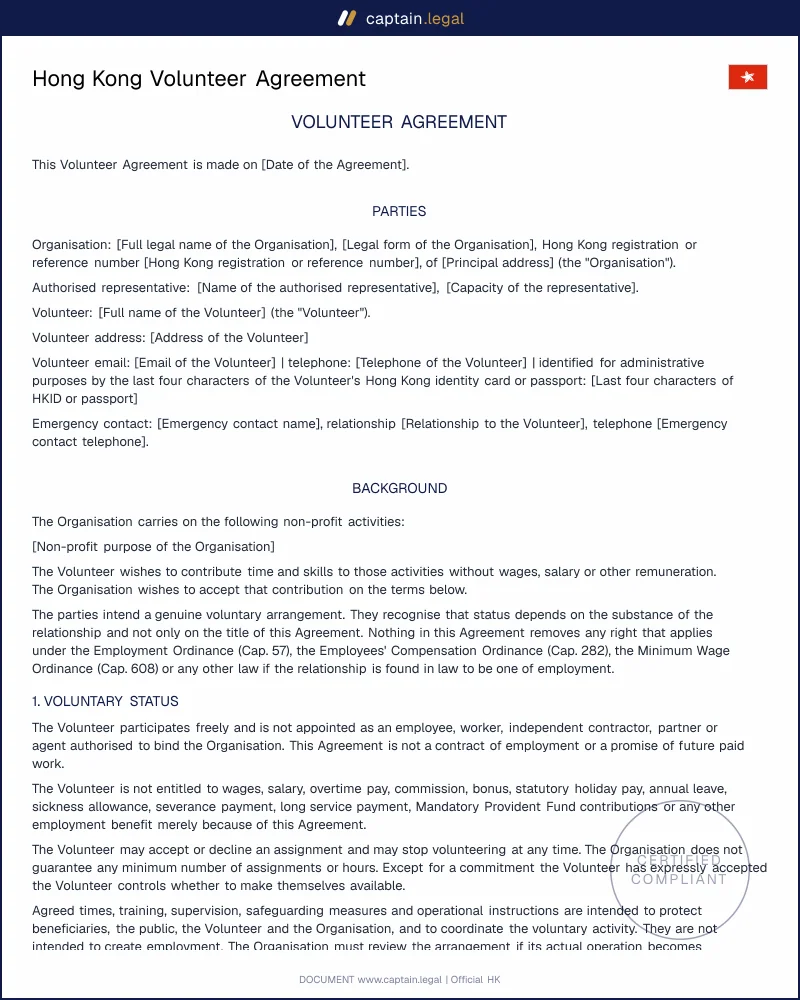
The agreement starts with the organisation's legal name, form, registration or reference number, address and authorised representative. It records the volunteer's contact details and the start date, then lets the parties choose a fixed end date or an ongoing arrangement.

The role schedule is the operational core. It describes the service, location, expected time commitment, supervisor, permitted activities and restricted tasks. It makes clear that the volunteer has no authority to bind the organisation. Safety provisions require compliance with instructions, completion of relevant training and prompt reporting of hazards, injuries and incidents.

Expenses are handled explicitly. The parties can choose either reimbursement of approved, properly evidenced expenses or no reimbursement. This avoids the ambiguity that can arise when occasional payments are made without a clear basis.

Confidentiality, personal data and security duties continue where appropriate after the placement ends. The volunteer must use information only for the authorised purpose, protect credentials and return or delete material when required. If the role involves commercial information or original work, the agreement also deals with intellectual property. Related protections may be considered with Hong Kong business agreements.

The document also addresses conduct, safeguarding, complaints, organisational property and conflicts of interest. The volunteer declares an actual, potential or perceived conflict, or confirms that none is known. Gifts, advantages and false expense claims are prohibited, supporting compliance with the Prevention of Bribery Ordinance (Cap. 201).

4

Insurance and risk should be stated, not assumed

The form asks whether volunteer-specific personal accident cover is available. If it is, the agreement records the insurer, policy number, coverage period, limits and important exclusions. If it is not, the document says so plainly. That distinction matters because an organisation's public liability policy may protect the organisation against certain third-party claims without necessarily compensating a volunteer for every injury.

Insurance wording does not replace practical risk management. The organisation should assess the activities, give suitable instructions and equipment, maintain incident procedures and check the actual policy terms. Higher-risk work may call for a broker or insurer to confirm that volunteers, locations and activities fall within the cover.

The agreement does not promise that all loss will be insured. It records the position disclosed by the organisation and preserves responsibility for matters that cannot lawfully be excluded. Never describe cover from memory: check the current policy schedule before completing the form.

5

Other Hong Kong compliance points

Volunteer records may include identity details, contact information, health or accessibility information and conflict disclosures. The organisation should collect only what it needs and handle it in line with the Personal Data (Privacy) Ordinance (Cap. 486). Access should be limited, retention periods should be sensible and information should not be reused for an unrelated purpose without a proper basis.

Immigration status needs separate attention. A visitor is generally prohibited under the Immigration Regulations (Cap. 115A) from taking employment, whether paid or unpaid. Describing an activity as volunteering does not create an exemption. The organisation should check the person's conditions of stay and obtain specific advice or permission where necessary.

For volunteers under 18, the form adds a parent or guardian acknowledgement. The organisation must still consider safeguarding, supervision, age-appropriate activities and any sector-specific requirements. Families may also find relevant forms within Hong Kong personal and family documents.

6

How the guided form works

The questionnaire first gathers the organisation and volunteer details, then moves through the role, duration and expected commitment. Conditional questions show only the clauses that matter. A fixed-term placement asks for an end date; expense reimbursement asks for the permitted categories and approval process; insurance cover asks for policy details.

The same approach applies to conflicts, media consent and age. A declared conflict opens a detailed disclosure. Media consent can be granted or withheld. If the volunteer is under 18, the parent or guardian section appears. This keeps the final agreement specific without forcing irrelevant wording into every document.

Before generating the document, review the summary against the actual placement. Both parties should keep the signed version and any role schedule. The completed agreement can be downloaded in editable Word format and as a PDF for signature and records.

7

Common mistakes to avoid

Do not copy an employment-style job description and merely replace the word employee with volunteer. Mandatory shifts, disciplinary control, fixed wages described as allowances and an expectation of continuous service can conflict with the stated voluntary nature of the arrangement.

Avoid vague duties such as helping whenever needed. Name the activities, boundaries, supervisor and restricted tasks. For expenses, state whether reimbursement is available and require approval and receipts where appropriate. For insurance, insert verified policy details rather than a broad assurance that the volunteer is fully covered.

Conflicts should be updated when circumstances change, not treated as a one-time formality. The same is true of safety and immigration checks. Finally, do not leave the agreement unsigned in an inbox. A dated copy, available to both parties, is much easier to administer and review.

Key takeaways

Employment status

A label will not avoid Cap. 57

Calling someone a volunteer does not decide whether the Employment Ordinance (Cap. 57) applies. If the day-to-day facts look like employment, a clause saying “no employment” will not strip statutory rights. Watch for tight control of hours and methods, integration into the organisation, and a role that mirrors a paid post. The agreement helps, but the working reality must match it.

Terms in writing

Keep it unpaid and genuinely optional

This agreement is meant to record a voluntary arrangement, not to disguise paid work or act as a payroll substitute. It should state there is no remuneration, no guaranteed work, and no obligation to accept every assignment. It should also separate reimbursement of genuine expenses from wages. If the role becomes regular, compulsory or closely managed, review whether a proper employment document is needed.

Risk controls

Set rules on access, data and conduct

Use the agreement before the volunteer starts where they will handle beneficiaries, confidential information, organisational systems, equipment or property, or represent the organisation publicly. Pull key operational protections into one place: confidentiality, conflicts of interest, insurance expectations and how the placement ends. Where personal data is involved, set clear handling expectations aligned with the Personal Data (Privacy) Ordinance (Cap. 486) so information is not used or disclosed casually.

Frequently Asked Questions

It can be a valid written agreement governing matters such as confidentiality, data handling, intellectual property and property return. Its non-employment clause is evidence of the parties' intention, but it is not conclusive. If the actual relationship is employment, statutory employee rights under Cap. 57 cannot simply be waived. Organisations should keep the day-to-day arrangement consistent with the document and review borderline cases using suitable Hong Kong HR and employment resources.

There is generally no separate Hong Kong filing or registration step merely because an organisation signs a volunteer agreement. The parties should date and sign it, retain a complete copy and follow any internal approval rules. Witnessing is not built in as a universal requirement. A regulated activity, safeguarding setting, grant condition or insurer may impose additional formalities, so those requirements should be checked before the volunteer starts.

Yes. After completing the guided questions, the agreement is available as an editable Word document and as a PDF. Word is useful when the organisation needs a final internal review or wants to add operational details. PDF provides a stable version for signature and record keeping. Check both versions for names, dates, selected options and schedules before they are circulated.

No. The label and signature record intention, but status depends on the whole relationship. Control, required hours, integration, payment practices and mutual obligations may all be relevant. If the arrangement changes in practice, review it promptly and clearly document the outcome. An organisation should not keep using a volunteer document where the role has become a paid or employment-like position.

The answer depends on the organisation's activities, policies and insurance arrangements. This template does not assume that a particular policy exists. It lets the organisation disclose volunteer-specific personal accident cover and its details, or state that no such cover is provided. Public liability and personal accident insurance serve different purposes, so policy wording and exclusions should be checked directly with the insurer or broker.

Signing an agreement does not override immigration conditions. A person admitted as a visitor is generally prohibited from taking paid or unpaid employment. Some narrowly defined activities or facilitation arrangements may be treated differently, but the organisation should not assume that ordinary volunteering is permitted. Check the volunteer's conditions of stay and obtain confirmation from the Immigration Department or qualified adviser before any activity begins.

The guided form adds a parent or guardian acknowledgement and signature section when the volunteer is under 18. That acknowledgement does not replace the organisation's safeguarding duties. The role should be age appropriate, supervision should be clear, restricted tasks should be documented and emergency arrangements should be understood. For broader governance and volunteer management materials, consult the non-profit document collection for Hong Kong.

4.5/5

17 verified reviews · 50 000+ downloads

Volunteer Agreement Under Hong Kong Law
  • Immediate access to the document
  • PDF + Word download
  • Compliant with 2026 legislation
  • Reviewed by lawyers
Fill in the template
Secure payment
Updated on August 25, 2026

You might also like

Public Fund-Raising Permit Pack Hong Kong
Deed of Gift Hong Kong