Employment & HR

HK Non-Compete: Restraint of Trade, Cap. 57 and HKCFI

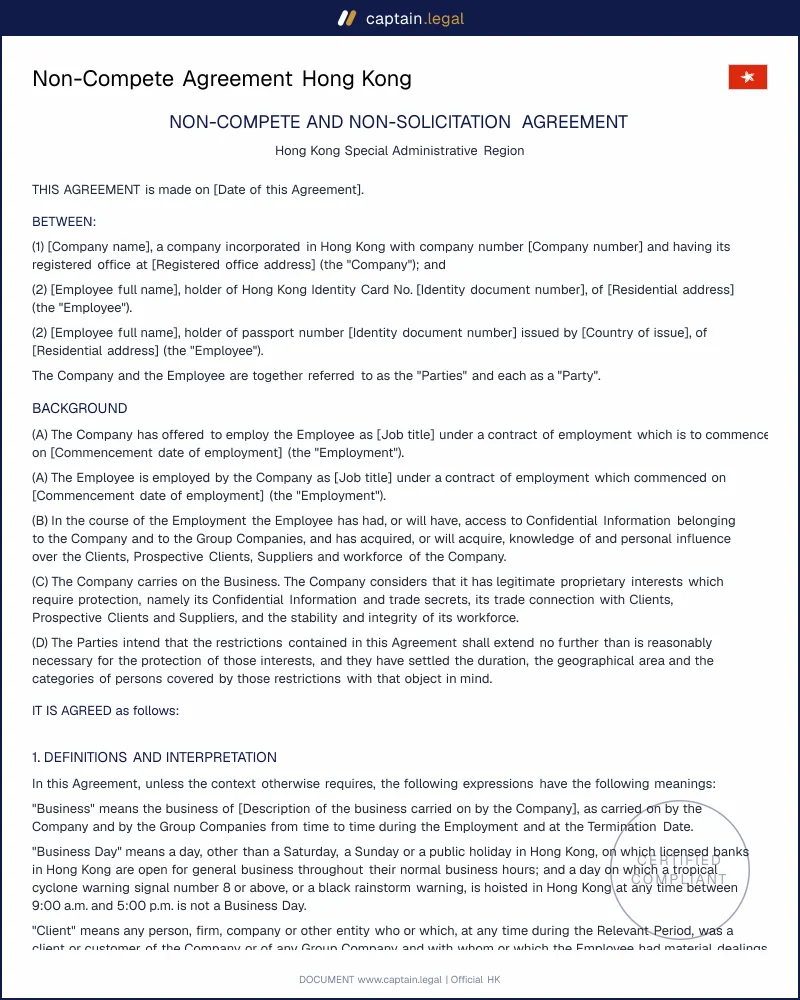
Non-compete and non-solicitation agreement drafted to the Nordenfelt test and HKCFI case law on legitimate proprietary interest. Hong Kong law, Word and PDF.
4.7/528 reviews50 000+ downloadsInstant download
Share

A non-compete and non-solicitation agreement is the document a Hong Kong employer signs with an employee to limit what that person may do once the employment ends: joining a named competitor, calling on the client portfolio they managed, or leaving with a team of colleagues. Hong Kong has no statute on the subject. Everything turns on the common law doctrine of restraint of trade, and the courts here apply it strictly. A covenant drafted too wide is not narrowed by the judge, it is struck out in full. This template is built for that reality, with duration, geographical perimeter and protected clients defined tightly enough to survive scrutiny, and the non-solicitation obligations kept as separate, independently enforceable covenants.

Compliant

2026 Legislation

50,000+ clients

trust us

Affordable

From $4.90 / doc

Secure payment

Instant download

HK Non-Compete: Restraint of Trade, Cap. 57 and HKCFI

Secure payment

Fill in the template

What is a non-compete and non-solicitation agreement in Hong Kong?

A non-compete and non-solicitation agreement is a set of post-termination restrictive covenants, either embedded in the employment contract or signed as a standalone document. The non-compete covenant stops the employee from joining or setting up a competing business for a defined period after the last day of service. The non-solicitation covenants do something narrower and far easier to defend: they stop the departing employee from approaching the clients they personally dealt with, and from recruiting former colleagues.

Hong Kong practitioners separate three restrictions, and the drafting is not interchangeable. A non-compete bars an activity outright. A non-dealing covenant lets the former employee be approached by a client but bars them from taking the work. A non-solicitation covenant bars only the approach, the least intrusive version and the most likely to be upheld, though also the hardest to police. None of this replaces a confidentiality clause: trade secrets are protected separately, and a properly drafted Hong Kong confidentiality agreement template often does work a restraint of trade clause cannot. An employer who reaches for a non-compete where a confidentiality obligation would have sufficed will struggle to show the wider restraint was reasonably necessary.

2

When do you need this document?

The clearest case is a senior hire with access to strategy, pricing models or client economics. Portfolio managers, desk heads, partners in professional firms, technical leads who see the source code: these are the roles where a Hong Kong court will entertain the argument. Below that level the calculation changes fast, and a restraint on a junior employee is not merely weak but a liability, because an unenforceable covenant leaves the employer with no protection and a costs order.

The second scenario is the client-facing role in a relationship business. Insurance broking, recruitment, private banking, freight forwarding: the value walks out with the person. Non-solicitation and non-dealing covenants matter more here than the non-compete, and a client list limited to accounts the employee personally handled beats a sweeping ban on the sector. The team move is the third trigger: a departing head who takes four analysts with him inflicts a loss no confidentiality clause touches. Consultants create the same exposure without any employment relationship, which is why equivalent covenants belong in a master services agreement for Hong Kong service providers.

Two edge cases deserve attention. Where the employee holds an SFC licence, a restraint barring them in practice from every Type 1, Type 4 or Type 9 activity looks like a bar on the trade they are qualified for. And where a covenant is added part-way through an engagement, fresh consideration is required: bolting a restraint onto a signed contract in exchange for nothing leaves it exposed.

3

Key clauses included in our template

  • The definition of the restricted business names the activity, not the industry. A clause barring the employee from any company in "financial services" catches thousands of Hong Kong entities and will not survive; the template ties the restriction to the products the employee actually worked on.
  • The restraint period runs from the last day of active service, with an express set-off for garden leave already served. Six months sits at the outer edge of what Hong Kong courts have enforced, and the template invites you to choose less where the information ages fast.
  • The geographical limit is stated expressly, with Hong Kong as the default. Manulife turned largely on the absence of any geography, and the template never asks a court to imply a boundary the parties failed to write down.
  • The client non-solicitation and non-dealing covenants are separate obligations, each with its own severability wording, so the failure of one does not drag down the others. Hong Kong courts sever only where the remaining words still make sense, and protected clients are defined by actual dealing in the final twelve months rather than by the customer database.
  • The employee non-solicitation covenant reaches only colleagues the employee worked with directly and who sit above a stated seniority level. An anti-raiding clause covering every name on the payroll is the version most often struck down.
  • The consideration and payment provisions record what the employee receives in return. A paid restraint is not a legal requirement, but BFAM shows the difference it makes when a judge weighs hardship against the employer's interest. A similar balance shapes the covenants in a shareholders agreement with its own restraint provisions, where the covenantor is a seller rather than an employee and the courts allow more latitude.
  • The governing law and injunctive relief clauses confirm that enforcement happens in the Hong Kong courts. The Labour Tribunal has no power to grant an injunction, so restraint proceedings start in the District Court or the Court of First Instance.
4

Sector and seniority considerations

Financial services is where most Hong Kong restraint litigation happens, and where covenants have the best prospects. Firms here already run long notice periods, garden leave and detailed confidentiality regimes, which help a court see a coherent protective scheme rather than a reflexive ban. BFAM is the model: precise particulars of the trading strategies at stake, a six-month window, payment throughout. Licensing cuts the other way, and judges are reluctant to shut someone out of the only regulated activity they are authorised to perform.

Professional services and consultancy firms should lead with client connection rather than competition. The manager who has fronted an account for three years is the firm's relationship on paper and the client's in fact, and a non-dealing covenant tied to that account beats a bar on joining a rival.

Technology and data roles run into the shelf life problem head on. Manulife criticised the employer for failing to explain how long each category of information stayed confidential and why twelve months followed from it. Where the roadmap turns over quarterly, three months is often the honest answer, and a short restraint you can prove beats a long one you cannot.

Sales and commission-based roles produce the awkward cases. Courts accept that employees well down the hierarchy can hold real customer connection where the job is built on personal contact, but they draw a line at routine servicing work. Commission structures are useful evidence: an employee paid to grow an account rather than service it has the stronger argument made for them.

Junior and administrative roles should be left out altogether. Moxie is the cautionary tale: the employer there ended up with two unenforceable covenants and nothing to show for the litigation. A confidentiality clause and a clean return-of-property obligation protect the business better than a restraint that will not hold.

5

How to fill out this non-compete and non-solicitation agreement

You start by identifying the parties and the engagement, since the covenants must be given by the individual and not by a holding company that happens to run the payroll. The form then asks you to describe the restricted activity in the employer's own commercial language, product by product, rather than by industry label. The next questions set the restraint period, the geography and the look-back window defining the protected clients, and each covenant can be switched on or off independently, so a client-facing hire can be given non-dealing obligations without any non-compete at all.

The final part covers consideration, garden leave set-off, severability and enforcement. Where covenants are added to an engagement already under way, the form flags the consideration issue and offers execution as a deed, which binds without it. Hong Kong deeds signed by an individual require signature, sealing and delivery before a witness, the same mechanics used across our deed and declaration templates for Hong Kong personal matters.

6

Common mistakes to avoid

The first and most expensive mistake is the one-size template applied across the workforce. Reasonableness is judged employee by employee at the moment of signing, so a clause copied from the head of trading into a graduate offer letter fails twice: it protects nothing on the junior contract, and it invites the argument that the employer never considered proportionality. The second is the missing geography, which sank the covenant in Manulife. Employers assume a court will read in Hong Kong as an obvious limitation, and it will not. The third is the vague description of confidential information; a statement that the employee saw sensitive commercial data is worthless in an affidavit, because judges want categories, examples and a view on how long each stays valuable.

Delay is the fourth trap, and it is procedural rather than editorial. An employer who waits three months after learning of the move before seeking an injunction has told the court the harm is bearable. Finally, agreements between rival firms not to hire each other's staff are a different animal. A covenant between an employer and its own employee sits outside the Competition Ordinance (Cap. 619), but a no-poach arrangement between two firms may amount to market sharing under the First Conduct Rule, and the Competition Commission has said so in terms.

Key takeaways

Restraint of trade

Too wide means struck out entirely

Hong Kong has no non-compete statute; enforceability turns on the common law restraint of trade doctrine from Nordenfelt. The courts apply it strictly: if the clause is drafted too broadly, a judge will not rewrite it to make it reasonable. It is knocked out as a whole, leaving you with no post-termination restraint at all.

Justification

Prove a legitimate proprietary interest

The employer carries the burden of justification. You must point to a legitimate proprietary interest such as trade secrets, client connection or workforce stability, not a general wish to stop competition. Moxie Communications Ltd v Lai Cheuk Lok [2024] HKDC 1323 is a reminder that a two-year restraint on a junior employee can fail where the role does not support that level of protection.

Drafting

Separate covenants and keep them tight

Treat non-compete, non-dealing and non-solicitation as different tools, not interchangeable wording. Non-solicitation is narrower and often easier to defend, but harder to police; non-compete needs careful limits on duration, geography and the protected client group. Courts assess reasonableness at the date of contract, and cases like BFAM Partners v Mills [2021] HKCFI 2904 and Manulife v Rappold [2024] HKCFI 989 show how evidence on confidential information and scope can make or break interim relief.

Frequently Asked Questions

The agreement is a binding contract, but the covenants inside it are enforceable only so far as a court accepts they are reasonable. Hong Kong treats every post-termination restraint as prima facie void, and the employer carries the burden of showing a legitimate proprietary interest plus a covenant no wider than needed to protect it. A tightly scoped clause on a senior employee stands a real chance; a broad clause on a junior one does not.

There is no statutory maximum, and duration is judged against the shelf life of what you are protecting. Three to six months is the range that survives most often. BFAM Partners (Hong Kong) Ltd v Mills [2021] HKCFI 2904 involved six months and was enforced; Manulife Financial Asia Ltd v Rappold [2024] HKCFI 989 involved twelve and failed. Anything longer needs evidence of why the information stays valuable.

Payment is not a condition of validity in Hong Kong, but it changes the arithmetic at the injunction stage. When a judge weighs the employer's interest against the hardship of keeping someone out of work, a paid covenant looks materially different from an unpaid one. Many employers reach the same result with a long notice period and garden leave, set off against the restraint so the two do not stack.

You can, but not for free. A variation needs fresh consideration, so a restraint introduced mid-engagement in exchange for nothing is vulnerable before anyone reaches the reasonableness argument. Tie the covenants to a promotion, a salary review or a retention award, and record that link in the document. The alternative is execution as a deed, which binds without consideration provided the signature, sealing and delivery formalities are observed.

No, and this catches employers out regularly. The Labour Tribunal hears monetary claims arising from employment contracts under the Labour Tribunal Ordinance (Cap. 25) and has no power to grant injunctions, the only remedy that matters while a restraint period is running. Proceedings go to the District Court or the Court of First Instance, and the application is usually made on an urgent interim basis within days of learning of the breach.

Yes. The document is generated in both formats, so you can circulate the PDF for signature and keep the Word file for the amendments restrictive covenants always attract. The Word version matters more here than elsewhere, since scope should be revisited on promotion rather than left running on terms agreed for a job the employee has outgrown. Every file in the Hong Kong document catalogue comes in the same two formats.

4.7/5

28 verified reviews · 50 000+ downloads

HK Non-Compete: Restraint of Trade, Cap. 57 and HKCFI
  • Immediate access to the document
  • PDF + Word download
  • Compliant with 2026 legislation
  • Reviewed by lawyers
Fill in the template
Secure payment
Updated on August 22, 2026

You might also like

FDH Hiring & Termination Pack Hong Kong
Termination Letter Hong Kong