Business & Incorporation

Founders Agreement HK: Companies Ordinance Cap. 622

Founders agreement drafted for Hong Kong law: articles under section 86, pre-incorporation ratification under section 122, IP assignment under Cap. 528.
4.8/523 reviews50 000+ downloadsInstant download
Share

A founders agreement is the private contract that settles ownership, roles and exit terms between the people starting a business together, signed before incorporation or in the weeks that follow. In Hong Kong it sits alongside the articles of association filed with the Companies Registry and does the work the articles cannot do: share splits tied to real contribution, vesting with a cliff, time commitment, assignment of intellectual property to the company, and the fate of a founder's shares when that founder walks away. Two engineers registering a private company limited by shares, three co-founders preparing a seed round, a family team turning a side project into a business: the same document serves all of them.

Compliant

2026 Legislation

50,000+ clients

trust us

Affordable

From $4.90 / doc

Secure payment

Instant download

Founders Agreement HK: Companies Ordinance Cap. 622

Secure payment

Fill in the template

What is a founders agreement under Hong Kong law?

A founders agreement is a contract between individuals, not a company filing. Nothing goes to the Companies Registry, nothing appears on a public company search, and no consent is needed to sign it. That is the point. The bargain between founders is too specific, and usually too personal, to belong in a constitutional document anyone can order online. The articles of association are the company's constitution and take effect under section 86 of the Companies Ordinance (Cap. 622) as a contract under seal binding the company and each member. They deal with share classes, transfer mechanics and board procedure. The founders agreement sits underneath them and answers different questions: why one founder holds a majority, how much of that holding is earned rather than granted, and what the others can do when the holder stops turning up.

Practitioners here treat this document and the shareholders agreement as one species at two stages. The first is signed when the register of members contains only founders, so its centre of gravity is contribution, commitment and departure. The second arrives with the first institutional investor and carries board seats, reserved matters and liquidation preference, supported by the shareholders agreements and board resolutions used by Hong Kong companies. Skip to the second and you lose your bargaining position, because vesting is then imposed by an investor rather than agreed between equals.

2

When do you need this document?

The classic moment comes before there is a company at all. Two or three people are building a product at nights and weekends, one writing code, another talking to customers, and everyone assumes the split is even. Sign then, while the assumption still holds. The second trigger is unequal contribution: one founder puts in capital, another puts in eighteen months of unpaid work, and a written bargain turns that asymmetry into a defensible cap table rather than a grudge. A third is the part-time founder who keeps a job at a bank or a law firm. That founder's own employment contract may already assign intellectual property to the employer, so the two documents have to be read together before any code is contributed.

Investor pressure supplies the fourth trigger. Accelerators and seed funds here ask for the founding papers in their first diligence request, and a founders agreement with vesting already running signals a team that has thought about failure. Two edge cases deserve flagging. Where a founder is resident in the mainland or overseas, execution, service of notices and the stamping deadline all shift. Where a founder contributes an asset rather than cash, a domain name, a customer list, a prototype, that asset must be transferred expressly, because contributing it in spirit transfers nothing at law.

3

Key clauses included in our template

  • The share allocation clause records the number of shares each founder subscribes for, the amount paid up and the date the allotment is entered in the register of members. Shares carry no par value under Cap. 622, so the subscription price is a commercial figure, and fixing it gives the Inland Revenue Department a documented starting point for any later valuation.
  • The vesting and cliff clause turns a headline shareholding into shares earned over time, typically four years with a one year cliff, and states the mechanism that claws back the unvested portion. That mechanism is usually a compulsory transfer at nominal value to the continuing founders, drafted to sit inside the transfer restrictions the articles impose.
  • The roles and time commitment clause names each founder's function and sets a minimum weekly commitment. Most founder disputes begin as a disagreement about effort rather than equity, and a written commitment gives the leaver test something objective to bite on.
  • The intellectual property assignment transfers present and future copyright, designs, source code and know-how to the company, with the written signature Cap. 528 requires and a further assurance undertaking so a trade mark filing can be perfected later. Work done before incorporation is captured expressly, which is where most start-ups have a gap.
  • The leaver and transfer clause separates the good leaver from the bad leaver, sets a valuation basis for each and gives the remaining founders a right of first refusal. Founders who spend long periods abroad often pair it with a general power of attorney deed valid in Hong Kong so signature never blocks completion.
  • The confidentiality, restrictive covenant and deadlock provisions protect trade secrets and customer connections, draw the non-compete narrowly by duration and geography, and give equal shareholders an escalation route before litigation.
4

How the agreement changes with your company structure

The private company limited by shares is the vehicle this template assumes. An individual company secretary must ordinarily reside in Hong Kong, and a sole director cannot also act as secretary, so a two founder team decides early who takes which office. The founders agreement records those appointments and ties them to vesting, so a founder who leaves also resigns the office. Since 1 March 2018 every company must keep a Significant Controllers Register, and each founder crossing the control threshold is identified in it.

An offshore holding structure changes the drafting entirely. Venture investors here often ask for a Cayman or BVI holding company above the operating entity, and terms written only at the Hong Kong level then govern a subsidiary that no longer carries the economics. Vesting and leaver provisions must be replicated at holding company level when the flip happens.

Founders on the payroll create a parallel relationship. Once a founder works at least eighteen hours a week for four consecutive weeks, the continuous contract rules of the Employment Ordinance (Cap. 57) apply, with the paid leave, sickness allowance and provident fund contributions that follow. Each working founder should hold one of the Hong Kong employment contracts and appointment letters that document the role separately from the shareholding.

Social ventures incorporated as a company limited by guarantee have members rather than shareholders and no equity to vest, so the founders agree on roles, decision making and intellectual property alone and their constitutional terms move into the governance papers for Hong Kong companies limited by guarantee.

5

How to fill out this founders agreement

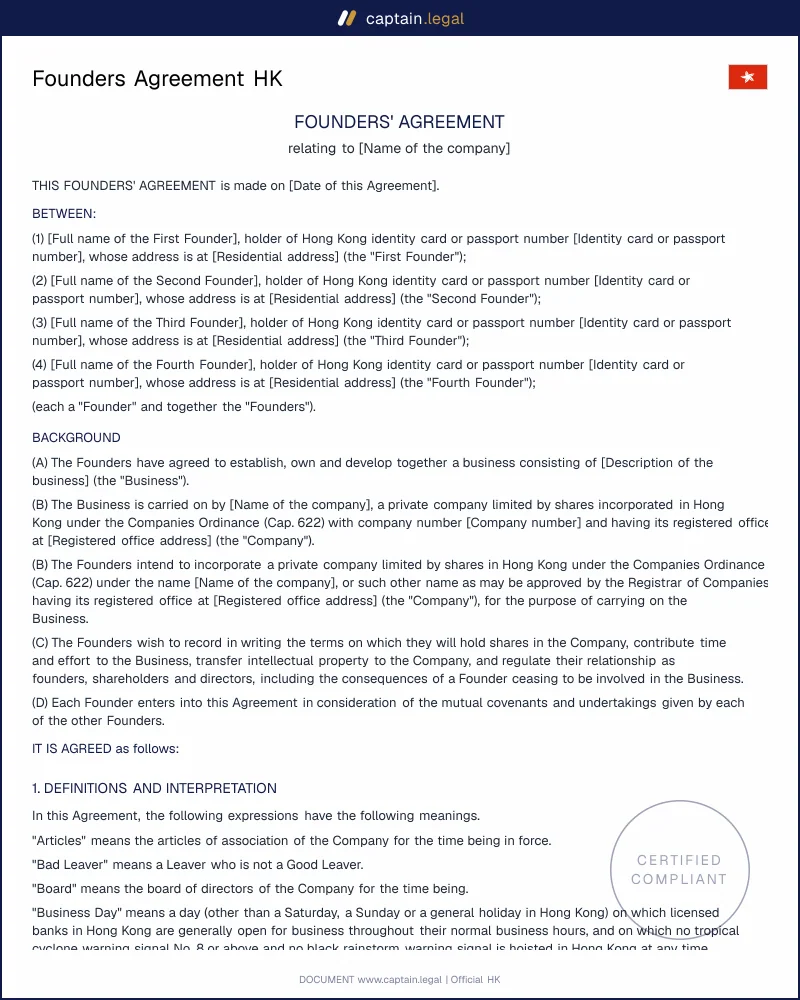
You begin by naming each founder as they appear on their Hong Kong identity card or passport, since the register of members and every later instrument of transfer must match. The form then asks for the company: its name, its Companies Registry number if incorporation has already happened, and its registered office. Where the company does not yet exist, you complete the document in the founders' own names and the board adopts it by resolution once the certificate of incorporation issues. If the business takes its own premises rather than a service address, the Hong Kong tenancy agreement templates cover the lease separately.

Next comes the cap table. You enter each holding, the subscription amount, the vesting period and the length of the cliff, and the template adjusts the compulsory transfer language to match. The most consequential field is the good leaver and bad leaver definition, because it decides whether a departing founder keeps vested shares or surrenders everything. You then set the time commitment, the limits of the restrictive covenants and the deadlock route.

6

Common mistakes to avoid

The most expensive error is the handshake split with no vesting. A founder who leaves after four months keeps a third of the company, contributes nothing further, and blocks the next round because no investor will price a cap table carrying a passive holder that size. The second is a founders agreement that contradicts the articles. Where the contract grants a right of first refusal and the articles give the board unfettered discretion to refuse a transfer, the company is bound by its articles under section 86 and the founders are left suing each other. The third is the intellectual property gap: code written before incorporation stays with its author unless a written assignment says otherwise, and section 15 of Cap. 528 gives a commissioning company only an exclusive licence, not ownership.

Two more mistakes surface late. Founders draft a two year non-compete covering all of Asia, and the court enforces none of it, because a restraint is prima facie void unless the party relying on it proves the restriction reasonable and no wider than necessary. Hong Kong judgments have upheld a six month restraint limited to Hong Kong and refused a twelve month worldwide one. The last mistake is treating a share transfer as a private matter between founders: the instrument of transfer and contract notes must be stamped within the statutory deadline and the register of members updated, or the transfer sits unrecorded when diligence begins.

Key takeaways

Private contract

It is not a public filing

A founders agreement is a private contract between the founders, not something lodged with the Companies Registry. That privacy is the point: it can deal with personal bargains the articles of association should not (or cannot) spell out, such as contribution-based share splits, vesting with a cliff, time commitment and what happens if someone stops turning up. It then sits alongside the articles rather than replacing them.

Cap. 622

Articles still set the company rules

Do not treat the founders agreement as the company’s constitution. Under section 86 of the Companies Ordinance (Cap. 622), the articles of association bind the company and members and must carry core mechanics like share classes, transfers and board procedure. For a private company, section 11 requires restrictions on share transfers, so pre-emption rights should appear in the articles first, then be mirrored in the founders agreement.

Statutory limits

Some promises cannot override the Ordinance

Founders can agree a lot, but not everything will stick against the Companies Ordinance. Under section 122, pre-incorporation contracts bind the signer personally until the company ratifies them, so founders should sign in their own names and have the first board meeting adopt the agreement. Under section 462 (with at least 28 days’ special notice under section 578), members can remove a director despite any contract term.

Frequently Asked Questions

Yes. It is an ordinary contract and binds each signatory once offer, acceptance, consideration and an intention to create legal relations are present, none of which requires a lawyer or a notary. It does not bind the company itself unless the company is a party or later ratifies it under section 122 of Cap. 622, which is why the first board resolution should adopt it expressly. Against the company the articles of association prevail, so consistency between the two is what makes the contract work.

Yes, and signing first is usually better. Founders execute in their own names, and section 122 of Cap. 622 lets the company ratify a pre-incorporation contract once it exists, with the board adopting it at the first meeting. Until ratification the founders remain personally bound, which is the right outcome while the business is still an idea. Signing early also lets the intellectual property assignment cover the build phase, exactly the period most teams forget.

Four years with a one year cliff is the market standard in Hong Kong and is recognised by every seed investor active here. A founder who leaves inside the first twelve months takes nothing, and shares then vest monthly or quarterly. Three year schedules appear where founders have already worked together for years. What matters more than the length is the trigger set: acceleration on a change of control, and who decides that a departure is a bad leaver event.

Sometimes, and only if it is drawn tightly. Hong Kong courts treat restraints of trade as prima facie void, and the party seeking enforcement must prove a legitimate interest, usually trade secrets or customer connections, and show the restriction goes no wider than necessary in duration, activity and geography. A six month restraint expressly limited to Hong Kong has been enforced by injunction; a twelve month clause with no geographical limit was refused.

Contract notes for a sale or purchase of Hong Kong stock are stamped within two days when the transaction is effected in Hong Kong, and within thirty days when it is effected outside. Late stamping penalties escalate with the delay and can reach ten times the duty, and an unstamped instrument is not receivable in evidence, which becomes a real problem when an investor's lawyers ask for the chain of title. Treat the deadline as part of the departure process.

The document downloads in both Word and PDF. The Word version is fully editable, so a clause can be renegotiated when an investor asks for acceleration language or a fourth founder joins and the cap table is restated. The PDF is the signing copy. Both carry the same clause set and the same statutory references, and the wider catalogue of Hong Kong legal document templates holds the resolutions and consents a new company needs alongside it.

4.8/5

23 verified reviews · 50 000+ downloads

Founders Agreement HK: Companies Ordinance Cap. 622
  • Immediate access to the document
  • PDF + Word download
  • Compliant with 2026 legislation
  • Reviewed by lawyers
Fill in the template
Secure payment
Updated on August 20, 2026

You might also like

Statutory Demand Hong Kong
NDA Template Hong Kong