Financial relief on divorce is governed by the Matrimonial Proceedings and Property Ordinance (Cap. 192). Sections 4, 5 and 6 give the court power to order maintenance, lump sums and property transfers, and section 7(1) lists the factors it must weigh: income and earning capacity, financial needs and obligations, the standard of living before the breakdown, the age of the parties and the duration of the marriage, any disability, the contributions each made to the welfare of the family, and any benefit lost by reason of the divorce. That discretion is deliberately broad, and section 14 treats spousal agreements as maintenance agreements whose provisions purporting to restrict the right to apply to the court are void, leaving the remaining financial arrangements intact. The statutory text is published on Hong Kong e-Legislation as the Matrimonial Proceedings and Property Ordinance.
The shape of that discretion was settled in LKW v DD (2010) 13 HKCFAR 537, which aligned Hong Kong with White v White and gave judges a five step method: identify the assets, assess needs, apply the sharing principle, ask whether there is good reason to depart from equal division, and decide the outcome. The yardstick of equal division and the rejection of role discrimination run through it.
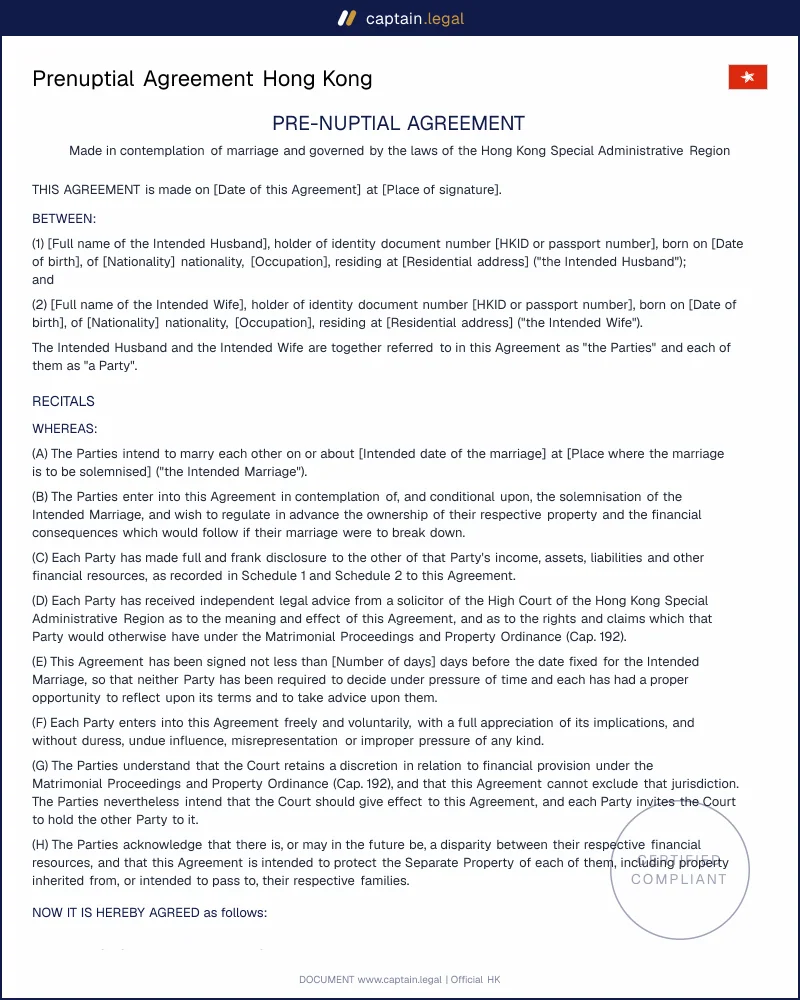
Nuptial agreements entered that framework in SPH v SA [2014] HKCFA 56, where the Court of Final Appeal held that the principles in Radmacher v Granatino [2010] UKSC 42, paragraphs 68 to 73 in particular, represent the law of Hong Kong. The court should give effect to an agreement freely entered into by each party with a full appreciation of its implications, unless in the circumstances prevailing it would not be fair to hold them to it. The Court of First Instance applied that test in LCYP v JEK [2019] HKCFI 1588, where an unvitiated agreement, one untainted by non-disclosure, misrepresentation or pressure, still gave way because the husband's wealth had grown far beyond anything the couple contemplated in their twenties. Fairness is assessed when the court is asked to enforce, not on the day of signing. Hong Kong imposes no registration requirement and no prescribed form, so evidence of process carries the entire burden.