Employment & HR

Independent Contractor Agreement HK: Cap. 57 and Cap. 485

Contract for services drafted to the Poon Chau Nam indicia, excluding Employment Ordinance (Cap. 57) and MPF (Cap. 485) obligations. Word and PDF.
4.6/526 reviews50 000+ downloadsInstant download
Share

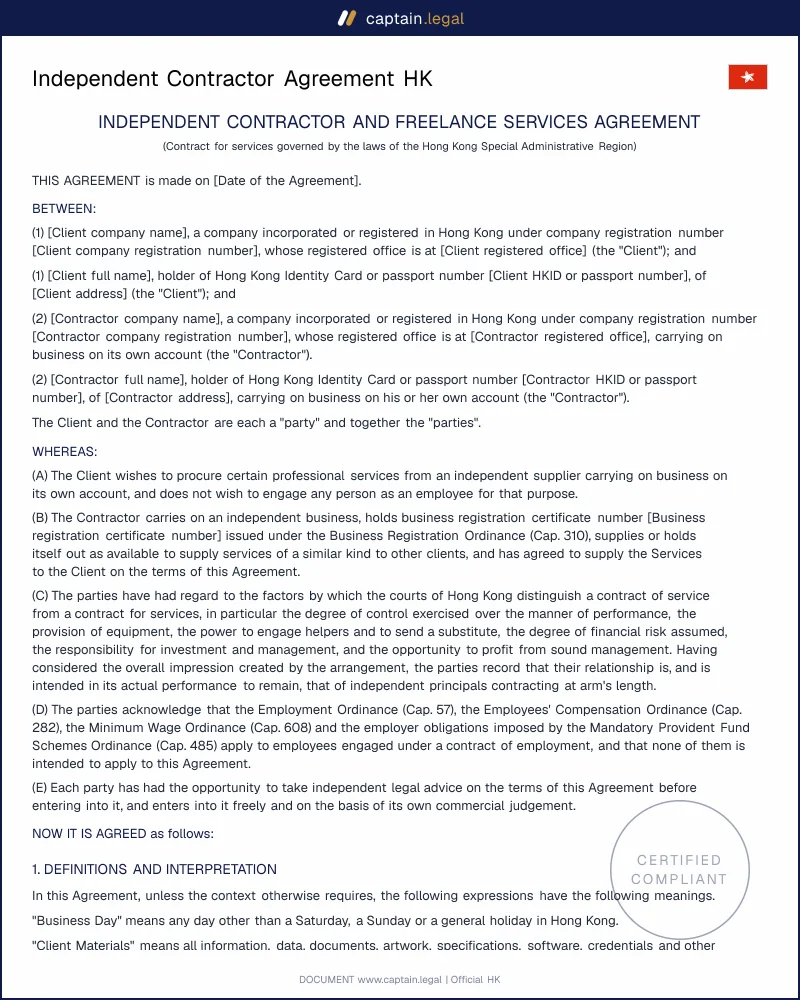
A Hong Kong independent contractor agreement is a contract for services between a principal and a self-employed supplier who sits outside the Employment Ordinance (Cap. 57). It records what the freelancer delivers, how the fee is calculated, who owns the work product, and why the engagement is not employment. Hong Kong has no statutory definition of an employee, so the Labour Tribunal and the courts decide status by looking at how the arrangement actually runs, not at the title on the front page. A carefully drafted freelance services contract gives a company a documented position on control, substitution, equipment and financial risk long before anyone files a claim. This template is built for Hong Kong businesses engaging consultants, designers, developers, trainers and other independent suppliers.

Compliant

2026 Legislation

50,000+ clients

trust us

Affordable

From $4.90 / doc

Secure payment

Instant download

Independent Contractor Agreement HK: Cap. 57 and Cap. 485

Secure payment

Fill in the template

What an independent contractor agreement covers in Hong Kong

Practitioners here call it a contract for services, in contrast to a contract of service, which is the technical name for an employment contract. The difference is not cosmetic. An employee under a continuous contract earns rest days, paid annual leave, sickness allowance, statutory holiday pay, severance payment and long service payment, and the employer must enrol that person in an MPF scheme and hold employees' compensation insurance. A self-employed supplier carries all of that personally.

Two neighbouring documents are often confused with this one. Where the supplier is a limited company, the instrument is a business to business services contract and the reclassification risk falls away, because a company cannot be an employee. Where the individual works set hours under supervision indefinitely, no drafting will rescue the arrangement, and the right paperwork is one of the standard Hong Kong employment contracts and HR letters. This template sits in the middle: an individual, engaged for defined deliverables, free to organise the work and free to serve other clients.

2

When do you need this agreement

The common trigger is a company bringing in specialist capacity it does not want on payroll: a brand designer for a launch, a developer for a fixed sprint, a compliance consultant for a licensing application. The retainer comes next, where a marketing or accounting professional serves several clients and gives each a few days a month. Charities reach for an independent contractor agreement when they engage freelance trainers or event producers, and it sits with the governance papers in the non-profit and association templates.

Two edge cases generate most of the disputes. The first is the departing employee re-engaged as a consultant days after termination, doing the same work at the same desk. Tribunals treat that pattern with suspicion, and the safer route is a real change in scope, hours and method rather than a relabelled continuation. The second is the retainer that quietly turns exclusive. A supplier who has served one client for three years, attends the daily stand-up and takes instructions from a line manager will struggle to show self-employment. Review any retainer that passes twelve months and confirm the original independence is still real.

3

Key clauses included in our template

  • The status and relationship clause states that the supplier is self-employed, disclaims any employment, agency or partnership, and expressly excludes entitlements under Cap. 57 and contributions under Cap. 485. A warranty on profits tax and personal MPF compliance supports it, backed by an indemnity if a claim to the contrary succeeds.
  • The scope of services is written around deliverables and acceptance criteria rather than working hours. The contractor decides the method, sequence and location of the work, using his or her own hardware, software licences and workspace, and the principal reviews the output.
  • The substitution and subcontracting right lets the contractor put forward a qualified replacement, subject to vetting on confidentiality and competence. This provision carried real weight in the Deliveroo judgment and is the clause most often missing from home made freelance contracts.
  • The fee and invoicing clause ties payment to milestones or project work, with invoices raised by the contractor and no payslips, no paid leave and no end of year payment.
  • The intellectual property assignment matters more here than in many markets. Under section 15 of the Copyright Ordinance (Cap. 528) the commissioner of a work is not the first owner unless the parties agree otherwise, so the template carries a present assignment plus a waiver of moral rights.
  • The confidentiality and personal data clause imposes contractual controls on personal data the contractor handles, as the Personal Data (Privacy) Ordinance (Cap. 486) requires of a data user engaging an agent. Heavier information risk calls for a separate mutual or one way NDA for Hong Kong.
  • The termination clause runs on contractual notice and material breach, with no severance payment and no statutory notice regime. Restraints stay limited to non-solicitation of named clients and staff, because a wide non-compete against a supplier meant to serve the market is hard to defend as reasonable.
4

Sector specific considerations

Construction and site based work carries the sharpest exposure. Under the Employees' Compensation Ordinance (Cap. 282) a principal who sublets work can be made liable for compensation to a subcontractor's employees, and the courts have used the Poon Chau Nam indicia to find that a supposedly self-employed worker was employed. Check insurance and site registration before day one.

Creative, editorial and software work turns on ownership. Because Cap. 528 leaves first ownership with the author of a commissioned work, a client without a written assignment holds only an exclusive licence for purposes the parties contemplated. That is thin protection when the client later wants to sublicense or resell the asset.

Platform and delivery operations now sit against a developed body of local authority. The distance between the Zeek and Deliveroo outcomes was operational: fixed routes, monitoring and a ban on substitutes on one side, freedom to log off and a real delegation right on the other. Audit the app, not only the contract.

Regulated financial services allow far less flexibility. An individual carrying out a regulated activity must be licensed by the Securities and Futures Commission and accredited to the licensed corporation under the Securities and Futures Ordinance (Cap. 571), whatever the contract calls them.

Non-resident suppliers raise immigration points first. A person on an employment visa is tied to the sponsoring employer and cannot lawfully take freelance work on the side. Corporate suppliers engaged from overseas are usually better served by a master services agreement drafted for Hong Kong.

5

How to complete this independent contractor agreement

You start by identifying the parties, and the form asks whether the supplier contracts personally or through a Hong Kong company, because the status, tax and assignment wording changes with the answer. Next comes the description of services, where the guided fields push you towards deliverables, acceptance criteria and a completion date rather than hours and duties. The fee section offers milestone, project and day rate structures, the last carrying an extra prompt about invoicing.

From there you cover intellectual property, confidentiality, the substitution right, the notice period and the non-solicitation window. Each answer adjusts the drafting rather than adding boilerplate, so a short design engagement produces a compact contract. Download the result in Word if you expect to negotiate, or in PDF for signature, and keep it with the rest of your Hong Kong legal document library.

6

Common mistakes to avoid

The most frequent error is drafting by deletion: taking an employment contract, striking out annual leave and MPF, and leaving the rest intact. What survives has a fixed monthly sum, a probation period and a reporting line, which reads to a tribunal as employment with the benefits removed. The second error is a substitution clause nobody means. Granting the right on paper while refusing every proposed replacement destroys it, and cross examination on that point is uncomfortable. Third, common in smaller companies, is paying freelancers through the payroll run with a payslip attached, usually the first document a claimant produces.

Two further mistakes are quieter. Skipping the assignment of intellectual property leaves the client with a licence rather than ownership, and the gap surfaces during due diligence, when it is expensive to close. An over ambitious restraint, typically a twelve month market wide non-compete, tends to fail the reasonableness test and can weaken the confidentiality protections next to it. Keep restraints narrow, specific and tied to a genuine business interest.

Key takeaways

Status test

Courts look past the contract label

In Hong Kong, calling someone an independent contractor does not settle the point. Under Poon Chau Nam v Yim Siu Cheung (2007) 10 HKCFAR 156, the court forms an overall impression by weighing indicia such as control, equipment, delegation and financial risk. If day-to-day reality looks like employment, the Employment Ordinance (Cap. 57) can still apply despite the paperwork.

Working model

Deliverables, autonomy and substitution matter

This template suits engagements where an individual is hired for defined deliverables and can organise the work, use their own tools, delegate, and serve other clients. The cases show the detail drives outcomes: the Zeek decision leaned towards employment where routes and timing were controlled and substitutes were banned, while Deliveroo [2024] HKDC 1932 stressed genuine choice and a delegation right, even if unused.

Consequences

Getting status wrong triggers statutory duties

If the relationship is found to be a contract of service, the principal may owe Employment Ordinance (Cap. 57) benefits such as rest days, paid annual leave, sickness allowance and statutory holiday pay, and face exposure around severance or long service payments. The Labour Department notes misclassification can lead to criminal liability under benefit provisions. MPF also follows status: a self-employed person must enrol under Cap. 485 within 60 days and pay 5% of relevant income, with no principal contribution.

Frequently Asked Questions

Yes. It is an ordinary commercial contract, enforceable once both parties sign and consideration passes, with no witness, notary or registration required. Electronic signatures are recognised for contracts of this kind, so a signed scan is normally enough. What it cannot do is convert an employment relationship into self-employment by declaration. If the working reality points to employment, the Employment Ordinance applies whatever the wording says.

They can, and the claim is heard on the facts rather than on the label. The Labour Tribunal applies the overall impression approach from Poon Chau Nam, weighing control, equipment, delegation rights, financial risk and integration. The outcome usually turns on three points: whether the person could genuinely send a substitute, who carried the cost of tools and mistakes, and whether the pay looked like wages. Keeping invoices and evidence of other clients on file is cheap protection.

No. Where the engagement is genuine self-employment, the obligation belongs to the contractor. A self-employed person aged between 18 and 64 must enrol within sixty days of starting and contribute five per cent of relevant income, subject to the statutory minimum and maximum income levels. The principal makes no matching contribution and files no employer return. If status is later reversed, back contributions and penalties land on the company.

Only what the contract provides. Statutory notice, wages in lieu, severance payment and long service payment apply to employees, not to suppliers under a contract for services. Most Hong Kong engagements settle on seven to thirty days of written notice, with immediate termination reserved for material breach, insolvency or loss of a licence. Longer retainers often use a fixed initial term followed by rolling monthly notice.

The freelancer does, unless the contract says otherwise. Section 15 of the Copyright Ordinance (Cap. 528) gives the commissioner an exclusive licence to exploit the work for the purposes both parties contemplated, plus a power to restrain objectionable uses, but first ownership stays with the author. That falls short of what most clients assume they bought. The template therefore includes a present assignment of existing and future rights, a waiver of moral rights, and an obligation to sign anything further needed to perfect it.

The independent contractor agreement is generated as a Word file and a PDF. Word suits an engagement still under negotiation, since you can adjust the scope schedule, fee structure or notice period before signature. PDF is the version to circulate for execution, by wet ink or an electronic signature platform, and it holds the layout across devices. Related business and incorporation documents come in the same formats.

4.6/5

26 verified reviews · 50 000+ downloads

Independent Contractor Agreement HK: Cap. 57 and Cap. 485
  • Immediate access to the document
  • PDF + Word download
  • Compliant with 2026 legislation
  • Reviewed by lawyers
Fill in the template
Secure payment
Updated on August 22, 2026

You might also like

Severance & Long Service Payment HK
Employee Confidentiality & IP Assignment HK