Real Estate & Rental

HK Tenancy Renewal: Cap. 7 Part IV and Cap. 117 Stamping

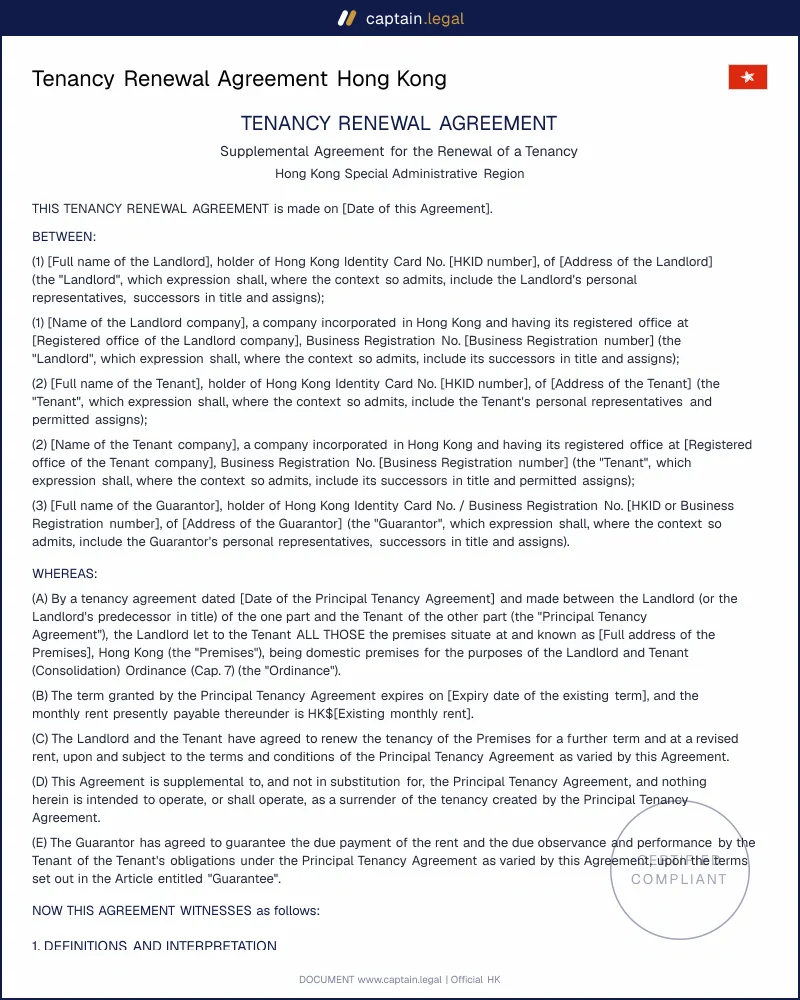
Renewal agreement drafted to the Landlord and Tenant (Consolidation) Ordinance (Cap. 7), with 30 day stamping and Form CR109 notice to the RVD.
4.8/519 reviews50 000+ downloadsInstant download
Share

A tenancy renewal agreement carries an existing letting into a fresh term, fixing the revised rent, the new commencement and expiry dates and any changed obligations, while leaving the rest of the original tenancy agreement in force. In Hong Kong it is signed at the end of a fixed term when landlord and tenant want to continue on agreed terms rather than let the arrangement drift into a monthly holding over. What follows the signature matters as much as the drafting. The renewal has to be stamped afresh with the Inland Revenue Department, and for a domestic letting a new Form CR109 goes to the Rating and Valuation Department. This template covers residential and commercial renewals.

Compliant

2026 Legislation

50,000+ clients

trust us

Affordable

From $4.90 / doc

Secure payment

Instant download

HK Tenancy Renewal: Cap. 7 Part IV and Cap. 117 Stamping

Secure payment

Fill in the template

What is a tenancy renewal agreement in Hong Kong?

A renewal records the continuation of a letting between the same landlord and the same tenant over the same premises, on terms unchanged except for rent and duration. Practitioners also call it a renewal tenancy agreement, an extension agreement or, when drafted as an appendix to the original, a supplemental agreement. The label carries little weight next to the legal effect: a renewal creates a new term rather than continuing the old one, which is why the Stamp Office treats it as a fresh chargeable lease and the Rating and Valuation Department expects a new notice. Our other Hong Kong tenancy and property documents follow the same logic.

Two neighbouring situations get confused with a renewal. The first is holding over, where the term expires and the tenant stays on paying monthly rent the landlord accepts. That conduct creates a monthly periodic tenancy on the old terms, terminable on one month's notice by either side, a much weaker position for a landlord who wanted two more years of income. The second is an option to renew written into the original tenancy, exercised by notice in the manner and within the window the clause prescribes. The tenancy renewal agreement then documents the rent the option formula produced.

2

When do you need this document?

The ordinary trigger is the approaching expiry of a fixed term both sides want to continue. Negotiations on a domestic flat open two to three months before expiry, and the renewal is signed once the parties settle the new rent and whether the break clause is repeated. The other common case is an option to renew, where the notice locks in the right and the renewal supplies the detail the clause left open, normally the reviewed rent and the revised deposit.

Corporate lettings account for a large share of renewals in the central districts. Employers who house staff under a company let renew in the company name, and the paperwork travels with the employee's contract and the rest of the Hong Kong employment and HR templates the finance team holds. Where the tenant is a company taking office, retail or workshop space, the renewal sits with the board approvals and other Hong Kong commercial agreements and corporate records. Societies renewing community premises sign through their office bearers, alongside the constitutions in our Hong Kong non-profit and association documents.

Two edge cases justify closer drafting. Where a tenant has already been holding over for months, the agreement should say whether the periodic tenancy is replaced or whether the new term runs from a back date, since the answer moves the stamping deadline. Where the flat changed hands during the term, the buyer signs as landlord, and the deposit must be shown to have been transferred on completion or the tenant will resist the top up.

3

Key clauses included in our template

  • The identification of the original tenancy names the parties, the premises and the date and stamp certificate reference of the agreement being renewed. That is what lets the Stamp Office link the renewal to the existing file, and it prevents a later argument about which document governs.
  • The new term and commencement date state the exact period, drafted so the renewed term begins the day after the original expires. Any gap creates a spell of holding over on different terms, the risk the renewal was meant to remove.
  • The revised rent and payment arrangements set out the new monthly figure, the due date, the payment method and the treatment of rates, Government rent and management fees. Practice varies on who bears outgoings, so the clause states the split rather than assuming it.
  • The deposit adjustment covers the top up required when rent rises, or the partial refund when it falls, and confirms the existing deposit stays on the original terms.
  • The break clause is repeated or removed. In the market standard one plus one structure, the renewal is often the year the break opens, so the notice period and method of service are restated in full.
  • The stamping and notification clause allocates duty between the parties and records the landlord's obligation to file the new statutory notice.
4

Property type and district considerations

Private domestic flats on Hong Kong Island, in Kowloon and in the New Territories follow the mainstream route: written renewal, stamping within 30 days, Form CR109 within one month. The exemption from CR109 covers only a tenancy of five years or more with no early termination right and no rent increase during the term, which almost no renewal satisfies.

Subdivided units sit under a separate regime. Part IVA of Cap. 7 has applied since 22 January 2022 to a regulated tenancy of a subdivided unit let for domestic use to an individual. The cycle runs two years plus two years, the tenant is entitled to a second term, and the landlord must make the offer on statutory Form AR1 during the offer period, being the second calendar month before the month the second term starts. The increase cannot exceed the movement in the territory wide domestic rental index and is capped at 10 per cent. Form AR2 replaces Form CR109 and is due within 60 days of commencement.

Non-domestic premises, meaning offices, shops, godowns and industrial units, fall outside Part IV. No Form CR109 is required and rental particulars reach the Rating and Valuation Department on Form R1A instead. Stamp duty applies identically, and commercial renewals more often exceed three years, which pulls in the deed and registration requirements.

Home Ownership Scheme flats with the premium unpaid may only be let through the designated letting scheme, and renewing outside it risks the Housing Authority treating the letting as a breach. Public rental housing cannot be sublet at all, and a renewal covering an unauthorised rooftop structure on a New Territories village house hands the tenant possession of something the Buildings Department may order removed.

5

How to fill out this tenancy renewal agreement

You start by confirming which regime applies, because the drafting changes if the premises are a subdivided unit or a non-domestic property. The guided fields then collect the details of the original tenancy, including its date and stamp certificate number, followed by the identity of landlord and tenant exactly as they appear on the earlier document. Company tenants are entered with the Business Registration number and the signing authority. Where an attorney signs for an owner living overseas, the power of attorney is named in the execution block, and our Hong Kong personal and family documents supply that instrument.

The form asks next for the new term, the revised rent, the deposit position and whether the break clause survives, then picks up outgoings, management fees and any changed inventory. The finished agreement downloads in Word and PDF, ready for signature in counterpart, after which you stamp it online and lodge the statutory notice.

6

Common mistakes to avoid

The most expensive error is treating the original stamp certificate as covering the renewal. It does not, and a landlord who discovers that two years on faces a penalty of up to ten times the duty plus an agreement no court will look at. Close behind is forgetting the fresh Form CR109, on the assumption that the notice filed at the start of the original tenancy still holds good. A third problem is dating, where a tenancy renewal agreement signed in the last week of a term is given a commencement date that overlaps or leaves a gap.

Drafting errors cluster around the deposit and the break clause. Parties agree a higher rent and say nothing about topping up the deposit, so the security falls below the two months Hong Kong practice assumes. Others repeat the break clause without adjusting the dates, leaving an early termination right that opens before the renewed term has started. Read the notice provisions again before signing, because a break clause is only as good as the address and method of service written into it.

Key takeaways

Legal effect

A renewal creates a new tenancy term

A tenancy renewal is not the old lease rolling on. It creates a fresh term with new start and end dates and any revised rent, while the rest of the original terms generally remain in force. That is why it is treated as a new lease for post-signing steps. Do not confuse this with holding over, which usually becomes a monthly periodic tenancy.

Stamp duty

Stamp within 30 days of execution

A renewal must be stamped again with the Inland Revenue Department under Schedule 1 of the Stamp Duty Ordinance (Cap. 117). The 30-day clock runs from the date the renewal is executed, not the commencement date. Duty is calculated by reference to the term length and rent, and late stamping can trigger penalties ranging from double duty up to ten times, with an unstamped document kept out of evidence under section 15.

CR109 notice

Domestic renewals need Form CR109 filing

For an unregulated domestic tenancy, Part IV of the Landlord and Tenant (Consolidation) Ordinance (Cap. 7) requires the landlord to lodge Form CR109 with the Rating and Valuation Department within one month of entering into the renewal. The consequence is practical and immediate: until the notice is endorsed, the landlord cannot maintain an action to recover rent under the renewed tenancy.

Frequently Asked Questions

Yes. A written renewal signed by both parties creates an enforceable tenancy for the new term, and no deed is needed for three years or less at market rent. Enforceability in court is the harder point. Under section 15 of the Stamp Duty Ordinance, an unstamped instrument cannot be received in evidence, so a landlord suing for arrears is sent away to stamp and pay the penalty first. For a domestic letting the endorsed Form CR109 is a further precondition.

Yes. The renewal is a separate chargeable lease under Schedule 1 of the Stamp Duty Ordinance (Cap. 117), with duty calculated on the new rent and the new term. The deadline is 30 days from execution, and the commencement date of the renewed term has no effect on that clock. Stamping is done online or on paper at the Stamp Office.

One month from the date the parties entered into the renewal. The form goes to the Commissioner of Rating and Valuation for endorsement and may be filed electronically. Late filing is accepted on payment of a fee, but not filing at all is serious, because the landlord cannot maintain an action to recover rent until the notice is endorsed.

For an ordinary domestic or commercial tenancy, yes. There is no general rent control, and the new figure is whatever the parties agree, which is why negotiations reference the rental index or comparable lettings in the same estate. Regulated tenancies of subdivided units are the exception: the second term increase cannot exceed the movement in the territory wide rental index, capped at 10 per cent, with a compulsory reduction if the index has fallen.

Acceptance of monthly rent after expiry creates a monthly periodic tenancy on the terms of the expired agreement, which either side can end on one month's written notice. The landlord loses the certainty of a fixed term, the tenant loses a defined expiry date, and the deposit position becomes unclear. A renewal dated from the day after expiry removes all of that.

Both formats are produced. The Word file is there for the changes renewals attract, whether a revised inventory, a car park space added or removed, or a rewritten break clause. The PDF is the version to sign and submit with the stamping application, as with every document in the catalogue of Hong Kong legal templates. Keep the stamp certificate and the endorsed Form CR109 with it.

4.8/5

19 verified reviews · 50 000+ downloads

HK Tenancy Renewal: Cap. 7 Part IV and Cap. 117 Stamping
  • Immediate access to the document
  • PDF + Word download
  • Compliant with 2026 legislation
  • Reviewed by lawyers
Fill in the template
Secure payment
Updated on August 21, 2026

You might also like

Commercial Lease HK
Break Clause & Notice to Quit HK