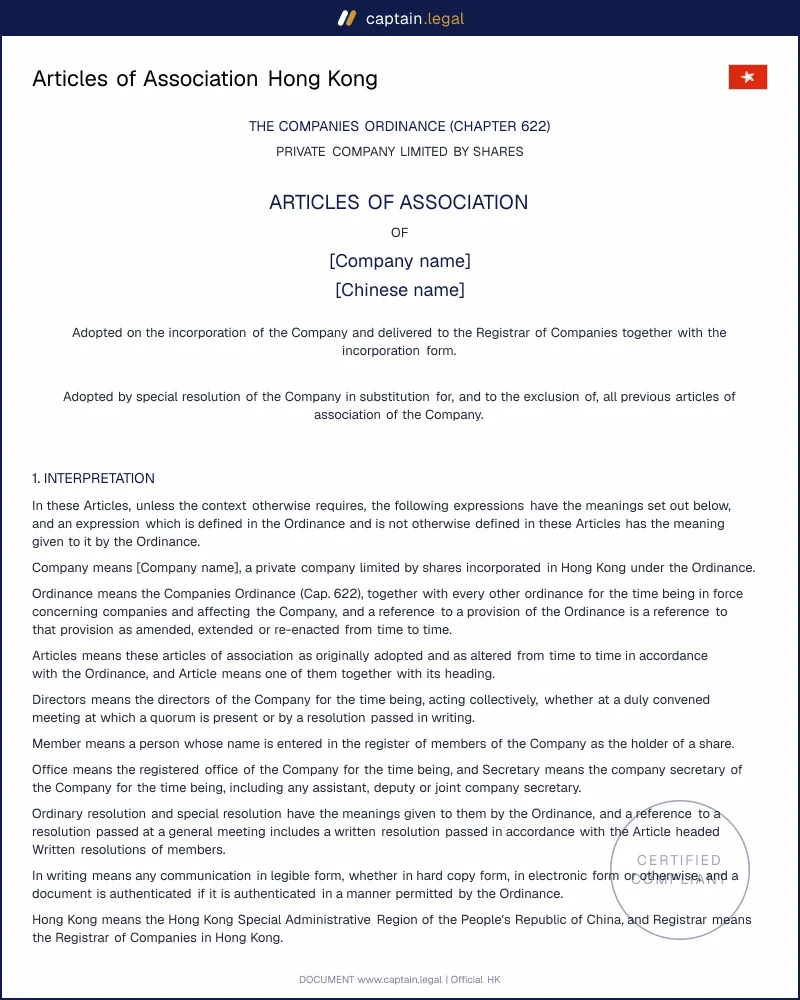
Single member companies are the most common Hong Kong incorporation and the easiest to get wrong. The articles should set the members' quorum at one, confirm that the sole member's written decisions bind the company, and record the reserve director nomination. Under section 612(2)(a) such a company need not hold an annual general meeting at all, and the articles should not impose one by accident. The sole director of a private company cannot also serve as its company secretary, so the appointment clauses must keep the two offices apart.
Founder teams splitting equity two or three ways need drafting that anticipates a departure. Good leaver and bad leaver definitions, compulsory transfer on cessation of employment and a valuation referred to an independent accountant are the standard package. Equal splits also need a tie-break, because a board of two with no casting vote can do nothing once the founders disagree.
Family holding companies care most about continuity. Transmission clauses that oblige the directors to register a transfer to a named heir or to the executor of a deceased member avoid the classic dispute where surviving directors refuse registration and the estate is left with an unregistrable asset.
Joint ventures and group subsidiaries pull in opposite directions. A joint venture needs reserved matters written into the articles as well as the shareholders agreement, because only the articles bind a future transferee. A subsidiary needs speed: a quorum of one director, written board resolutions signed in counterparts, and a corporate representative appointed under section 606. Whatever the profile, the articles and any shareholders agreement must be reconciled clause by clause, because an article that conflicts with the agreement generally prevails as against the company.