Employment & HR

Severance & LSP Hong Kong: Cap. 57 Part VA and VB

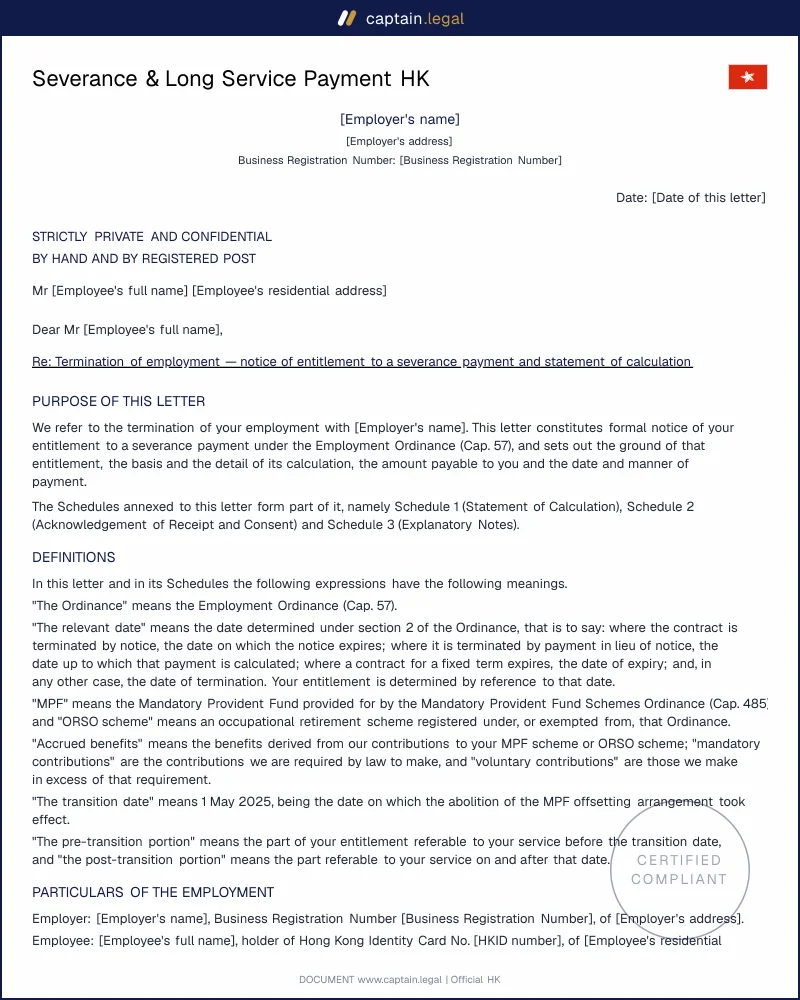
Employment Ordinance Part VA and VB entitlements, the 468 rule, statutory ceilings and post-transition portions. Calculation sheet plus notification letter.
4.6/521 reviews50 000+ downloadsInstant download
Share

A severance and long service payment pack gives a Hong Kong employer the two documents the Labour Department expects to see when a continuous contract ends: a calculation sheet showing how the figure was reached, and a written notification to the employee setting out the amount, the reckonable years and the payment date. It covers both statutory entitlements under the Employment Ordinance (Cap. 57), applies the two-thirds formula and the statutory ceilings, and splits service either side of 1 May 2025 so that the abolition of MPF offsetting is handled correctly. HR managers and company secretaries use it to close a redundancy or a retirement without a Labour Tribunal claim following months later.

Compliant

2026 Legislation

50,000+ clients

trust us

Affordable

From $4.90 / doc

Secure payment

Instant download

Severance & LSP Hong Kong: Cap. 57 Part VA and VB

Secure payment

Fill in the template

What is a severance and long service payment pack?

Hong Kong has no general redundancy compensation scheme. The Employment Ordinance instead creates two mutually exclusive statutory debts, and this pack covers both because the correct one is not always obvious on the day of dismissal. Severance payment is owed to an employee on a continuous contract for not less than 24 months who is dismissed by reason of redundancy, whose fixed term contract expires without renewal because of redundancy, or who is laid off. Long service payment is owed after not less than 5 years of continuous service where employment ends for almost any other reason: dismissal short of summary dismissal for serious misconduct, expiry of a fixed term contract, death in service, resignation on a certificate of permanent unfitness for the job, or resignation at 65 or above.

An employee never receives both. Where the ground is redundancy, severance payment displaces long service payment entirely, even for someone with fifteen years behind them. That single rule decides the whole calculation, which is why the pack opens with a ground-of-termination questionnaire rather than a wage field. The ground you record in the letter is the ground you will have to defend, and the Ordinance presumes a dismissed employee was made redundant unless the employer proves otherwise. Neither sum is a negotiated settlement: both are fixed by statute and enforceable in the Labour Tribunal without proof of fault.

2

When do you need this document?

The commonest trigger is a genuine redundancy: the business closes, a site shuts, or the requirement for work of a particular kind ceases or diminishes. All three are statutory grounds, and all three produce a severance payment for anyone past 24 months. The second trigger is retirement, which in Hong Kong is not automatic. An employee aged 65 or above who resigns qualifies after 5 years, and employers who log the departure as an ordinary resignation regularly find themselves paying two years later.

Lay-off is the trigger most employers miss. Where wages depend on work being provided, an employee is laid off once the days without work exceed half the normal working days in any 4 consecutive weeks, or a third of them in any 26 consecutive weeks. Seasonal catering operations and construction subcontractors cross that line more often than they realise, and the employee can claim while still nominally on the books. Two edge cases deserve flagging. Where an employee dies in service after 5 years, long service payment passes to the surviving spouse, child or parent on application, which usually calls for evidence of relationship such as a statutory declaration with a Cap. 11 jurat. And where the employer offers in writing, at least 7 days before dismissal or expiry, to renew or re-engage on new terms, an unreasonable refusal extinguishes the claim.

3

Key clauses included in our template

  • The statement of the ground of termination opens the notification letter and drives everything after it. Redundancy, expiry, lay-off, retirement at 65, certified unfitness and death in service each carry different consequences, so the template pins the ground to the statutory wording of Part VA or Part VB rather than to a commercial euphemism such as restructuring.
  • The reckonable service record sets out the commencement date, the termination date and the split at 1 May 2025, with incomplete years expressed pro rata. Employment straddling the transition date produces two lines rather than one, because the portions use different wage bases and offsetting rules.
  • The wage base election records which figure the employee has chosen: the last full month's wages, or average monthly wages over the 12 months immediately preceding termination. Daily-rated and piece-rated staff instead take any 18 days' wages out of the last 30 normal working days. The election belongs to the employee, and the template captures it in writing.
  • The statutory ceiling block applies both limits automatically. The monthly wage entering the formula is capped at 22,500 Hong Kong dollars, so the two-thirds multiplicand never exceeds 15,000, and total entitlement is capped at 390,000. Where the aggregate crosses that cap, the excess comes off the post-transition portion, never the earlier one.
  • The offsetting schedule lists accrued benefits from mandatory contributions, voluntary contributions and any length-of-service gratuity, and allocates each against the correct portion. Applying mandatory contributions against post-transition service is the single most common and most expensive error in Hong Kong termination practice.
4

Workforce categories that change the calculation

Foreign domestic helpers sit outside the MPF System, so their employers make no mandatory contributions and the abolition does not touch them. A helper with 5 years of service is assessed across the whole employment period on the last month's wages, with no pre-transition and post-transition split at all. Household employers remain bound by the 7 day deadline and the same criminal penalties, a point that surprises most families ending a long placement.

Part-time and irregular-hours staff in retail, catering, cleaning and security are the group most affected by the revised continuous contract test. Someone whose roster swings between twelve and twenty-two hours a week may now satisfy the 68 hour aggregate test even in the weeks that fall short, accruing service that would previously have been broken. Employers who built their staffing model around the old threshold should assume the arithmetic has moved against them.

Members of occupational retirement schemes under the Occupational Retirement Schemes Ordinance (Cap. 426) follow a parallel regime. Part of the employer-funded benefit is carved out and treated like mandatory MPF contributions, so it offsets the pre-transition portion only. The scheme administrator holds that figure, and requesting it early is what keeps you inside the 7 day window.

Fixed term and project-based hires, common in construction and engineering, need care at expiry. Expiry without renewal by reason of redundancy produces severance payment; expiry for any other reason produces long service payment after 5 years. Letting a fixed term contract lapse in silence is not a neutral act, and an employer who makes no written renewal offer at least 7 days before expiry loses the only defence available.

Employers in liquidation cannot simply stop paying. Employees rank as preferential creditors for wages, wages in lieu of notice and severance under the Companies (Winding Up and Miscellaneous Provisions) Ordinance (Cap. 32), and the Protection of Wages on Insolvency Fund offers an ex gratia route where assets fall short. Where the employer is a company limited by guarantee, the governance duties are set out across our Hong Kong non-profit and association templates.

5

How to fill out this severance and long service payment pack

You begin by identifying the ground of termination, because the pack routes you down one branch or the other from that answer alone. Next come the commencement and termination dates, from which the tool works out whether the employment straddles 1 May 2025 and needs a two-part calculation. If it does, you supply two wage figures rather than one: the last full month's wages immediately preceding the transition date for the earlier portion, and the last full month's wages before termination for the later one. Daily-rated staff enter the chosen 18 days of wages instead.

The sheet then applies the two-thirds formula, prorates the incomplete year, imposes both ceilings, and shows each step so the employee can follow the arithmetic. You then add the accrued benefits available for offsetting, split between mandatory and voluntary contributions. The notification letter populates from the same fields, so letter and sheet cannot contradict each other, and both export as Word and PDF. Everything else you may need in the same termination file is indexed in the complete Hong Kong template catalogue.

6

Common mistakes to avoid

Most disputes start with the wrong wage base. Employers habitually take basic salary and ignore commission and allowances that count as wages under the Ordinance, which understates the figure and invites a Tribunal claim months later. The mirror error is forgetting the ceiling: running the two-thirds formula on a monthly salary of forty thousand rather than on the capped figure inflates the sum and produces a mismatch the Labour Department will query on any subsidy application. Employers also overlook the employee's right to elect the 12 month average, which matters where a bonus or a stretch of unpaid sick leave has distorted the final month.

The second cluster concerns timing and paperwork. Payment for long service falls due within 7 days of termination, not within the payroll cycle, and treating it as an ordinary final payment is what turns a civil debt into a prosecution. Wage records for the 12 months preceding 1 May 2025 must be kept for any employee hired before that date until six months after departure, and a firm that discards them cannot prove its pre-transition portion. Subsidy applications must be lodged within 3 months of payment, and missing that window forfeits the government contribution whatever the merits. Related precedents sit in our Employment Ordinance based HR paperwork for Hong Kong employers.

Key takeaways

Entitlement type

Severance and LSP never stack

Under the Employment Ordinance (Cap. 57) you either owe severance payment (redundancy/lay-off, at least 24 months on a continuous contract) or long service payment (at least 5 years, most other endings). The employee cannot receive both. If the termination is recorded as redundancy, severance payment displaces long service payment entirely, even for long-serving staff.

Termination ground

The reason you write is the fight

The pack starts with a ground-of-termination questionnaire for a reason: the ground stated in the notification letter is the ground you may later have to defend. The Ordinance presumes a dismissed employee was made redundant unless the employer proves otherwise. These are statutory debts, not a negotiated settlement, and can be pursued in the Labour Tribunal without proving fault.

Transition and deadline

Split service at 1 May 2025

MPF offsetting changed on 1 May 2025 under the Mandatory Provident Fund Schemes Ordinance (Cap. 485). For employees hired before that date, the entitlement splits into a pre-transition portion (still offsettable against mandatory contributions) and a post-transition portion (paid in cash, no offset from mandatory contributions). Long service payment must be paid within 7 days of termination; default without reasonable excuse is a criminal offence with a fine up to HKD 350,000.

Frequently Asked Questions

Take the last full month's wages, cap that figure at 22,500 Hong Kong dollars, multiply by two-thirds and then by the reckonable years of service, prorating any incomplete year. If the employee started before 1 May 2025, run the formula twice: once on the wages immediately preceding that date for the service up to it, and once on the final wages for the service after it. Add the portions, apply the overall limit of 390,000, and deduct any excess from the later portion. Offsetting comes last, and only the earlier portion absorbs mandatory contributions.

The calculation sheet and notification letter are drafted to the Employment Ordinance (Cap. 57), and a completed notification is admissible evidence of what was paid, when and on what basis. The obligation is statutory rather than contractual, so the document does not create the debt: it records and discharges it. Nothing in the pack can reduce an entitlement below the statutory floor, because section 70 voids any term purporting to extinguish a right the Ordinance confers. Where dismissal is contested on discrimination grounds, take advice before issuing anything.

The long service sum is due within 7 days after the contract ends. Severance payment runs on a different clock: the employee serves a written claim within 3 months of dismissal or lay-off, and the employer pays within 2 months of receiving it. Both deadlines carry criminal liability for default, and the long service offence reaches a fine of 350,000 Hong Kong dollars and three years imprisonment. Where a company cannot pay because of insolvency, employees may look to the Protection of Wages on Insolvency Fund, and creditors may separately serve a statutory demand under section 178 of Cap. 32.

No. The two are mutually exclusive. An employee dismissed by reason of redundancy receives severance payment and nothing further, whatever the length of service. An employee dismissed for any other reason short of summary dismissal for serious misconduct, with 5 years or more behind them, receives long service payment instead. Employers occasionally pay both out of caution, which is lawful but converts the excess into taxable income.

Both the calculation sheet and the notification letter download as Word and PDF. The Word version stays editable, which matters when a payroll figure shifts between drafting and issue, or when the template is reused across a group redundancy. The PDF is the version you sign, issue and file. Keep the completed sheet with the wage records: the Labour Department may ask for it on a subsidy application, and the Tribunal will ask for it if the figure is disputed.

Employers who pay for service falling on or after 1 May 2025 may apply under the Subsidy Scheme for Abolition of MPF Offsetting Arrangement, a 25 year scheme run by the Labour Department. The subsidy covers the post-transition portion only, and the sharing ratio falls year by year. Applications go in after the employee has been paid and must reach the Department within 3 months of that payment. Keep the signed receipt and the calculation sheet, since both support the claim.

4.6/5

21 verified reviews · 50 000+ downloads

Severance & LSP Hong Kong: Cap. 57 Part VA and VB
  • Immediate access to the document
  • PDF + Word download
  • Compliant with 2026 legislation
  • Reviewed by lawyers
Fill in the template
Secure payment
Updated on August 22, 2026

You might also like

Mutual Separation Agreement
FDH Hiring & Termination Pack Hong Kong