Real Estate & Rental

Tenancy Agreement HK: Cap. 7 and Stamp Duty Rules

Domestic tenancy agreement drafted to the Landlord and Tenant (Consolidation) Ordinance (Cap. 7), with 30 day IRD stamping and Form CR109 explained.
4.8/524 reviews50 000+ downloadsInstant download
Share

A tenancy agreement in Hong Kong is the written contract that gives a tenant exclusive possession of a domestic flat for a fixed term at an agreed rent, and it is the document the Inland Revenue Department stamps and the Rating and Valuation Department records. Our template follows the market standard for a private residential letting: a two year term structured as 1+1, a break clause available after the first twelve months, a security deposit of two months rent, and clean drafting on repairs and reinstatement. It suits landlords letting directly, tenants who want to understand what they are signing, and agents preparing papers ahead of stamping.

Compliant

2026 Legislation

50,000+ clients

trust us

Affordable

From $4.90 / doc

Secure payment

Instant download

Tenancy Agreement HK: Cap. 7 and Stamp Duty Rules

Secure payment

Fill in the template

What is a tenancy agreement in Hong Kong?

A tenancy agreement grants exclusive possession of defined premises for a term certain in return for rent, which separates it from a licence, where the occupier has permission but no estate in the land. Hong Kong practice also divides a tenancy agreement from a lease. Under section 4(1) of the Conveyancing and Property Ordinance (Cap. 219) a legal estate is created by deed, so a term longer than three years must be granted by a lease executed as a deed. A domestic tenancy of two years sits well below that threshold, is validly made under hand before a witness, and keeps its priority without registration under section 3(2) of the Land Registration Ordinance (Cap. 128).

The 1+1 structure confuses people, including some agents. It is not two consecutive one year tenancies. It is a single fixed term of two years in which one party, or both, may end the tenancy at or after the twelve month mark on written notice of one or two months. The distinction changes the stamp duty rate, because the Stamp Office treats a fixed term terminable on an earlier event as a tenancy for the whole fixed term. Our other Hong Kong property and rental templates follow the same conventions.

2

When do you need this document?

Most users reach for this template at a fresh private letting, once the flat has been viewed, the rent agreed and the agent is pressing for signature. Renewal is the second trigger. Landlords often let a tenancy roll on informally after the fixed term expires, which turns it into a periodic tenancy on uncertain terms and leaves the deposit sitting on a lapsed document. A fresh agreement, freshly stamped, with a fresh Form CR109, closes that gap. Corporate lettings are the third pattern: the company signs as tenant, a named employee occupies, and the employer keeps the stamped copy to support the treatment of the rent under salaries tax. Name the occupier, or the tenancy and the housing benefit records will not line up.

Two edge cases deserve a flag. A charity or an incorporated society taking a flat as staff quarters needs its signing authority to match its own constitution, a governance point before it is a property one, and our society constitutions and charity governance papers cover that side. The other is the subsidised sale flat with the premium unpaid, where letting is an alienation prohibited by the Housing Ordinance (Cap. 283).

3

Key clauses included in our template

  • The identification of the parties and the premises carries more weight here than most people expect. Individuals are named with their identity document, companies with their registered name and business registration number, and the flat by unit, floor, block and estate, with any car parking space let alongside.
  • The term and break clause are drafted as one fixed term of two years with a right to determine on written notice at or after the twelve month point. The clause states who may serve, how much notice is required, how service is effected and whether rent already paid is apportioned on early departure.
  • The rent and deposit provisions fix the payment date and method and treat the deposit as an earnest of performance. Two months rent is the settled domestic norm. What may be deducted, and when the balance comes back, is the most litigated point in small tenancy disputes.
  • The outgoings clause allocates rates, Government rent, management fees payable under the deed of mutual covenant and the Building Management Ordinance (Cap. 344), utilities and any air conditioning charge, with apportionment on the first and last day of the term spelled out.
  • The repairs and reinstatement clause leaves structural and external repairs with the landlord and internal upkeep with the tenant, subject to fair wear and tear. Reinstatement of alterations is expressly stated, measured against the condition report taken on entry.
  • The covenants and forfeiture provisions bar assignment, subletting, illegal use and unauthorised building works, oblige the landlord to give quiet enjoyment, and allow re-entry on breach, subject to relief under section 58 of the Conveyancing and Property Ordinance (Cap. 219).
4

Property types and district considerations

Private residential flats across Hong Kong Island, Kowloon and the New Territories are the standard case, and the template is drafted for them. What differs by district is practical rather than legal: management fee levels, whether rates and Government rent are quoted inclusive or exclusive, and whether the deed of mutual covenant restricts pets. Read that deed before promising anything.

Village houses in the New Territories need a closer look before signature. Many carry rooftop or ground floor structures never covered by an occupation permit, and under the Buildings Ordinance (Application to the New Territories) Ordinance (Cap. 121) a Buildings Department order can land on the property mid tenancy. Let the floor area that is lawfully there, not the area the tenant walks through.

Subsidised sale flats and public rental housing sit outside this template. Letting a Home Ownership Scheme flat before the premium is paid is void and criminal under the Housing Ordinance (Cap. 283), and subletting a public rental flat counts as an abuse of public housing resources. The Housing Authority's pilot letting scheme, open to owners of ten years or more on payment of a letting permit fee, is the narrow exception.

Subdivided units fall under Part IVA of Cap. 7 as regulated tenancies, with four years of security in two consecutive two year terms, a cap on renewal rent increases pegged to the private domestic rental index, and a Notice of Tenancy on Form AR2 lodged within 60 days. The Basic Housing Units Ordinance (Cap. 658) adds registration and recognition requirements on floor area, ceiling height, ventilation and metering.

Serviced flats and short lets raise a licensing question, since premises let for periods shorter than 28 days generally fall within the Hotel and Guesthouse Accommodation Ordinance (Cap. 349), which a domestic tenancy agreement does not answer.

5

How to fill out this tenancy agreement

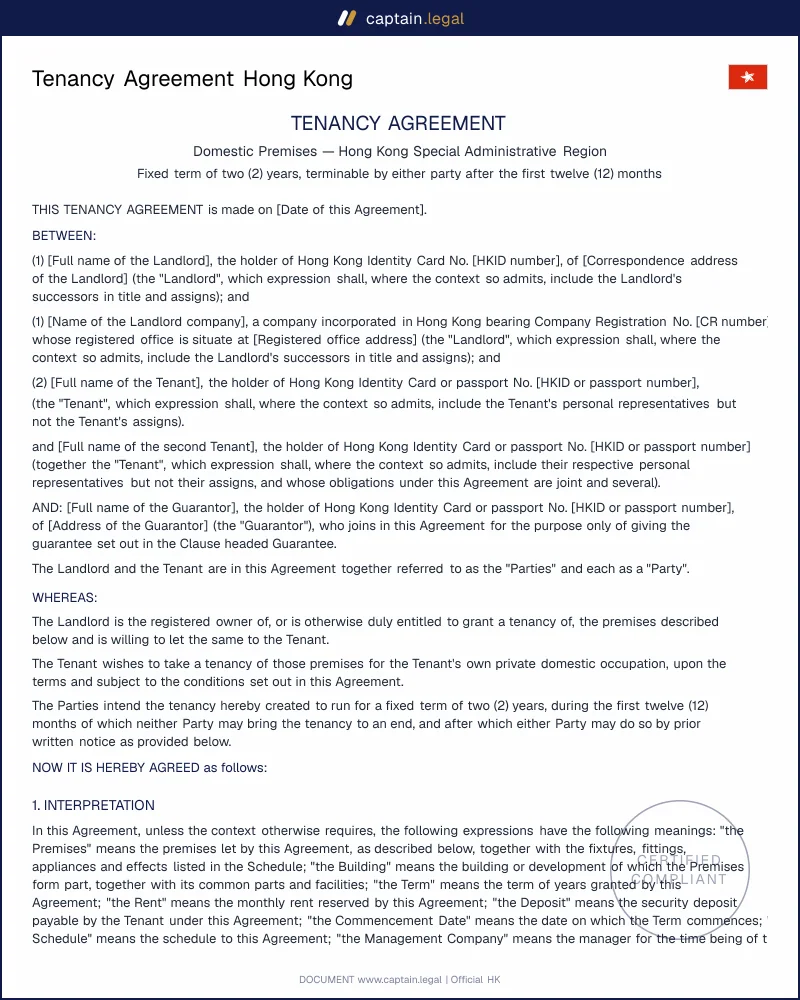
You begin by choosing whether landlord and tenant are individuals or companies, since that decides the identification fields and the execution block. The form then takes the property details, the term and the shape of the break clause, where you set the earliest date notice may be given and the notice period agreed. Rent, payment date and deposit follow, with any rent free or fitting out period. The outgoings section allocates rates, Government rent, management fees and utilities line by line, and the furniture schedule records what stays in the flat. The document downloads in Word and PDF, so you can adjust wording before signature or print it as it stands. Print two counterparts, have both signed before a witness, send them for stamping and lodge the Form CR109. A company tenant usually also needs a board resolution from our Hong Kong corporate and commercial documents, and an owner abroad signs through one of our powers of attorney and authorisation letters.

6

Common mistakes to avoid

The costliest mistake is stamping a 1+1 tenancy as though it were a one year letting. The Stamp Office looks at the fixed term, not at the break right, so a two year agreement attracts the higher rate from the outset and a shortfall found later carries a penalty. Close behind is the forgotten Form CR109. Landlords remember stamping because the agent chases it, then discover at the first rent default that the claim cannot proceed until the notice is endorsed. Third is a break clause that names a notice period but says nothing about who may serve it, how service is effected, or what happens to the deposit.

Two others recur. Deposits are withheld against damage nobody documented, because no condition report or photographs were taken at handover, and the tenant's account of the flat becomes as credible as the landlord's. And employers arranging staff accommodation sometimes sign in the employee's own name while paying rent from the company, which undermines the housing benefit treatment and leaves the company with no standing over the flat. Fix the party names at the outset, alongside the employment contracts and staff documentation behind the arrangement.

Key takeaways

KEY TERMS

A 1+1 is one two-year tenancy

The market-standard 1+1 structure is a single fixed term of two years, not two separate one-year deals. The agreement may allow one or both parties to break at or after month 12 on one or two months written notice, but it still remains a two-year term for legal and duty purposes. Typical drafting also includes a two months rent security deposit and clear repair and reinstatement obligations.

STAMPING

Stamp within 30 days or lose leverage

A domestic tenancy agreement must be stamped with the Inland Revenue Department within 30 days of execution under the Stamp Duty Ordinance (Cap. 117), regardless of the tenancy start date. Late stamping can trigger a penalty of up to ten times the duty (section 9). If it is not duly stamped, it is inadmissible in civil proceedings (section 15), meaning a landlord may be unable to sue on the document.

CR109

File Form CR109 to recover rent

Part IV of the Landlord and Tenant (Consolidation) Ordinance (Cap. 7) requires the landlord to lodge the Notice of New Letting or Renewal Agreement (Form CR109) with the Commissioner of Rating and Valuation within one month of entering into or renewing a domestic tenancy. If the CR109 is not endorsed, the landlord cannot maintain an action to recover rent under the agreement. Late lodgement is still possible on payment of a fee.

Frequently Asked Questions

Yes. A domestic tenancy of three years or less is validly created in writing under hand, signed by both parties, with no deed required under section 4 of the Conveyancing and Property Ordinance (Cap. 219). The template is drafted to Cap. 7 and to Hong Kong practice, and binds the parties on execution. What it cannot do until stamped is serve as evidence in court, since section 15 of the Stamp Duty Ordinance (Cap. 117) shuts an instrument that is not duly stamped out of civil proceedings.

At or after the end of the first twelve months, by serving written notice for the period the agreement specifies, usually one or two months. The tenancy ends when that notice expires, not on the day it is served. Read the clause on two points: whether both parties hold the right or only the tenant, and how notice must be delivered. Service by email where the tenancy agreement requires delivery to the premises is the classic way a break goes wrong.

Thirty days from the date of execution. The date the tenancy begins is irrelevant to that deadline, which catches out parties who sign well ahead of handover. Stamping goes through the e-stamping service, by post or at the Stamp Office counter, and a stamp certificate follows. Late stamping carries a penalty that scales with the delay and can reach ten times the duty, while the agreement stays inadmissible until duty and penalty are paid.

The landlord cannot maintain an action to recover rent until the Commissioner of Rating and Valuation has endorsed the notice. That is a bar on enforcement rather than an invalidation of the tenancy, so the agreement itself stands. The notice may still be lodged after the one month window on payment of a fee, and endorsement restores the right to sue. Landlords letting through an agent should confirm in writing who lodges it.

Both formats are provided. Take the Word file if you expect to negotiate, since Hong Kong tenancy terms are routinely marked up before signature, particularly on the deposit, the break clause and reinstatement. The PDF is the clean version for printing and execution in counterparts. Related paperwork sits in the full catalogue of Hong Kong legal documents.

Two months rent is settled market practice for a domestic letting, and the template is drafted on that basis. No general statutory cap applies to ordinary domestic tenancies, so the figure is negotiable, though anything materially above two months is unusual outside luxury lettings. The deposit secures performance and comes back at the end of the term less properly evidenced deductions.

4.8/5

24 verified reviews · 50 000+ downloads

Tenancy Agreement HK: Cap. 7 and Stamp Duty Rules
  • Immediate access to the document
  • PDF + Word download
  • Compliant with 2026 legislation
  • Reviewed by lawyers
Fill in the template
Secure payment
Updated on August 21, 2026

You might also like

Break Clause & Notice to Quit HK
HK Agreement for Sale and Purchase