Non-Profit & Associations

Deed of Gift HK: Cap. 112 s.26C Donation Agreement

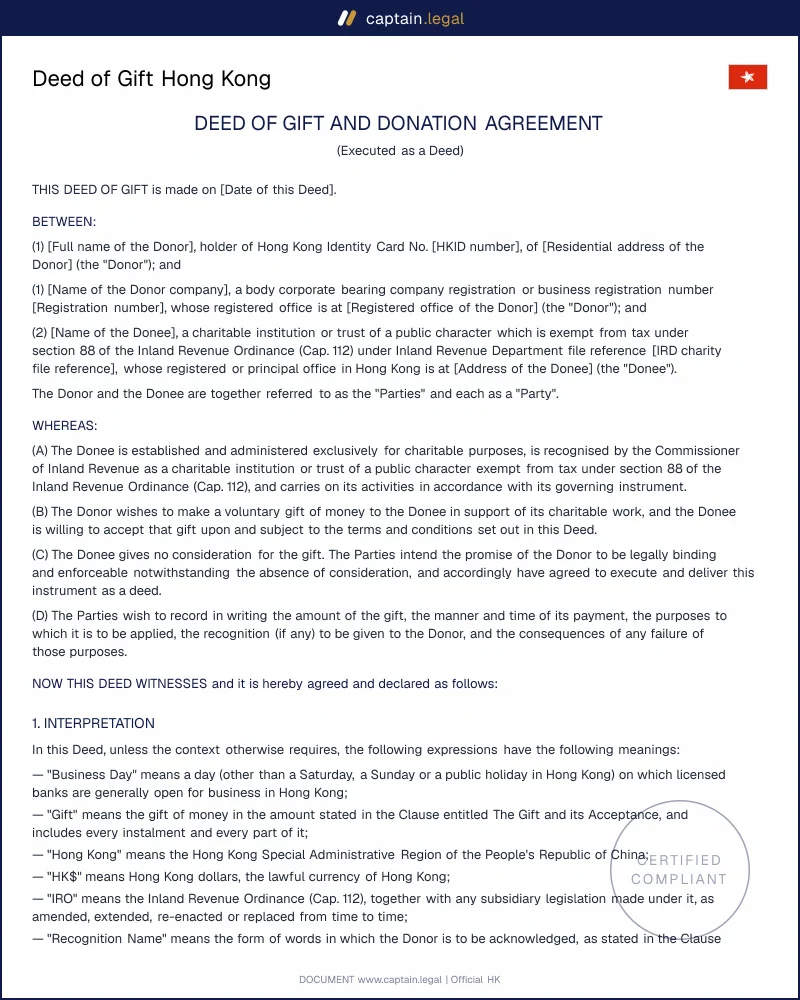
Hong Kong deed of gift drafted to Cap. 219 execution rules and section 26C of the Inland Revenue Ordinance for approved charitable donations.
4.8/531 reviews50 000+ downloadsInstant download
Share

A deed of gift and donation agreement records a voluntary transfer of money or property to a charity, a society or another donee, in a form that binds the donor although nothing of value passes back. Hong Kong donors reach for it when a gift carries conditions: a restricted purpose, instalments spread over several years, naming arrangements, or a right to recover funds applied elsewhere. Executed as a deed, the document solves the oldest problem in gift law, which is that a bare promise to give binds nobody. This charitable donation agreement is drafted for Hong Kong practice, with the acknowledgement and receipt terms a donor needs to support a deduction under section 26C of the Inland Revenue Ordinance (Cap. 112).

Compliant

2026 Legislation

50,000+ clients

trust us

Affordable

From $4.90 / doc

Secure payment

Instant download

Deed of Gift HK: Cap. 112 s.26C Donation Agreement

Secure payment

Fill in the template

What is a deed of gift in Hong Kong?

A gift is a transfer made voluntarily, without contractual obligation and without any benefit of a material character flowing back to the giver. That definition carries a weakness: a signed letter promising to donate lacks consideration, so the donee cannot sue on it if the donor changes his mind. Hong Kong law offers one clean answer, the deed. A promise in a properly executed deed binds without consideration, and the limitation period runs to twelve years under the Limitation Ordinance (Cap. 347) rather than the usual six.

A deed of gift is not a sponsorship agreement. Sponsorship buys visibility or association with a cause, which makes it a commercial contract taxable on both sides. Nor is it a legacy, which takes effect only on death. The template sits alongside the constitutions and policies in our Hong Kong charity and society governance documents, and is written for lifetime giving.

2

When do you need this document?

The commonest trigger is a multi-year pledge. A donor funds a scholarship, a clinic or a capital project across three or five financial years, and the organisation must book the commitment and satisfy its auditors that the money is legally promised. A pledge card will not do that; a deed will. The second scenario is the restricted gift, where money is given for a named programme and the donor wants the restriction written down rather than trusted to an institutional memory that changes with the next executive director.

Recognition is the third driver. Once a building, a chair or an annual prize carries a family name, both sides need to know what happens if the organisation later merges, relocates or faces reputational damage. Non-cash assets form the fourth group: shares in a family company, a flat, artwork, medical equipment, each needing a transfer mechanism and a valuation position. Donors who intend the gift to survive them often pair the deed with a Hong Kong will under the Wills Ordinance (Cap. 30), so that lifetime instalments and the legacy work together instead of duplicating each other.

3

Key clauses included in our template

  • The identification of the parties names the donee by its full registered title, its Companies Registry or Societies Officer reference and, where relevant, its charity file number.
  • The description of the gift distinguishes a single payment from a pledge payable by instalments, sets the dates on which each tranche falls due and states whether the promise binds the donor's estate. Gifts of shares or property carry a schedule identifying the asset precisely.
  • The purpose and application clause is the heart of a restricted gift. It states whether the donation is unrestricted, tied to a named programme or endowed with only the income applicable, and says what the organisation may do if that purpose becomes impracticable.
  • The recognition clause sets out naming rights, listing in annual reports and use of the donor's name or logo. It is drafted so that recognition reads as acknowledgement rather than as a benefit bargained for, which protects the payment's character as a gift.
  • The restitution clause entitles the donor or his estate to repayment of unapplied funds where the donee breaches the restriction, loses its charitable status or is wound up. The alternative is a gift over to a substitute charity.
  • The receipt and data clause obliges the donee to issue an official receipt within a stated period, confirms that no goods, services or material benefit were supplied in return, and governs donor information under the Personal Data (Privacy) Ordinance (Cap. 486), including the consent Part VIA requires before contact details are reused for fundraising.
4

Considerations by donee status and asset type

Section 88 recognised charities offer the cleanest position: the donor gets a deductible payment provided the gift is money and carries no material benefit. Check the Inland Revenue Department list of tax-exempt charities on the date of payment, not the date the deed was drafted, because recognition is reviewed periodically and can be withdrawn.

Unincorporated societies raise a different problem. A society registered under Cap. 151 has no separate legal personality, so the gift is normally made to named committee members who hold it on trust. The deed must identify those trustees and provide for succession when they retire. Donations to such a body are not deductible unless it separately holds section 88 recognition.

Gifts of Hong Kong stock need a transfer mechanism the deed alone does not supply, namely the instrument of transfer and bought and sold notes used for share transfers. Under section 27(4) of the Stamp Duty Ordinance (Cap. 117) a transfer for no or inadequate consideration is a voluntary disposition inter vivos and duty is assessed on value, though section 44 removes the charge where the beneficial interest passes by way of gift to a charitable institution or trust of a public character. That relief is not automatic: the instrument goes to the Collector of Stamp Revenue for adjudication under section 13.

Gifts of immovable property follow the same logic with higher stakes. Section 27(1) charges a conveyance operating as a voluntary disposition inter vivos as a conveyance on sale, so a flat given for love and affection attracts ad valorem duty on market value unless the section 44 exemption applies. Title passes by assignment, prepared as carefully as any sale and purchase document, then registered at the Land Registry.

Gifts in kind deserve a warning. The monetary value of donated property, whether artwork, equipment or land, is not deductible under section 26C. The deed still earns its place by recording title, condition, insurance and any obligation to display the item, but no one should promise the donor a tax outcome the Ordinance does not allow.

5

How to fill out this deed of gift

You begin by identifying the donor, choosing between an individual, a company and a family trust, since that choice drives the execution block and the tax analysis. The form then asks for the donee's full legal name, reference numbers and section 88 status, so that the receipt wording adjusts. Next comes the gift itself: a single sum or an instalment schedule, cash or a described asset, with the payment dates in a schedule rather than buried in the recitals.

The conditions block follows. You indicate whether the donation is unrestricted or tied to a purpose, whether capital is preserved and only income spent, and what recognition the donor expects. A restricted purpose activates the restitution and variation wording. You then choose the execution route, individual with witness or corporate under sections 127 and 128, and the document generates the matching attestation. Sign and date the deed before the donation is paid, not after. The file downloads in Word and PDF.

6

Common mistakes to avoid

The mistake that costs the most is treating recognition as a bargain. A donor who negotiates gala tables, advertising space or a discounted service alongside the payment turns the whole sum into something other than a gift, and the assessor disallows the deduction outright rather than apportioning it. A second common error is the vague purpose clause. "For education" leaves the organisation free to spend the money on anything defensible under that heading, while "to fund two named scholarships for students from low income households" creates a restriction the board must respect.

Third, a restricted gift can trap the charity. If the purpose fails and the deed says nothing, the money sits unspent pending an application to the court to apply it cy-pres, so a substitute purpose saves years. Fourth, execution goes wrong more often than it should: an unwitnessed signature, a missing seal, a company signature by a single director of a two-director company. Fifth, a gift made when the donor is already in financial difficulty can be attacked as a transaction at an undervalue under the Bankruptcy Ordinance (Cap. 6), and the charity is the party who has to repay.

Key takeaways

BINDING PROMISE

A deed makes the gift enforceable

A simple signed promise to donate can fail for lack of consideration, so the charity may have no claim if you change your mind. Executing the donation as a deed fixes that: a properly executed deed binds even though nothing of value comes back. It also shifts the time limit for claims to twelve years under the Limitation Ordinance (Cap. 347), not the usual six.

EXECUTION

Follow Hong Kong deed formalities

The document only does its job if it is executed as a deed in Hong Kong form. For individuals, it should be signed, sealed and delivered; under section 19 of the Conveyancing and Property Ordinance (Cap. 219), describing it as a deed and applying a seal mark (often a red wafer) supports the sealing presumption. Witness attestation is recommended practice. Companies should execute under sections 127 and 128 of the Companies Ordinance (Cap. 622).

TAX DEDUCTION

Section 26C relief is tightly policed

If you want a salaries tax or personal assessment deduction under section 26C of the Inland Revenue Ordinance (Cap. 112), the payment must be a donation of money to a section 88 approved charity or to the Government for charitable purposes. Deductions are capped at 35 per cent of assessable income after allowable deductions, with a HKD 100 minimum yearly aggregate, and amounts above the cap cannot be carried forward. Any material benefit can disqualify the whole payment, so the receipt wording matters.

Frequently Asked Questions

Yes, once executed correctly. The template follows the formalities Hong Kong law requires of a deed: for an individual, signature with a seal and delivery; for a company, execution under sections 127 and 128 of the Companies Ordinance (Cap. 622). Because the promise sits in a deed rather than a simple contract, the donee can enforce it although it gave nothing in return.

Both formats are produced at the end of the questionnaire. The Word file is the working version, useful when the finance committee adjusts the payment schedule or an adviser reviews the restriction wording before signature. The PDF is what you circulate for approval and file once signed, and most organisations store a scan of it alongside the donation receipt in case the Inland Revenue Department queries the deduction.

There is no statutory deadline, which is why the deed should fix one. Fourteen to thirty days after each payment is the usual term, and many organisations also send a consolidated annual receipt once the year of assessment closes on 31 March. Content matters more than speed: the receipt must carry the charity's full constitutional name and mark the sum clearly as a donation. Keep receipts for six years after the year of assessment ends.

Neither is required for a straightforward cash gift: a competent adult witness is enough, and Hong Kong law does not call for notarisation of a domestic deed of gift. Professional input earns its keep in three situations: gifts of immovable property, which need an assignment and stamping; gifts of shares in a private company, where the articles may restrict transfers; and gifts large enough to affect estate planning.

No. Section 26C and section 16D allow deductions only for donations of money, and the Inland Revenue Department has confirmed that the monetary value of gifted property, including landed property and works of art, falls outside the relief. Donors who want both sometimes sell the asset and donate the proceeds, which turns the gift into money, though that route carries its own stamp duty consequences.

It depends on the deed. Where it provides a substitute purpose, a power to vary with the donor's written consent or a right of restitution, the funds are redirected without external involvement. Where the deed is silent and the purpose has genuinely failed, the organisation may need to apply to the court for a cy-pres scheme, at a cost out of proportion to most gifts.

Not unilaterally, and that is the point of using a deed. Once delivered, the instrument binds the donor and his estate for the instalments promised, and the donee can sue on it within twelve years under the Limitation Ordinance (Cap. 347). Sensible deeds include an agreed exit, usually a hardship clause allowing suspension if the donor's circumstances change materially. Related governance templates sit in our Hong Kong document library.

4.8/5

31 verified reviews · 50 000+ downloads

Deed of Gift HK: Cap. 112 s.26C Donation Agreement
  • Immediate access to the document
  • PDF + Word download
  • Compliant with 2026 legislation
  • Reviewed by lawyers
Fill in the template
Secure payment
Updated on August 24, 2026

You might also like

Society Constitution Hong Kong
Hong Kong Volunteer Agreement