Business & Incorporation

HK Share Transfer Pack: Cap. 622 and Stamp Duty Rules

Instrument of transfer, bought and sold notes and board resolution drafted to the Companies Ordinance (Cap. 622) and 0.2% duty under Cap. 117 stamping.
4.5/519 reviews50 000+ downloadsInstant download
Share

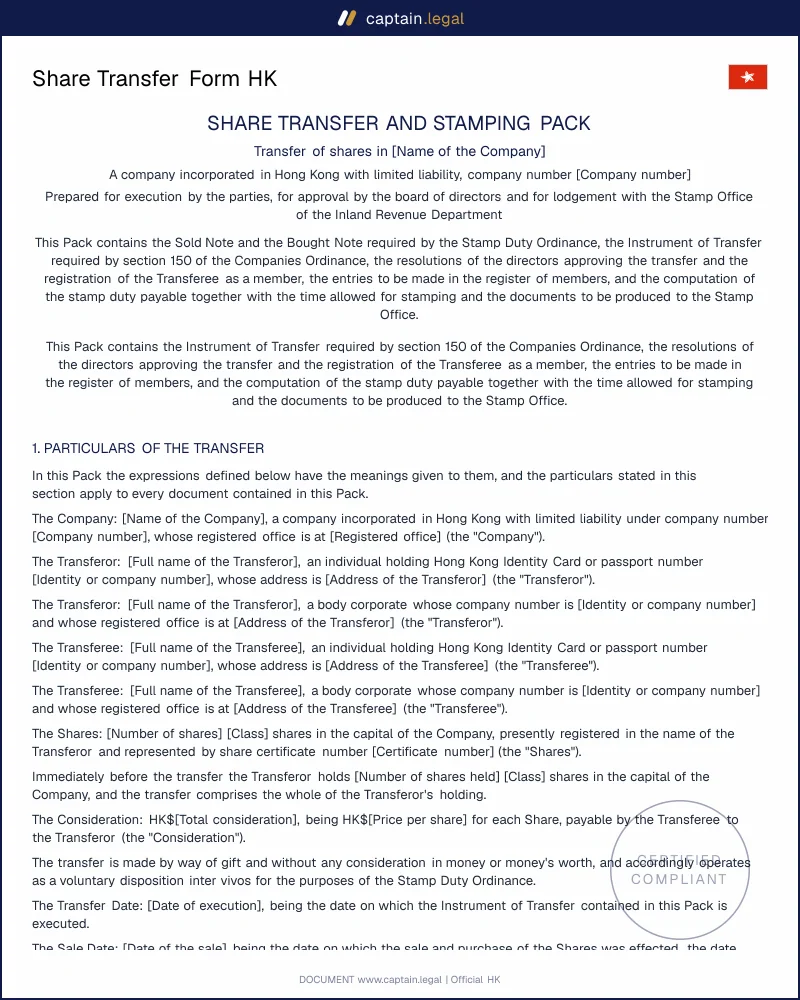
A share transfer in a Hong Kong private company is never one document. It is a small file of instruments that must be executed, stamped and registered in a fixed sequence: an instrument of transfer, a matching pair of bought and sold notes, a board resolution approving the transaction, and an updated register of members. This pack contains all four, drafted for a private company limited by shares governed by the Companies Ordinance (Cap. 622), with the stamp duty computation required under the Stamp Duty Ordinance (Cap. 117) built into the workflow. Directors, company secretaries, founders buying out a co-shareholder and corporate service providers use it to move legal title cleanly and to satisfy the Stamp Office on first submission.

Compliant

2026 Legislation

50,000+ clients

trust us

Affordable

From $4.90 / doc

Secure payment

Instant download

HK Share Transfer Pack: Cap. 622 and Stamp Duty Rules

Secure payment

Fill in the template

What is a share transfer and stamping pack?

A share transfer pack is the evidential trail that takes shares out of one person's name and puts them into another's. The instrument of transfer is the operative document: it is the "proper instrument of transfer" that section 150(1) of Cap. 622 requires before a company may register any transfer at all. The bought and sold notes are contract notes within the meaning of section 19 of Cap. 117, and they carry the ad valorem duty. The board resolution records the directors exercising the discretion the articles give them. The register of members entry is the step that confers membership, because a transferee holds nothing more than an equitable interest until the company writes the name in.

Practitioners often confuse this pack with a share purchase agreement. They do different work. An agreement fixes price, warranties and completion mechanics between buyer and seller; it transfers nothing. The pack here is the conveyancing layer that follows. It is also distinct from an allotment of new shares, which needs member approval under section 141 and triggers a return of allotment to the Registrar within one month rather than any stamping. If you are issuing fresh equity rather than selling existing equity, you need the Hong Kong business and company secretarial templates, not this one.

2

When do you need this document?

The most frequent trigger in Hong Kong practice is the founder buy-out. Two or three people incorporated a company, one wants out, and the others acquire the departing holding at an agreed price or at net asset value. Close behind sits the secondary sale to an incoming investor who buys existing shares rather than subscribing for new ones. A third scenario is the pre-restructuring reorganisation, where shares move between companies inside one group and the 90 per cent association test may take the transfer out of ad valorem duty altogether.

Succession supplies the rest of the volume. A parent transferring a controlling block to an adult child at nil consideration is making a gift, and the absence of a price does not reduce the duty by a single dollar, because the charge follows value. Two edge cases deserve flagging. Where a departing shareholder is also an employee or director, the transfer travels with a resignation and should be sequenced with the employment and termination documents required under the Employment Ordinance. And where the registered holder has died, section 153 allows the personal representative to execute a valid transfer without first being registered as a member.

3

Key clauses included in our template

  • The instrument of transfer identifies both parties exactly as their names appear in the register of members, with identity card or passport numbers for individuals and company numbers for corporate holders. It states the number and class of shares, the consideration, and carries execution blocks with witness attestation. A mismatch between register and instrument is the commonest reason a file comes back from the Stamp Office.
  • The bought and sold notes carry the particulars section 19 of Cap. 117 demands: whether each party acts as principal or agent, the date of the transaction and of the note, the quantity and description of the stock, the price per share and total consideration, and the date of settlement.
  • The board resolution records that the directors considered the instrument, waived or confirmed compliance with any pre-emption provisions, approved registration, cancelled the old certificate and directed the secretary to update the statutory records.
  • The register of members update arrives as a completed entry rather than a blank form, showing the transferee's particulars, the date of entry and the date the transferor ceased to hold, alongside a new certificate for signature and sealing.
  • The stamp duty computation sheet sets consideration and net asset value side by side and applies the higher figure, with a working note for the adjustment the Stamp Office expects where dividends have been declared since the last audited accounts.
  • The submission checklist covers the annual return or articles, the sale agreement or a signed confirmation that none exists, the schedule of landed properties and the accounts. Where a party signs through an attorney, the pack cross-refers to a general power of attorney deed drafted for Hong Kong use.
4

Situations that change the stamping analysis

Sales for consideration follow the standard path: two contract notes at 0.1 per cent each, an instrument of transfer at the fixed duty, and stamping through the e-stamping service on GovHK. The contract note clock runs from the moment the sale is effected, not from the day your accountant assembles the file, giving two days where the sale is effected in Hong Kong and thirty where it is effected elsewhere.

Gifts and nil consideration transfers drop the contract notes and shift the whole ad valorem charge onto the instrument, which must be stamped within seven days of execution, or thirty days if executed outside Hong Kong.

Intra-group transfers can be relieved under section 45 where one body corporate holds at least 90 per cent of the issued share capital of the other, or a third company holds that proportion in both. The association must survive two years after the transfer, and the Collector can claw the relief back if the group is unwound early.

Companies holding Hong Kong immovable property attract the closest scrutiny. The Stamp Office requires a schedule of landed properties and will not accept book value where the property has appreciated, so the net asset figure must rest on current valuations. Anyone dealing with a property holding vehicle should review the underlying title and tenancy paperwork among our Hong Kong property and tenancy documents before agreeing a price.

Shares that are not Hong Kong stock fall outside the charge. Duty attaches to stock the transfer of which must be registered in Hong Kong, so shares in a British Virgin Islands or Cayman holding company whose register sits offshore are not chargeable, even where the operating business and every director are in Hong Kong.

5

How to complete your share transfer and stamping pack

You begin with the company details, the number and class of shares moving, and whether the transfer is a sale or a gift, because that single answer decides whether contract notes are generated and which deadline applies. The form then asks for the transferor and transferee particulars in the format the register of members uses, then takes the consideration alongside the net asset value from the most recent accounts, applying the higher figure to the duty calculation. Next comes the board approval, where you confirm the directors in office and whether the articles contain pre-emption rights that have been waived or exhausted. The output is a consistent file in Word and PDF: instrument of transfer, contract notes where applicable, board resolution, register entry, share certificate and submission checklist. You execute, submit through e-stamping, lodge the stamped instrument with the company, and the secretary completes the register.

6

Common mistakes to avoid

The most expensive error is treating the sale agreement as the transfer. Parties sign, shake hands, move the money, and do nothing further for months, only to find that legal title never shifted and the duty clock expired long ago. Almost as common is the nominal consideration trap, where shares are sold for one dollar in the belief that duty follows the stated price. It does not; the Collector assesses on value and treats an undervalued sale as a voluntary disposition. Stale accounts cause the next tier of delay, because where the audited accounts are not made up to a date within six months of the transfer, the Stamp Office wants certified management accounts running to a date within three months of it.

Companies also update the register of members and stop there, forgetting the significant controllers register. That register must be corrected as soon as practicable and in any event within seven days of the change becoming known. Finally, secretaries issue the new share certificate before the instrument has been stamped, which is premature under section 155 and awkward to unwind if the Collector assesses a higher value than the parties declared.

Key takeaways

Paper trail

A transfer needs four linked documents

A Hong Kong share transfer is a file, not a single form: instrument of transfer, bought and sold notes, board resolution, and an updated register of members. The instrument is the “proper instrument of transfer” required by section 150(1) of the Companies Ordinance (Cap. 622) before the company may register anything. Until the register of members is updated, the buyer only has an equitable interest, not membership.

Company timing

Registration and certificates have set windows

Once the transfer is lodged, section 151(2) of Cap. 622 gives the company two months to register it or issue a refusal notice to both parties. If either party asks, written reasons for refusal are due within 28 days. Section 155 then ties the issue of a new share certificate to a two-month timeframe from lodgement, but that obligation pauses while stamp duty remains unpaid.

Stamp duty

0.2% duty, plus penalties for delay

Stamping sits under the Stamp Duty Ordinance (Cap. 117). Since 17 November 2023, the bought and sold notes each bear 0.1% ad valorem duty, so a sale is 0.2% in total, charged on consideration or share value, whichever is higher. The instrument of transfer also carries a fixed HKD 5 duty. Late stamping triggers heavy multipliers: twice the duty within one month, four times within two months, and ten times thereafter.

Frequently Asked Questions

Yes, provided each step is completed. Once executed by both parties and duly stamped, the instrument is the proper instrument of transfer that section 150 of Cap. 622 requires, and the board resolution evidences the directors' approval. Legal title passes when the company enters the transferee in the register of members, not when the parties sign, so registration rather than signature is the moment the buyer becomes a member with voting rights.

Ad valorem duty runs at 0.1 per cent on each contract note, so a sale between two parties carries 0.2 per cent in aggregate, plus a fixed duty of five Hong Kong dollars on the instrument of transfer. The charge is computed on the consideration or the value of the shares, whichever is higher, and for an unquoted company that value means net asset value taken from the latest accounts. The seller bears the sold note and the buyer the bought note, though parties often agree otherwise.

Contract notes must be stamped within two days after the sale is effected in Hong Kong, or thirty days where it is effected elsewhere. An instrument of transfer on an ordinary sale is due for stamping before execution, or within thirty days if executed outside Hong Kong. Late stamping attracts twice the duty for a delay up to one month, four times between one and two months, and ten times beyond that, though the Collector may remit the penalty where the delay is explained in writing.

Largely. The Inland Revenue Department operates an e-stamping service through GovHK that accepts applications around the clock without the original instruments being presented, and issues a stamp certificate carrying the same legal effect as an impressed stamp. Supporting accounts are uploaded with the application. What cannot be done online is the internal step: the board still has to approve the transfer and the secretary still has to write the entry in the register of members.

There is no standalone filing for a share transfer. The change surfaces at the next annual return, where a private company reports its members as at the return date, and it must be reflected in the significant controllers register if the transfer alters who ultimately controls the company. Related corporate filings and governance documents sit in our catalogue of Hong Kong legal templates.

Both formats come with every document. The Word version matters more than usual here, because share transfers rarely go through unamended: articles impose pre-emption wording that has to be recited, and corporate transferors need an execution block referencing their own board authority. Companies limited by guarantee have no share capital and use the governance documents in our Hong Kong non-profit and association templates instead.

4.5/5

19 verified reviews · 50 000+ downloads

HK Share Transfer Pack: Cap. 622 and Stamp Duty Rules
  • Immediate access to the document
  • PDF + Word download
  • Compliant with 2026 legislation
  • Reviewed by lawyers
Fill in the template
Secure payment
Updated on August 20, 2026

You might also like

Articles of Association Hong Kong
Shareholders Agreement HK
Share Transfer Form HK: Instrument and Contract Notes