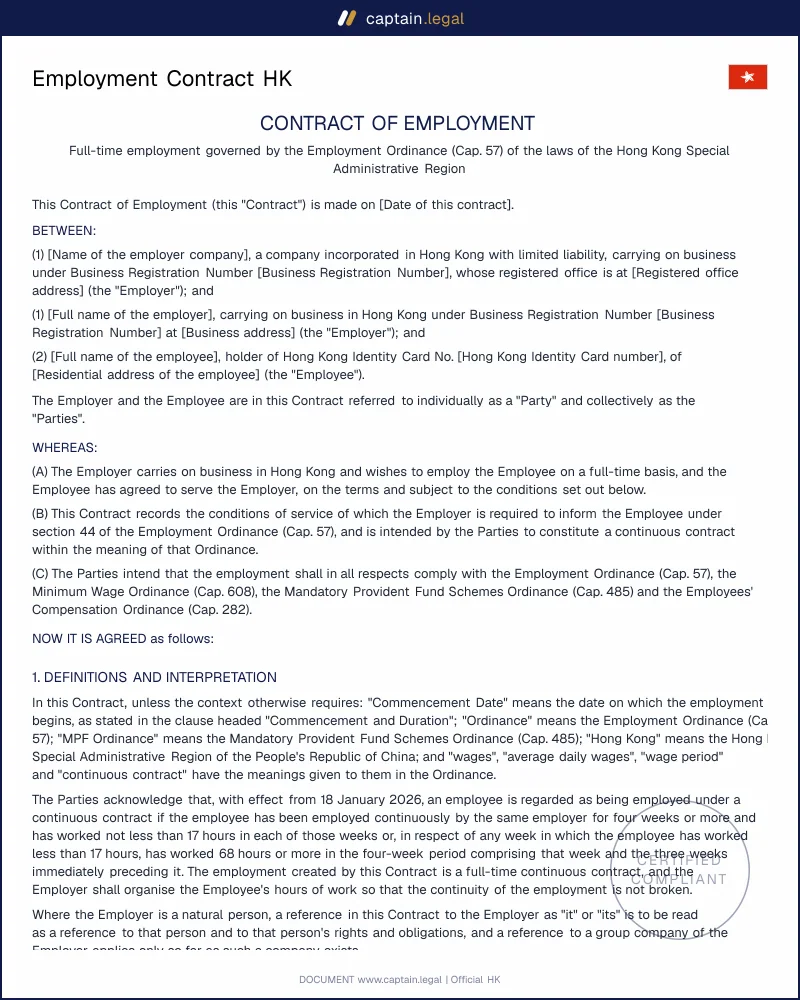
The Employment Ordinance (Cap. 57), administered by the Labour Department, sets the minimum terms every full-time contract must respect. Its organising concept is the continuous contract, defined in the First Schedule, because the substantive benefits depend on it: rest days under section 17, paid annual leave under section 41AA, sickness allowance under section 33, severance payment under section 31B and long service payment under section 31R. The Employment (Amendment) Ordinance 2025 replaced the old 418 test with the dual threshold practitioners call the 417/468 rule. A week counts towards the four consecutive weeks requirement if the employee worked at least 17 hours in that week, or, where it falls short, if the employee worked 68 hours or more across that week and the three weeks immediately preceding it. The four-week requirement itself is unchanged. The threshold applies from 18 January 2026, without retrospective effect, and in any dispute the burden of showing that a contract is not continuous falls on the employer, as the Labour Department briefing on the revised continuous contract requirement confirms.
Payment discipline is equally statutory. Wages fall due on the last day of the wage period and must be paid within seven days of its end under section 23; sums payable on termination follow the same rule under section 25; deductions are capped by section 32 at half the wages payable in any wage period. Three statutes sit around the contract: the Mandatory Provident Fund Schemes Ordinance (Cap. 485), requiring enrolment of a new relevant employee within 60 days, the Employees' Compensation Ordinance (Cap. 282), whose section 40 makes work injury insurance compulsory, and the Minimum Wage Ordinance (Cap. 608). Since 1 May 2025, mandatory MPF contributions no longer offset severance or long service payments for service from that date, which changes the real cost of a termination. The four anti-discrimination ordinances and the Personal Data (Privacy) Ordinance (Cap. 486) govern the records the contract generates. It belongs beside the rest of the employment and HR paperwork drafted for the Employment Ordinance.