Employment & HR

Termination Letter Hong Kong: Cap. 57 ss. 6, 7 and 9

Hong Kong termination letter drafted to sections 6, 7, 9 and 25 of the Employment Ordinance (Cap. 57), with a summary dismissal variant. Word and PDF download.
4.7/518 reviews50 000+ downloadsInstant download
Share

A termination letter is the document a Hong Kong employer issues to end a contract of employment, recording the last day of service, the notice given or bought out, and the money that falls due on departure. The Employment Ordinance (Cap. 57) does not oblige an employer to explain itself, but it is unforgiving about notice periods and about the seven day payment deadline. This template covers the ordinary route, termination on contractual notice or on payment in lieu of notice, and the exceptional one, summary dismissal for serious misconduct. It is built for HR managers, company secretaries and directors who need a dismissal letter that will still read well if the Labour Tribunal sees it.

Compliant

2026 Legislation

50,000+ clients

trust us

Affordable

From $4.90 / doc

Secure payment

Instant download

Termination Letter Hong Kong: Cap. 57 ss. 6, 7 and 9

Secure payment

Fill in the template

What is a termination letter in Hong Kong?

A termination letter is the employer's written notice that the employment relationship ends on a stated date. Hong Kong law prescribes no form for it. Sections 6 and 7 of the Employment Ordinance let either party end a continuous contract by giving notice or paying wages in lieu, orally or in writing, so a verbal dismissal is lawful. It is also a gift to the other side in a dispute: the employer carries the burden of proving what was said and what was offered.

Practitioners keep it apart from three neighbouring documents. A resignation acceptance responds to the employee's decision and carries none of the employer's notice obligations. A mutual separation agreement is a negotiated settlement in which the employee releases claims for an agreed sum, and it sits outside the notice machinery entirely. A certificate of service is a courtesy issued after departure. Our employment and HR templates drafted for the Employment Ordinance keep these instruments separate, because merging them into one termination letter is how employers waive a notice right or promise a reference they later regret.

2

When do you need this document?

Redundancy is the most common trigger. A closure, a relocation out of Hong Kong or the disappearance of a function generates a dismissal that has to be papered properly. An employee with 24 months of continuous service is owed a severance payment under section 31B and will expect the letter to account for it. Restructuring inside a group raises the same issue more quietly: moving someone to a sister company is a termination and a fresh hire unless continuity is expressly preserved. Poor performance and repeated conduct problems form the next cluster, and there the termination letter follows a warning trail rather than replacing it. Probation confirmations that go the other way are the third, usually served on seven days.

Two situations catch employers out. Where the departing employee is a director or bank signatory, the dismissal must be sequenced with the corporate paperwork, and our Hong Kong company and incorporation documents carry the resolutions that strip authority as the employment ends. Where the employee holds a work visa, the last day drives both the immigration position and the tax filing, so it must be firm rather than floating.

3

Key clauses included in our template

  • The identification of the parties and the contract names the employer exactly as it appears on the Business Registration Certificate, the employee as named in the original contract, and the date of that contract. A letter issued on group letterhead by an entity that is not the contracting employer invites an argument at the Tribunal about who dismissed whom.
  • The last day of employment is separated from the date notice is given, because that distinction decides whether the twelve month wage average runs to the notice date or the termination date.
  • The notice election records whether the employer gives contractual notice, pays wages in lieu, or combines a short worked period with a bought out balance, and cross checks the contractual period against the statutory floor.
  • The ground for termination stays optional and is drafted narrowly where it is used, since a stated reason becomes the reason the employer must defend if a Part VIA claim follows.
  • The final settlement schedule itemises outstanding wages, payment in lieu, accrued annual leave, pro rata end of year payment and any severance or long service payment. The seven day deadline is stated on the face of the termination letter.
  • The return of property and confidentiality reminder lists devices, access cards, records and keys, and restates the surviving confidentiality obligation. Where the employee occupies a company leased flat, it dovetails with the surrender arrangements in our Hong Kong tenancy and property documents.
4

Considerations by employee category

Probationers are the group employers handle most carelessly. Within the first calendar month of probation the contract can end on the day, with no notice and no payment in lieu, but that window shuts at one month and the seven day floor governs from then on. Probation suspends nothing else: statutory holidays, the wage rules and the anti-discrimination ordinances bite from day one, and a probationer dismissed on a discriminatory ground has the same claim as anyone else.

Part-time and irregular hours staff changed status when the continuous contract threshold moved from the old 418 rule to the 468 rule. An employee now qualifies after four or more weeks if weekly hours reach 17, or if the hours across that week and the three preceding weeks total 68. Rosters deliberately built below 18 hours a week no longer keep staff outside the continuous contract regime, so notice rights, annual leave pay and severance eligibility reach a population many employers still treat as casual.

Employees with two years or more of service carry the heavier bill. Severance under section 31B follows redundancy or lay-off after 24 months, and long service payment under section 31R follows most other dismissals after five years. Part VIA gives that same group a remedy where no valid reason exists among the five statutory grounds. Since the transition date of 1 May 2025, mandatory employer contributions to the Mandatory Provident Fund can no longer be applied against the part of severance or long service payment referable to later service, though voluntary contributions and service based gratuities still can.

Non-profit and subvented employers get no dispensation. A registered society, a company limited by guarantee or a subvented service unit is an employer like any other under Cap. 57, and the constitutional documents in our charity and society governance templates usually require a committee resolution before a paid officer is dismissed. Skipping it turns a valid statutory notice into an invalid internal act.

5

How to fill out this termination letter

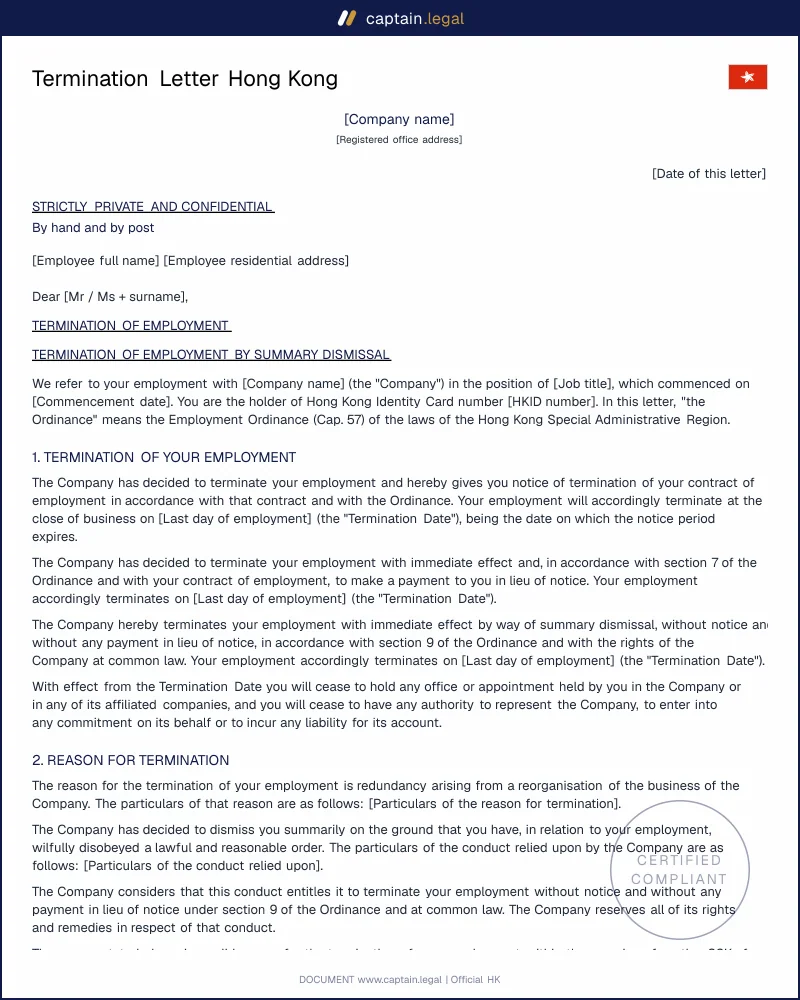
You begin by choosing the route, notice or payment in lieu or summary dismissal, because the rest of the letter reshapes around that choice. The form asks for the contractual notice period and compares it against the statutory minimum, flagging any clause that drops below seven days. Wage details come next, and the guided fields separate basic wages from the commission and allowances that count when the twelve month average is built. You then enter the last day, and the termination letter calculates the deadline section 25 imposes.

The settlement schedule is assembled line by line, so accrued annual leave, pro rata end of year payment and any severance entitlement appear separately rather than as one figure the employee cannot check. The summary dismissal variant swaps in the statutory ground and the investigation record. You finish with the property return list and the signature block, then download in Word to adapt the wording or in PDF to issue as it stands.

6

Common mistakes to avoid

The most expensive error is treating summary dismissal as a shortcut out of a difficult exit. Section 9 is a narrow gate, and a Tribunal that rejects the ground awards payment in lieu, severance or long service payment, often with costs. Close behind sits the seven day settlement deadline, missed because payroll runs monthly and nobody adjusts the cycle. Late payment triggers interest and, where the failure is wilful, prosecution. A third recurring problem is the stated reason: no obligation exists to give one, yet a termination letter routinely offers a vague justification that later locks the employer into defending it.

Two administrative traps complete the picture. Form IR56F goes to the Commissioner at least one month before cessation under section 52(5) of the Inland Revenue Ordinance (Cap. 112), and where the employee is leaving Hong Kong the IR56G route requires payments to be withheld for one month or until the letter of release arrives. Releasing the final settlement to a departing expatriate before tax clearance can leave the employer paying that tax twice. The second is residual authority: a senior employee may hold a bank mandate or a power of attorney that outlives the job, and revocation runs through the powers of attorney and authorisation letters, not the dismissal.

Key takeaways

NOTICE

Notice must meet the statutory floor

Under the Employment Ordinance (Cap. 57) ss. 6 and 7, termination can be by giving notice or by payment in lieu, and the letter should state which route you are using and the last day of service. The notice period is the contractual period if stated, but never less than seven days, and it becomes at least one month where the contract is silent.

PAYMENTS

Seven days to settle most sums

Cap. 57 s. 25 puts a hard clock on termination money: wages and other termination payments (other than statutory severance) must be paid as soon as practicable and in any event within seven days after the last day of employment. Late payment can attract interest, and wilful non-payment is a criminal offence that may expose directors to personal liability.

MISCONDUCT

Summary dismissal needs provable serious grounds

Summary dismissal under Cap. 57 s. 9 is the exception: no notice and no payment in lieu only where the employee has, for example, wilfully disobeyed a lawful and reasonable order, committed misconduct, fraud or dishonesty, or been habitually neglectful of duties. The employer bears the burden of proof, and a single lapse rarely justifies this route.

Frequently Asked Questions

Yes, provided it reflects the underlying contract and the Employment Ordinance. A dismissal takes effect through notice or payment in lieu under sections 6 and 7, and the letter is the evidence of what was given and when. The template reproduces the statutory minimum notice, records the wage basis used for any payment in lieu and itemises the final settlement, which is what the Labour Tribunal reads first. It cannot make an unlawful dismissal lawful: a termination served on a pregnant employee protected by section 15 stays prohibited however carefully it is drafted.

For a continuous contract the length is whatever the contract specifies, subject to a statutory floor of seven days, and not less than one month where the contract says nothing. During the first month of probation neither party owes notice; after that month the seven day floor applies. Either party may instead pay wages in lieu under section 7, calculated on the average daily or monthly wages over the preceding twelve months.

Only within section 9, which covers wilful disobedience of a lawful and reasonable order, misconduct, fraud or dishonesty and habitual neglect of duties, alongside the common law grounds. The employer bears the burden of proof, and the Labour Department treats summary dismissal as reserved for very serious misconduct or failure to improve after repeated warnings. A single incident rarely qualifies unless it is grave. Where the ground holds, no payment in lieu or severance is due, though accrued wages and annual leave pay still are.

Every termination payment other than statutory severance falls due as soon as practicable and within seven days of the last day, under section 25. Severance is different: it is due within two months of the employer receiving the employee's written claim. Missing it attracts interest on the outstanding wages, and a wilful failure is a criminal offence for which directors can be prosecuted personally. A monthly payroll cycle is not a reasonable excuse.

No. Hong Kong courts have confirmed that an employer terminating on proper notice or payment in lieu need not explain the decision, and the implied duty of mutual trust and confidence does not extend to the act of termination. The position shifts once the employee reaches 24 months of service, because Part VIA lets them ask the Tribunal whether a valid reason existed among the five statutory grounds. Many practitioners omit it from the termination letter and hold the evidence in reserve.

Only in part. Since the transition date of 1 May 2025, accrued benefits from an employer's mandatory contributions can no longer be applied to the part of severance or long service payment relating to later service. Voluntary contributions and gratuities based on years of service remain available. For staff employed before that date the earlier portion can still be offset, and employers funding the later portion may apply to the subsidy scheme within three months of paying.

Both. The termination letter downloads as an editable Word file when you want to adjust the wording or use company letterhead, and as a PDF when it is ready to issue or file. The summary dismissal variant comes in the same two formats. Other Hong Kong HR instruments, including employment contracts and warning letters, sit in the complete Hong Kong document catalogue.

4.7/5

18 verified reviews · 50 000+ downloads

Termination Letter Hong Kong: Cap. 57 ss. 6, 7 and 9
  • Immediate access to the document
  • PDF + Word download
  • Compliant with 2026 legislation
  • Reviewed by lawyers
Fill in the template
Secure payment
Updated on August 22, 2026

You might also like

Employment Contract HK
Severance & Long Service Payment HK