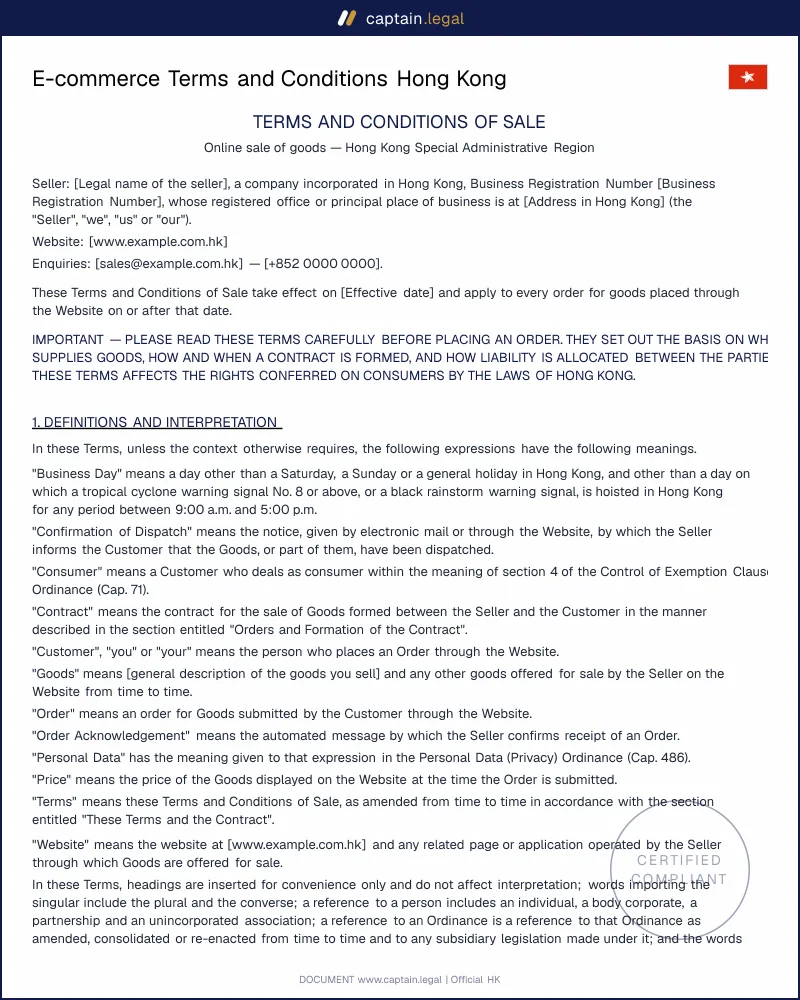
Hong Kong governs online selling through a patchwork of ordinances layered over the common law of contract, not a dedicated e-commerce code. The Sale of Goods Ordinance (Cap. 26) supplies the implied conditions sitting under every sale: title under section 14, correspondence with description under section 15, merchantable quality and fitness for purpose under section 16, sale by sample under section 17. Section 2(5) measures merchantable quality by appearance and finish, freedom from minor defects, safety and durability. Section 57(4) makes any term excluding sections 15, 16 or 17 void in a consumer sale, which section 57(7) defines as a business sale of goods ordinarily bought for private use to a buyer acting outside a business.
The Control of Exemption Clauses Ordinance (Cap. 71) polices your limitation language. Liability for death or personal injury caused by negligence cannot be excluded at all under section 7(1); other negligence losses can be capped only so far as the term is reasonable, and section 11(2) blocks any contracting out of the Cap. 26 undertakings against a person dealing as consumer. Services follow a parallel track under the Supply of Services (Implied Terms) Ordinance (Cap. 457), which implies reasonable care and skill at section 5.
Marketing copy answers to the fair trading sections of the Trade Descriptions Ordinance (Cap. 362), which since the 2013 amendments reach services as well as goods and create offences for misleading omissions, aggressive practices, bait advertising and wrongly accepting payment. The Customs and Excise Department enforces them, and conviction on indictment carries imprisonment for five years. Formation is validated by the Electronic Transactions Ordinance (Cap. 553): section 17 recognises contracts concluded by electronic records, and section 6 accepts any electronic signature that is reliable and agreed by the recipient. Read the official text of the Sale of Goods Ordinance on Hong Kong e-Legislation before adapting any warranty wording.