Personal & Family

Advance Medical Directive Cap. 651: Hong Kong AMD Form

Advance medical directive drafted to the Advance Decision on Life-sustaining Treatment Ordinance (Cap. 651), in force since 31 July 2026. Word and PDF.
4.7/513 reviews50 000+ downloadsInstant download
Share

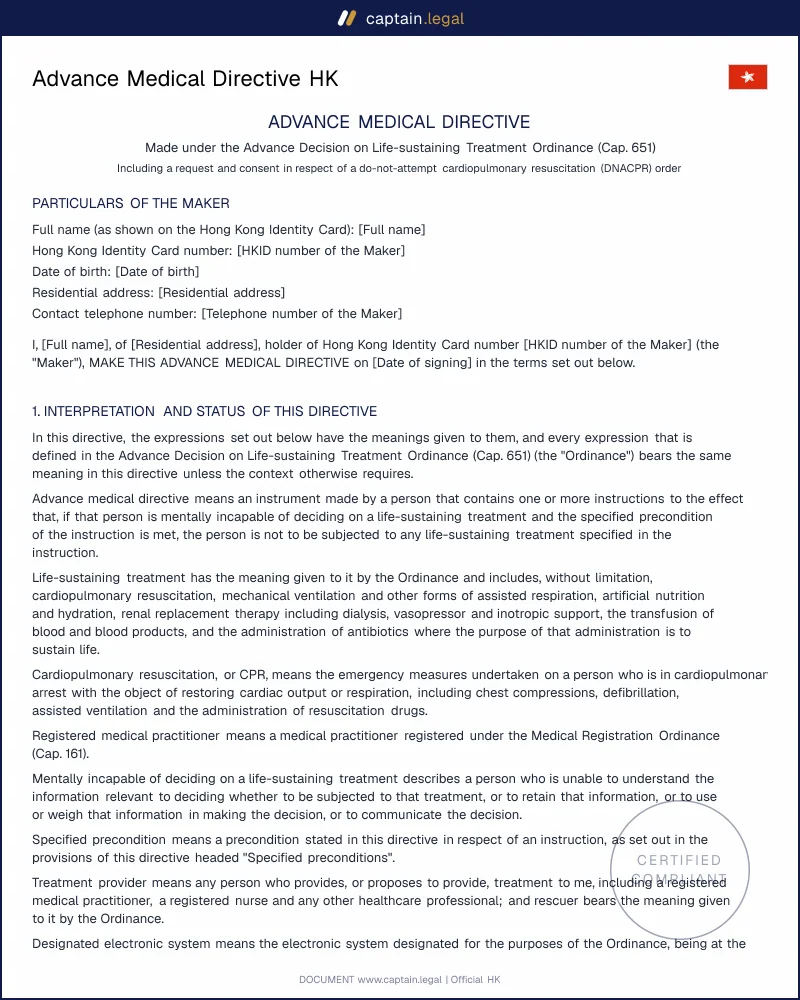
An advance medical directive is the written instrument by which an adult in Hong Kong refuses specified life-sustaining treatment in advance, so that it still speaks when they cannot. Since the Advance Decision on Life-sustaining Treatment Ordinance (Cap. 651) came into operation on 31 July 2026, that refusal binds treating doctors and rescuers instead of merely guiding them. The template is drafted to Cap. 651 and follows the structure of the model form in Schedule 2, with the specified preconditions, the treatment instructions and the two witness attestation blocks in the order a registered medical practitioner expects. It is built for Hong Kong residents planning end of life care.

Compliant

2026 Legislation

50,000+ clients

trust us

Affordable

From $4.90 / doc

Secure payment

Instant download

Advance Medical Directive Cap. 651: Hong Kong AMD Form

Secure payment

Fill in the template

What is an advance medical directive in Hong Kong?

An advance medical directive is made by an adult who is still mentally capable. It contains instructions that a named life-sustaining treatment is not to be given once two conditions hold together: the maker has lost the mental capacity to decide on it, and the precondition written into the instruction has been reached. Cap. 651 shortens the term to AMD and treats the instrument as a refusal, never a request. It cannot demand a treatment your doctors consider futile, and it cannot refuse basic care, meaning food and drink by mouth and help in taking them, or palliative care.

Hong Kong practice keeps three neighbouring documents apart, and confusing them is why families arrive at hospital holding the wrong paper. An enduring power of attorney under Cap. 501 and its Prescribed Form Regulation covers property and financial affairs only, so the attorney cannot refuse treatment for you. A Hong Kong will drawn to section 5 of the Wills Ordinance operates after death, not in the weeks before it. The AMD fills the gap. A DNACPR order is different again: two registered medical practitioners, one a specialist, sign it on a prescribed form so that rescuers can act on a refusal of resuscitation in seconds.

2

When do you need an advance medical directive?

The usual trigger is a diagnosis. A patient told that an illness is advanced, progressive and irreversible often wants the ventilator question settled while the conversation is still calm, and a directive signed in a clinic room after a full discussion is worth far more than one signed in a crisis. Admission to a residential care home is the second common moment, because homes will ask what documentation exists before a night shift has to call an ambulance.

Household structure drives the rest. Residents living alone, or with adult children settled overseas, sign a directive so that a hospital does not have to guess and a distant relative does not have to decide by telephone. Couples often prepare together, alongside a section 7 general power of attorney under the Powers of Attorney Ordinance for the banking side of the same exercise. One edge case deserves attention. Anaesthesia routinely involves interventions that resemble resuscitation, so a blanket refusal of CPR must be discussed with the anaesthetist before the day.

3

Key clauses included in our template

  • The identification and capacity block records your name, Hong Kong identity card particulars and date of birth, then states that you are an adult and mentally capable of deciding on a life-sustaining treatment at the moment of signing.
  • The specified preconditions are the trigger conditions you choose, and the template offers the three from the statutory model form: terminal illness, meaning an advanced, progressive and irreversible condition with a life expectancy measured in days, weeks or months; a persistent vegetative state or a state of irreversible coma; and any other end stage, irreversible, life limiting condition, which must be named rather than left blank.
  • The treatment instructions set out what you refuse against each precondition, whether cardiopulmonary resuscitation alone, named treatments such as artificial ventilation or dialysis, every form of life-sustaining treatment except artificial nutrition and hydration, or every form of it. Do not tick the widest option without discussing artificial nutrition and hydration with your doctor. A reservation clause confirms that nothing refuses basic care or palliative care.
  • The attestation block gives separate panels to the two witnesses, with the doctor's declaration on capacity and explanation, their registration particulars, and a declaration by each witness that they are not an interested person.
  • The revocation and notification schedule lists who holds a copy, revokes any earlier directive, and adds a wallet card and a covering letter to your family doctor so the document can be found.
4

Where the directive has to work: hospital, care home and out of hospital rescue

Public hospitals are the setting the Ordinance was designed around, and the Hospital Authority has the longest experience of advance directives. Voluntary storage of an electronic copy in the electronic Health Record Sharing System is what makes a directive visible to a hospital you have never attended. Notice is the operative concept throughout Cap. 651: a treatment provider who never sees a validating copy, and is never told one is stored electronically, is protected for treating you.

Private hospitals and residential care homes have had less exposure to advance directives than the public sector. Hand a copy to the admitting office in writing. Care home staff are not registered medical practitioners and cannot determine that a precondition has been met, which is why a resident who has refused resuscitation is normally also assessed for a DNACPR order signed by two doctors.

Out of hospital rescue is the reason that order exists as a separate instrument. Ambulance crews act on a validating copy of the order, not on a reading of a directive. The Ordinance also preserves the reflex to resuscitate where the arrest may have arisen from an unnatural cause or a self-inflicted injury.

At home, the question is who is present. Many households rely on a domestic helper as the daytime carer, and that helper should know where the document is kept and whom to telephone. Employers in that position often review the domestic helper hiring and termination pack for Hong Kong at the same time, so that caring duties and the employment contract stay consistent.

5

How to fill out this advance medical directive

You begin by choosing between the full directive and the short version limited to refusal of cardiopulmonary resuscitation, which is the right starting point for most people whose only firm decision is about CPR. The form asks for your particulars, then takes the three specified preconditions one at a time, so you can attach different instructions to different conditions.

The document is generated in Word and PDF. Print it, but do not sign it before your witnessing appointment: Cap. 651 requires the signature to be made in the presence of the two witnesses, and a form signed at home is defective on its face. Take it to the doctor who knows your condition, work through the explanation the Ordinance requires, then sign with the second witness present. Keep the original, give copies to your family doctor and to the person you would want contacted, and carry the wallet card. The rest of your personal and family paperwork for Hong Kong can be prepared in the same sitting.

6

Common mistakes to avoid

The witnessing rules account for most defective directives. Two friends, or a solicitor and a spouse, will not do: one witness must be a registered medical practitioner, and neither may be an interested person. Asking the daughter who stands to inherit to witness the document destroys it. The next failure is silence: a directive locked in a drawer at home protects nobody, since a doctor with no notice of it is expressly protected for administering treatment.

The remaining errors are conceptual. People assume an AMD covers money as well as medicine, and discover on the ward that financial decisions need an enduring power of attorney registered with the High Court. They assume a refusal of resuscitation stops an ambulance crew, when what stops an ambulance crew is a DNACPR order signed by two doctors on a prescribed form. And they leave outdated copies circulating among relatives. A fresh AMD revokes the earlier one, so collect the old copies.

Key takeaways

LEGAL EFFECT

From 31 July 2026, it binds

An advance medical directive (AMD) is a statutory refusal under the Advance Decision on Life-sustaining Treatment Ordinance (Cap. 651), in force since 31 July 2026. If the AMD is valid and applicable, it binds treating doctors and rescuers rather than merely guiding them. It only operates once you have lost capacity and the written precondition for that instruction has been reached.

MAKING IT

Two witnesses, one must be a doctor

Cap. 651 is strict on how an AMD is made. You must be an adult with mental capacity, and the refusal must be in writing and clear enough to act on. You sign before two witnesses, and neither witness can be an interested person, so relatives and likely beneficiaries are usually excluded. One witness must be a registered medical practitioner who confirms capacity and explains the consequences.

LIMITS

You can refuse treatment, not basic care

An AMD is never a request for treatment: it can refuse specified life-sustaining treatment, but it cannot compel doctors to provide treatment they consider futile. It also cannot refuse basic care, meaning food and drink by mouth and help in taking them, nor can it refuse palliative care. Do not confuse it with an enduring power of attorney (property and finances only), a will (after death) or a DNACPR order.

Frequently Asked Questions

The template is drafted to the requirements of Cap. 651, and a directive that satisfies them binds treatment providers who have notice of it. Binding force comes from the execution, not the paper. You must be an adult and mentally capable when you sign, the instructions must be clear, and the signature must be made before two witnesses, one a registered medical practitioner who declares that you were capable and that each instruction was explained.

No. The registered medical practitioner is a structural requirement, not an administrative one. That doctor must be satisfied that you are mentally capable of deciding on a life-sustaining treatment, must explain what following each instruction would mean for your own condition, and must record both in the directive. A form witnessed by two lay people is not a valid AMD, whatever it says on its face. The natural choice is the doctor who knows your history, and the appointment doubles as the advance care planning conversation.

You make the directive; doctors make the order. An AMD is your own refusal of specified life-sustaining treatment, effective once you lose capacity and a specified precondition is met. A DNACPR order is a prescribed form signed by two registered medical practitioners, one a specialist, certifying that your condition already falls within a precondition of a valid directive refusing resuscitation. Its purpose is speed, so that rescuers act without assessing a directive at the scene. An order based on an AMD falls away when the directive is revoked.

The directive is delivered in Word and PDF. The Word file lets you adjust the description of another end stage condition after talking to your doctor, or name individual treatments. The PDF is the version to print for the witnessing appointment. Retain the signed original, and consider storing an electronic copy in the electronic Health Record Sharing System so that any hospital can retrieve it.

It takes effect on signature, but becomes applicable only when you have lost the mental capacity to decide on the treatment in question and a specified precondition has been reached. Revocation is immediate and informal by design: in writing, orally, or by destroying the document, and a new directive revokes the earlier one. Telling your doctor is what makes revocation work in practice, since a treatment provider acts on the copy in front of them.

Yes. Hospital Authority forms signed before commencement are grandfathered, and a directive on another pre-commencement form is respected where it met the conditions in Part 2 of Schedule 1. Many people still sign a fresh directive, because the newer drafting sets out preconditions and instructions in the structure clinicians now work to. If you do, retrieve and destroy the old copies. The full catalogue of Hong Kong legal templates covers the related paperwork.

4.7/5

13 verified reviews · 50 000+ downloads

Advance Medical Directive Cap. 651: Hong Kong AMD Form
  • Immediate access to the document
  • PDF + Word download
  • Compliant with 2026 legislation
  • Reviewed by lawyers
Fill in the template
Secure payment
Updated on September 2, 2026

You might also like

General Power of Attorney HK
Prenuptial Agreement Hong Kong