Personal & Family

Enduring Power of Attorney Cap. 501: Prescribed Form HK

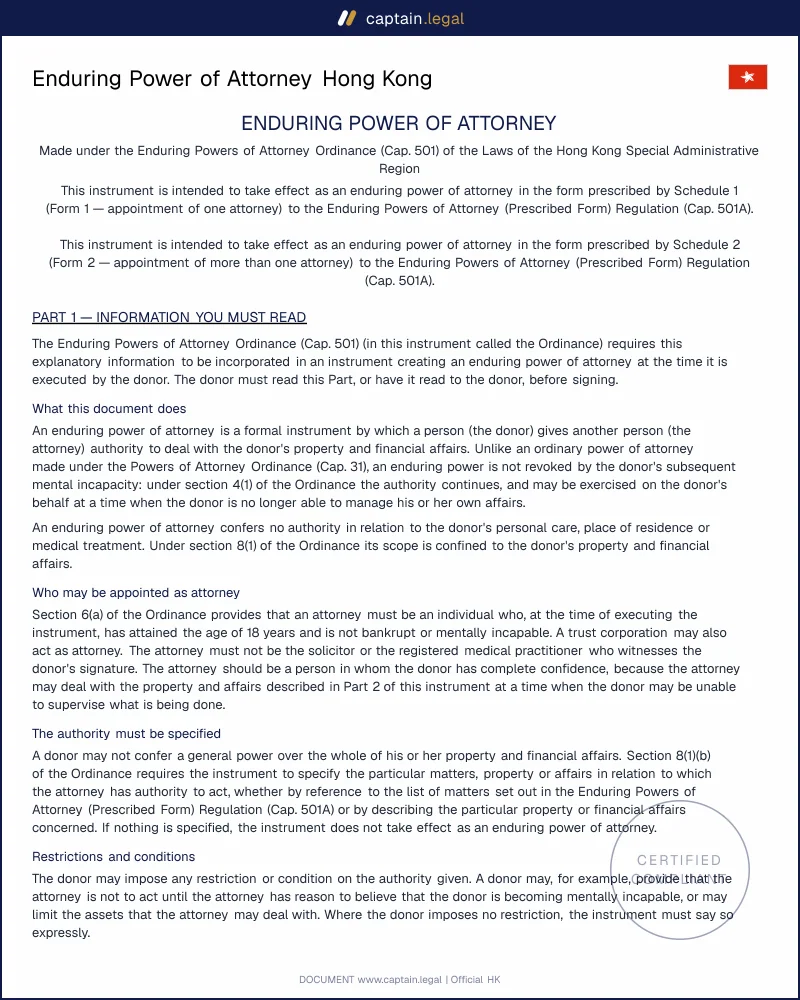
Enduring power of attorney drafted to Cap. 501 and the Prescribed Form Regulation (Cap. 501A), for signing before a solicitor and a registered doctor.
4.7/522 reviews50 000+ downloadsInstant download
Share

An enduring power of attorney in Hong Kong is the one authority that keeps working after you no longer can. Signed while you are still mentally capable, it appoints an attorney to deal with your property and financial affairs, and it survives the onset of mental incapacity instead of lapsing the way an ordinary power of attorney does. It must follow the statutory form set out in the Enduring Powers of Attorney (Prescribed Form) Regulation (Cap. 501A) and be signed before both a solicitor and a registered medical practitioner. This template follows that prescribed form and the requirements of the Enduring Powers of Attorney Ordinance (Cap. 501), ready for the signing appointment and for registration at the High Court Registry.

Compliant

2026 Legislation

50,000+ clients

trust us

Affordable

From $4.90 / doc

Secure payment

Instant download

Enduring Power of Attorney Cap. 501: Prescribed Form HK

Secure payment

Fill in the template

What is an enduring power of attorney in Hong Kong?

An EPA is a deed by which a donor who is still mentally capable authorises one or more attorneys to act in relation to his property and financial affairs, and which continues to operate once the donor becomes mentally incapable. That last part is the whole point. An ordinary power of attorney under the Powers of Attorney Ordinance (Cap. 31) works for a single conveyance or a spell abroad, but it dies the moment the donor's mind goes, precisely when the family needs it. Cap. 501 created the statutory exception in 1997.

Two boundaries are regularly misunderstood. An EPA reaches property and financial affairs only, under section 8(1): bank accounts, rent, investments, MPF, the sale of a flat, insurance, tax. It confers no authority over medical treatment, residence or personal care, which fall to the Guardianship Board under Part IVB of the Mental Health Ordinance (Cap. 136). Nor is it a will: the attorney's authority stops when the donor dies and the executor takes over, and the instruments in our range of Hong Kong personal and family document templates are kept separate for that reason.

2

When do you need this document?

The trigger is very often a diagnosis. Someone in the early stages of dementia usually retains the capacity to sign, and this is the window families miss, because capacity is judged at the moment of execution. Six months of hesitation can close the door for good. Retirement is the calmer trigger: owners of a flat, an MPF account and a share portfolio increasingly sign alongside a will, as planning rather than crisis management.

Distance drives a third group. Adult children in London or Vancouver cannot operate a Hong Kong bank account by telephone, and an EPA gives one of them standing to pay the care home, collect rent and deal with the Inland Revenue Department. Employers face a sharper version, since wages and MPF contributions owed under employment contracts drafted for the Employment Ordinance do not pause when a sole signatory loses capacity. Business owners sit in the same position with shares, director's fees and bank mandates, which is why an EPA belongs next to company and shareholder documents under the Companies Ordinance in a succession plan.

Two edge cases deserve flagging. A personal office cannot be delegated: a directorship or a seat on the committee of a registered society stays with the holder, so society and charity governance papers must handle resignation separately. A donor who is already a trustee should take advice first, since trustee powers are not ordinary property rights.

3

Key clauses included in our template

  • The appointment of the attorneys follows the correct prescribed form, with the choice between acting jointly and jointly and severally stated plainly. Joint appointment means every decision needs every signature, safer but slower; joint and several lets one attorney act alone, which suits families spread across time zones.
  • The statement of authority is the clause the Registry reads first. Ours either lists the specific affairs concerned or adopts the general categories of section 5(3) of Cap. 501A, so it cannot fail for vagueness. Blanket wording such as "all my affairs" is replaced by language that holds.
  • Restrictions and conditions let the donor limit the attorney without redrafting the deed. A common one delays the attorney's power until he has reason to believe the donor is becoming mentally incapable, keeping the EPA dormant while the donor runs his own life.
  • The nomination of persons to be notified before registration is set out as the Regulation requires, with room for up to two people besides the attorney, or an express statement that nobody is nominated. Skipping the question is a defect, not a blank.
  • The certificate blocks for the solicitor and the doctor appear in the statutory wording, and the attorney's own statement, signed before a witness, records the duty to apply for registration and the limits on using the donor's money, including gifts of reasonable value.
4

Signing, registration and what institutions actually ask for

The doctor is the part donors underestimate. Any registered medical practitioner may certify, but where cognitive decline is suspected, a certificate from a geriatrician or psychiatrist who has documented an assessment carries far more weight than a note from a doctor who met the donor once.

Registration goes to the High Court Registry, not to a government department. The attorney lodges the original with the prescribed application under Cap. 4E, pays the fee and waits for the Registrar's leave; the Registry then writes to the donor with the registration date and number. Two consequences deserve thought before registering early: the register is open to public inspection under section 9(5), and revoking a registered EPA needs the court's confirmation under section 13(2).

Banks, insurers and buyers' solicitors add their own layer of practice. A bank normally wants sight of the registered original, a certified copy for its file and its own mandate form completed before it releases control of an account. Where the donor owns property, an attorney handling a sale or a new tenancy produces the registered instrument alongside the usual Hong Kong property and tenancy documents, and the authority clause gets read word by word. One structural limit matters too: Cap. 501 addresses affairs in Hong Kong, so a donor with a flat on the Mainland or accounts in Singapore needs a separate instrument in each jurisdiction.

5

How to fill out this enduring power of attorney

You start by saying how many attorneys you want, because that answer alone decides whether the document is built on Form 1 or Form 2 and whether the joint or joint and several wording appears. You then identify the donor and each attorney by full name as it appears on the identity card, and set out the authority granted, either by adopting the general categories drawn from the Regulation or by describing particular assets such as a named account or a specific flat. The form next asks about restrictions, and this is where a delayed trigger or a cap on dealings with property is recorded in the donor's own words.

Then come the notification choices: you name up to two people who must be told before your attorney applies to register, or state that nobody is nominated. The finished document downloads in Word and PDF, so you can take a clean printed copy to the solicitor and the doctor and keep the editable file if anything changes. Nothing is signed online: the instrument exists in law only once the donor has signed before both certifying professionals and the attorney has signed before a witness.

6

Common mistakes to avoid

The most expensive mistake is timing. Families arrive at a solicitor's office with a form already filled in for a parent whose capacity has clearly gone, and the doctor cannot certify what is no longer there. An EPA signed after capacity has been lost is not a technical defect, it is a nullity. What remains is an application to the Court of First Instance for a committee of the estate under Part II of the Mental Health Ordinance, slower, public and far more costly than the document nobody signed in time. A close second is choosing the wrong witnesses: the son who happens to be a solicitor and the daughter in law who happens to be a doctor are both disqualified by section 5(2)(aa).

The rest are drafting and procedural failures. A vague authority clause, or a foreign lasting power of attorney copied across with no standing here, produces an instrument the Registry will not register. Signing before the doctor and letting weeks drift before reaching the solicitor breaks the 28 day rule. Attorneys also act too early, moving money on an unregistered EPA once the donor has declined, in breach of section 4(3).

Key takeaways

Scope

It covers money and property only

An enduring power of attorney (EPA) under the Enduring Powers of Attorney Ordinance (Cap. 501) lets your attorney manage property and financial affairs if you later lose mental capacity. It does not cover medical treatment, where you live, or personal care. It is also not a will: the attorney’s authority ends on death and your executor takes over.

Signing

Use the prescribed form and sign correctly

Cap. 501 is strict about form and execution. The EPA must follow the prescribed form in Cap. 501A (Form 1 for one attorney, Form 2 for two or more) and you must set out the authority properly, either by specifying matters or using the general categories in the Regulation. If the authority section is left blank or described loosely, it will not operate as an EPA at all.

Registration

No registration, no acting on incapacity

Registration is the second gate. When the attorney has reason to believe you are, or are becoming, mentally incapable, section 4(2) of Cap. 501 requires an application to the Registrar of the High Court, and section 4(3) suspends the attorney’s authority until registration is complete. Registration does not fix defects: section 9(7) leaves an invalid instrument invalid.

Frequently Asked Questions

The template reproduces the form prescribed by Cap. 501A and the statements Cap. 501 requires, so the drafting is sound. Binding force comes from the execution. The donor must sign before a registered medical practitioner and a solicitor who both give the certificates required by section 5(2), and neither may be the attorney, the attorney's spouse or a relative. Signed that way it is valid, and exercisable once the Registrar of the High Court has registered it.

Yes, in both formats. The Word version matters more than usual here, because a solicitor reviewing the draft before the appointment often adjusts the authority clause or adds a restriction, and an editable file saves a redraft. Print the final version single sided for signature, since the Registry works from the original. The rest of our Hong Kong legal document catalogue comes in the same two formats.

The attorney must apply as soon as practicable after forming the belief that the donor is, or is becoming, mentally incapable. Straightforward applications are processed within weeks, though a request for further documents, most often the solicitor's practising certificate, adds time. Until the Registrar grants leave, section 4(3) prevents the attorney from acting. Banks then need their own weeks to update the mandate, so the realistic horizon is one to three months.

Yes, and there is no waiver. Section 5(2) requires the donor to sign before a registered medical practitioner who certifies mental capacity and before a solicitor who gives the statutory certificate, and section 16 stops anyone dispensing with the Ordinance. Both may attend the same appointment, or the donor may sign before the doctor and then the solicitor within 28 days. Miss that deadline and the process restarts.

No. Section 8(1) confines the power to property and financial affairs. Consent to surgery, choice of care home and daily welfare decisions sit outside it. Where those decisions must be made for someone who has lost capacity, a family member applies to the Guardianship Board under Part IVB of the Mental Health Ordinance (Cap. 136). Many donors sign an EPA for their finances and record treatment wishes separately in an advance directive.

Nobody automatically inherits the right to manage your money, not even a spouse. A joint account may keep running, but a solely held account, a property or a portfolio freezes. A relative must apply to the Court of First Instance under Part II of the Mental Health Ordinance for a committee of the estate, which involves medical evidence, a hearing and continuing supervision. It takes many months, and the court rather than the family decides who is appointed.

4.7/5

22 verified reviews · 50 000+ downloads

Enduring Power of Attorney Cap. 501: Prescribed Form HK
  • Immediate access to the document
  • PDF + Word download
  • Compliant with 2026 legislation
  • Reviewed by lawyers
Fill in the template
Secure payment
Updated on August 19, 2026

You might also like

Prenuptial Agreement Hong Kong
Last Will and Testament Hong Kong