Non-Profit & Associations

Guarantee Company Articles HK: Cap. 622 s. 84(2), NNC1G

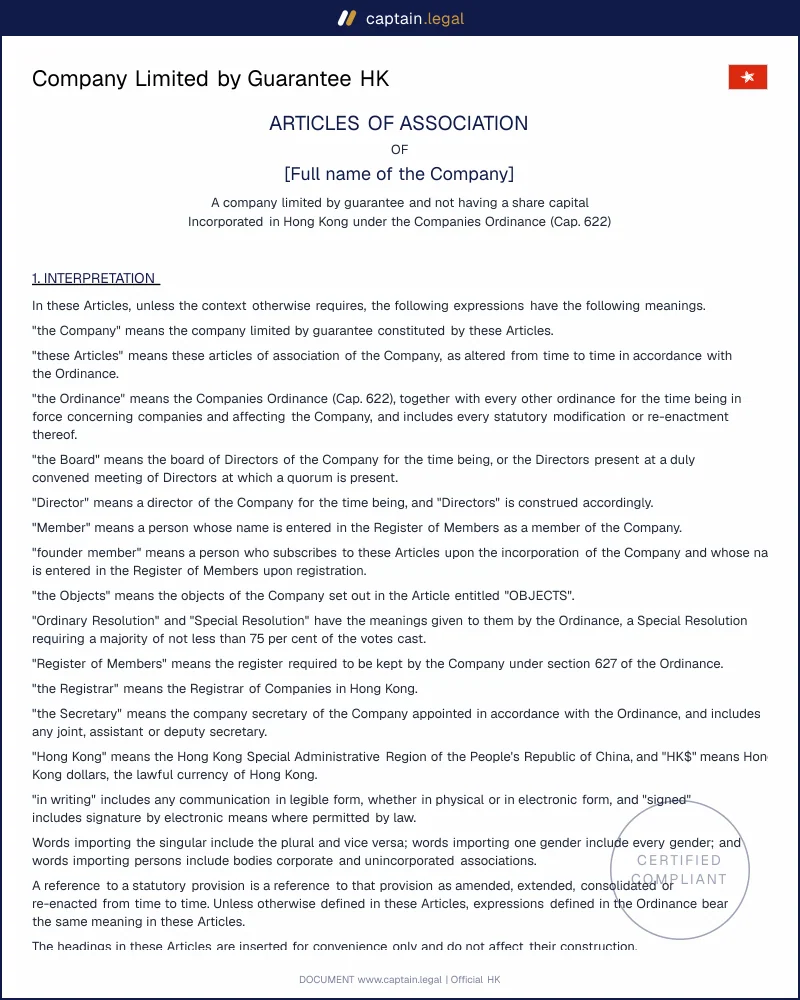
Articles of association for a company limited by guarantee under the Companies Ordinance (Cap. 622): guarantee undertaking, objects, asset lock, section 88.
4.8/519 reviews50 000+ downloadsInstant download
Share

A company limited by guarantee has no shares, no shareholders and nothing to distribute, so its constitution carries the whole governance load on its own. The articles of association for a company limited by guarantee are the only constitutional document such a company has under the Companies Ordinance (Cap. 622). They are what the Companies Registry registers with Form NNC1G, what a bank reads before opening an account, and what the Inland Revenue Department examines when it assesses an application for charitable tax exemption. This template is drafted for Hong Kong founders incorporating a charity, a professional body, an alumni association, a sports club or an NGO that wants separate legal personality and limited liability without raising share capital.

Compliant

2026 Legislation

50,000+ clients

trust us

Affordable

From $4.90 / doc

Secure payment

Instant download

Guarantee Company Articles HK: Cap. 622 s. 84(2), NNC1G

Secure payment

Fill in the template

What are articles of association for a company limited by guarantee?

Since the Companies Ordinance (Cap. 622) came into force on 3 March 2014, the memorandum of association no longer exists in Hong Kong. Everything that used to sit in the memorandum now sits in the articles, so one document fixes the company name, the objects, the members' liability, the composition of the board and the fate of the assets on a winding up. The articles operate as a statutory contract between the company and each member, and between the members in their capacity as members: the principle traced back to Hickman v Kent or Romney Marsh Sheep-Breeders' Association still governs how a Hong Kong court reads a membership dispute.

Two comparisons matter. A company limited by shares states its capital and initial shareholdings in the articles, as our articles of association for a Hong Kong company limited by shares do; a guarantee company has no capital clause at all and replaces it with the guarantee undertaking. The second comparison is with a society registered under the Societies Ordinance (Cap. 151), quicker to set up but not a separate legal person, so office bearers stay personally exposed on contracts and leases.

2

When do you need this document?

The obvious trigger is incorporation: Form NNC1G is rejected unless a copy of the articles travels with it, so no charity, foundation or trade association reaches the Companies Register without them. The second trigger is growth. A volunteer group registered under the Societies Ordinance (Cap. 151) signs a tenancy, hires its first coordinator or accepts government subvention, and the committee decides it no longer wants those obligations in personal names. Incorporating and moving the activity across is the standard answer, and our Hong Kong non-profit and association documents cover both forms.

A third situation is a stalled section 88 application. The Inland Revenue Department often comes back not because the activity is uncharitable but because the constitution is loose: objects drafted as a mission statement, no limitation on the application of funds, no prohibition on distributing income, no asset lock on dissolution. Two edge cases deserve a flag. An association applying for a licence to omit "Limited" must state its objects in the articles and keep them there while the licence subsists. And a company incorporated under the old Companies Ordinance (Cap. 32) still carries its former memorandum conditions as deemed provisions of its articles. Consolidating that split constitution into one modern set of articles is the cheapest governance improvement an older Hong Kong association can make.

3

Key clauses included in our template

  • The name, registered office and objects clauses name the company, record that it is limited by guarantee, fix the registered office in Hong Kong and state the charitable or public purposes precisely rather than aspirationally. An ancillary powers clause covers property, borrowing, employment and investment.
  • The members' liability and guarantee clause reproduces the section 84(2) undertaking in full, including the one year tail after a member resigns, and fixes the guaranteed amount per member at a nominal figure that every founder member signs up to in the incorporation form.
  • The income and property clause locks income and assets to the objects and prohibits any transfer of income to members by way of dividend, bonus or profit. It carves out reimbursement of expenses and arm's length payment for services, drafted so as not to defeat the non-distribution rule.
  • The membership clause governs admission, classes of member, subscriptions, resignation, expulsion and the register, and records the number of members with which the company is registered so the board knows when a filing is triggered.
  • The board and general meetings clauses cover appointment, retirement, disqualification, quorum, conflicts of interest, statutory notice periods, written resolutions and the conduct of hybrid or virtual meetings.
  • The dissolution clause sends any surplus remaining after debts to another body with similar charitable objects and a comparable non-distribution rule, never back to the members.
4

Hong Kong specific considerations

Governance rules bite harder on a guarantee company than on a small private company. Under sections 453 and 456 of the Companies Ordinance (Cap. 622), a guarantee company must have at least two directors, every one of them a natural person: the corporate directorship allowed in a private company limited by shares is not available here, so an institutional member nominates an individual instead. The company also needs a company secretary ordinarily resident in Hong Kong, a registered office in Hong Kong, and a significant controllers register with a designated representative appointed to give access to it. Related paperwork sits in our Hong Kong incorporation and company law templates.

Incorporation is slower than for a trading company. Form NNC1G, a copy of the articles and a Notice to Business Registration Office (IRBR1) go to the Registry together, and the Registry indicates roughly three weeks before the certificates issue. Do not sign a lease or an employment contract before the certificate of incorporation issues, because the entity does not yet exist. Once it does, the organisation will need a Hong Kong employment contract drafted for the Employment Ordinance for its first paid staff and usually a tenancy agreement for its Hong Kong premises.

The annual cycle differs too. Section 610 requires the annual general meeting within nine months after the end of the accounting reference period, and the annual return under sections 662(3) and 662(4)(b) must reach the Registry within 42 days after the return date, with certified copies of the financial statements, the directors' report and the auditor's report. Small guarantee companies may qualify for the reporting exemption in Division 2 of Part 9. Section 114 adds a trap: if membership rises above the registered number, notice goes to the Registrar within 15 days.

5

How to fill out these articles of association

You start by confirming the proposed English and Chinese names and checking them against the Companies Register, since a rejected name means a rejected incorporation. The form then asks whether you intend to seek charitable recognition, and that answer changes the drafting: the objects, income and property, and dissolution clauses switch to the wording the Inland Revenue Department expects, and the remuneration carve outs tighten accordingly. You set the guaranteed amount per member, the number of members with which the company is to be registered, and the classes of membership where the association has institutional as well as individual members.

The questions then move to the board: number of directors, retirement cycle, quorum, casting vote, financial year end, auditor appointment and notice periods for general meetings. The output is a clean set of articles in Word and PDF, ready to sign and file with Form NNC1G. Keep the Word version, because you will be amending these articles at some point and starting from the registered text saves hours.

6

Common mistakes to avoid

The most frequent error is treating the objects clause as marketing copy. A clause saying the company exists to improve lives in the community tells the Inland Revenue Department nothing about whether the purposes fall within the recognised heads of charity, and the application comes back with questions. The second is forgetting the guarantee itself: articles copied from a company limited by shares, with the capital clause deleted, do not comply with section 84(2) and the Registry will not accept them. The third is a dissolution clause that lets surplus assets return to members, which destroys any prospect of tax exemption.

Two governance mistakes recur once the company is running. Boards appoint a single director, forgetting that a guarantee company needs two natural persons, or appoint a corporate member to the board, which sections 453 and 456 prohibit. And directors quietly pay themselves for serving as directors under a general expenses clause, which the Department treats as a distribution of income to members. Where a board member is paid for professional services, the articles must permit it expressly, on arm's length terms, with the interested director excluded from the vote.

Key takeaways

CONSTITUTION

One document carries your whole governance

A guarantee company has no shares and no memorandum, so the articles of association are the only constitutional document under the Companies Ordinance (Cap. 622). They are filed with the Companies Registry on Form NNC1G, and they are routinely reviewed by banks for account opening and by the Inland Revenue Department when considering charitable tax exemption. Treat them as your rulebook from day one.

GUARANTEE

Section 84(2) guarantee clause cannot be omitted

Section 84(2) of the Companies Ordinance (Cap. 622) is non-negotiable for a company limited by guarantee: the articles must state each member’s undertaking to contribute an amount, capped at a specified figure, on a winding up. The exposure applies if the company is wound up while the person is a member or within one year after they stop being one. This clause defines members’ financial risk.

OBJECTS

Objects and asset lock drive charity outcomes

Objects are optional for most companies (s. 82(2)), but mandatory if you want a licence under section 103 to drop “Limited”, with conditions under section 104. The wording also matters for tax: exemption under section 88 of the Inland Revenue Ordinance (Cap. 112) turns on what the governing instrument says. If the articles are silent, model articles in Schedule 3 (Cap. 622H) can fill gaps you did not intend.

Frequently Asked Questions

Yes. Once registered with the Companies Registry, the articles bind the company and each member as though every one of them had signed and sealed the document, and they are enforceable in the Hong Kong courts. The template reproduces the mandatory provisions required by sections 81, 83(1) and 84(2) of the Companies Ordinance (Cap. 622), so the constitution stands on its own rather than falling back on the model articles in Schedule 3 to Cap. 622H.

Both formats come together. The PDF is the version to print and sign for filing with Form NNC1G, and the Word file is the working copy your company secretary uses when the board later adds a membership class, changes the financial year end or tightens a conflicts clause. That editable copy matters, because a constitution gets revisited whenever a funder or a regulator asks questions. The rest of the paperwork sits in the Hong Kong document library.

Longer than for a company limited by shares. Electronic incorporation of a private company limited by shares typically produces the certificate of incorporation and the business registration certificate within about an hour, whereas the Companies Registry indicates approximately three weeks for a company limited by guarantee. Build that delay into your timetable if a funding deadline depends on the entity existing. Recognition under section 88 of the Inland Revenue Ordinance (Cap. 112) is a separate application made after incorporation.

Yes, and it is not automatic. Section 103 of the Companies Ordinance (Cap. 622) allows the Registrar to license an association formed to promote commerce, art, science, religion, charity or another useful object to be registered without "Limited" as the last word of its name, on the conditions imposed under section 104. The articles must then state the objects for as long as the licence remains in force, under section 82(1). Most Hong Kong guarantee companies simply keep "Limited".

The template carries the clauses the Department expects: precisely stated charitable objects, a limitation of the application of funds to those objects, a prohibition on distributing income or property to members, restrictions on paying members of the governing body, proper accounting records, and an asset lock sending any surplus on dissolution to another charitable body. Recognition still depends on the objects being charitable at law and on the activities matching them.

By special resolution, under section 88(2) of the Companies Ordinance (Cap. 622). The company delivers a copy of that resolution to the Companies Registry with the appropriate notice of alteration, Form NAA1 for a change to the articles generally or Form NAA2 for a change to the objects, plus a certified copy of the articles as altered. A charity recognised under section 88 of the Inland Revenue Ordinance (Cap. 112) should also notify the Department of any change to its crucial clauses.

4.8/5

19 verified reviews · 50 000+ downloads

Guarantee Company Articles HK: Cap. 622 s. 84(2), NNC1G
  • Immediate access to the document
  • PDF + Word download
  • Compliant with 2026 legislation
  • Reviewed by lawyers
Fill in the template
Secure payment
Updated on August 23, 2026

You might also like

Hong Kong Volunteer Agreement
Hong Kong Data Protection Policy