Business & Incorporation

Shareholders Agreement HK: Companies Ordinance Cap. 622

Shareholders agreement drafted for Cap. 622 companies: section 11 transfer limits, section 462 removal, reserved matters and deadlock. Word and PDF.
4.7/522 reviews50 000+ downloadsInstant download
Share

A shareholders agreement is the private contract that fixes how the owners of a Hong Kong private company limited by shares will run it together: who sits on the board, which decisions need more than a bare majority, what happens when a founder leaves, and how a deadlock is broken. It sits alongside the articles of association filed with the Companies Registry, and unlike the articles it never becomes public. Founders, joint venture partners, angel investors and family businesses use it to write down what the Companies Ordinance (Cap. 622) otherwise leaves to default rules.

Compliant

2026 Legislation

50,000+ clients

trust us

Affordable

From $4.90 / doc

Secure payment

Instant download

Shareholders Agreement HK: Companies Ordinance Cap. 622

Secure payment

Fill in the template

What is a shareholders agreement in Hong Kong?

A shareholders agreement is a contract between some or all of the members of a company, usually with the company itself as a party, governing the relationship between owners rather than the machinery of the company. Hong Kong law does not require one. The articles of association are the only constitutional document a company must have, and under section 86 of Cap. 622 they take effect as a contract between the company and each member. What the articles cannot do is stay confidential. They are filed at the Companies Registry and every alteration notified, so terms founders would rather not publish, such as funding obligations, non-compete undertakings or a valuation formula on exit, belong in the shareholders agreement.

One neighbouring document causes confusion. A subscription agreement covers the issue of new shares and the warranties an investor gives on the way in, while this agreement governs everything afterwards. The template also assumes a company with a share capital, since a company limited by guarantee has no shareholders and runs on its constitution, covered in our society and guarantee company documents. The distinction that matters most is enforceability: the articles bind every member automatically, while this agreement binds only those who signed it or executed a deed of adherence.

2

When do you need this document?

The classic trigger is two founders incorporating on an equal split with no tie-breaker anywhere in the constitution. A fifty-fifty company running on model articles has no reliable casting vote and no way to force a sale, so one disagreement over strategy can freeze the business until somebody petitions the court. The second trigger is outside money. Angel and seed investors here expect reserved matters, information rights and an anti-dilution formula, and those terms have to live somewhere other than public articles. Joint ventures follow the same logic whenever a Hong Kong vehicle holds a Mainland operating subsidiary.

Family businesses reach for the document later, usually when the second generation starts receiving shares. The issue is rarely control on day one. It is death, divorce and bankruptcy, and whether shares can drift outside the family by transmission. Model articles let a transmittee be registered without any pre-emption step, which is how outsiders end up on the register of a family company, so read the agreement alongside the wills and powers of attorney used in Hong Kong. One case gets overlooked entirely: the company that has traded for years without an agreement, where the gap only surfaces during bank diligence.

3

Key clauses included in our template

  • The shareholding schedule records each member, the class and number of shares held and the amount paid up. Hong Kong shares carry no par value since the 2014 reform, so the schedule works from share numbers and subscription amounts, and anchors every threshold used later.
  • The transfer restrictions and pre-emption waterfall require a seller to serve a transfer notice on the company, which offers the shares to continuing members pro rata before any outsider is approached. Permitted transfers to family trusts and holding companies are carved out, with a clawback if the transferee stops qualifying.
  • The tag-along and drag-along mechanics run off a defined controlling percentage. Tag-along lets a minority holder join a sale on identical terms; drag-along lets holders above the threshold compel the rest to sell on them.
  • The reserved matters schedule covers what needs consent above the ordinary board majority: issuing shares, borrowing beyond a set limit, changing the business, related party transactions and amending the articles. Board reserved matters stay separate from shareholder reserved matters, since collapsing the two makes governance unworkable.
  • The board composition and appointment rights allocate seats by shareholding band and set quorum so no meeting proceeds without a nominee of each investor group, with weighted voting on removal offered as an option.
  • The founder leaver provisions separate good leavers from bad leavers and price the buyback accordingly, with vesting over a stated period. A leaver clause with no valuation method is the single most litigated gap in Hong Kong shareholder disputes.
  • The deadlock and dispute resolution clause escalates from board referral to a put and call procedure and then to arbitration, worded broadly enough to catch disputes about the affairs of the company, not only disputes under the agreement itself.
4

Hong Kong specific considerations

Fifty-fifty companies need a deadlock exit that ends the stalemate. Russian roulette and shoot-out clauses are enforceable here but favour the party with more cash, so the template also offers a put and call at an independently determined price. Where the parties choose arbitration, the drafting matters more than the forum. In Dickson Holdings Enterprise Co Ltd v Moravia CV the court refused to stay an unfair prejudice petition because the arbitration clause reached only disputes arising out of the agreement, while the complaint rested on board notice and share forfeiture under the articles.

Joint ventures with a Mainland partner should assume enforcement will be tested. Hong Kong sits under the Arbitration Ordinance (Cap. 609), awards are enforceable in the Mainland under the reciprocal arrangement, and the courts will stay even a winding up petition in favour of arbitration where the substance of the dispute is arbitrable, as in Quiksilver Greater China Ltd.

Offshore holding structures create a jurisdictional trap. Where founders flip into a Cayman or BVI parent and keep the Hong Kong company as a subsidiary, section 724 does not reach the parent. The Court of Final Appeal confirmed this in Yung Kee, while allowing a just and equitable winding up of the BVI company under section 327(3)(c) of Cap. 32.

Property holding companies are a local speciality, since the flat stays put and the shares move instead, so transfer restrictions carry the weight a conveyance normally carries and should be read against the sale and purchase and tenancy documents used in Hong Kong. Companies granting equity to staff need leaver definitions that match the underlying employment contracts drafted under the Employment Ordinance, because a bad leaver test tied to summary dismissal only works if the contract supports it.

5

How to fill out this shareholders agreement

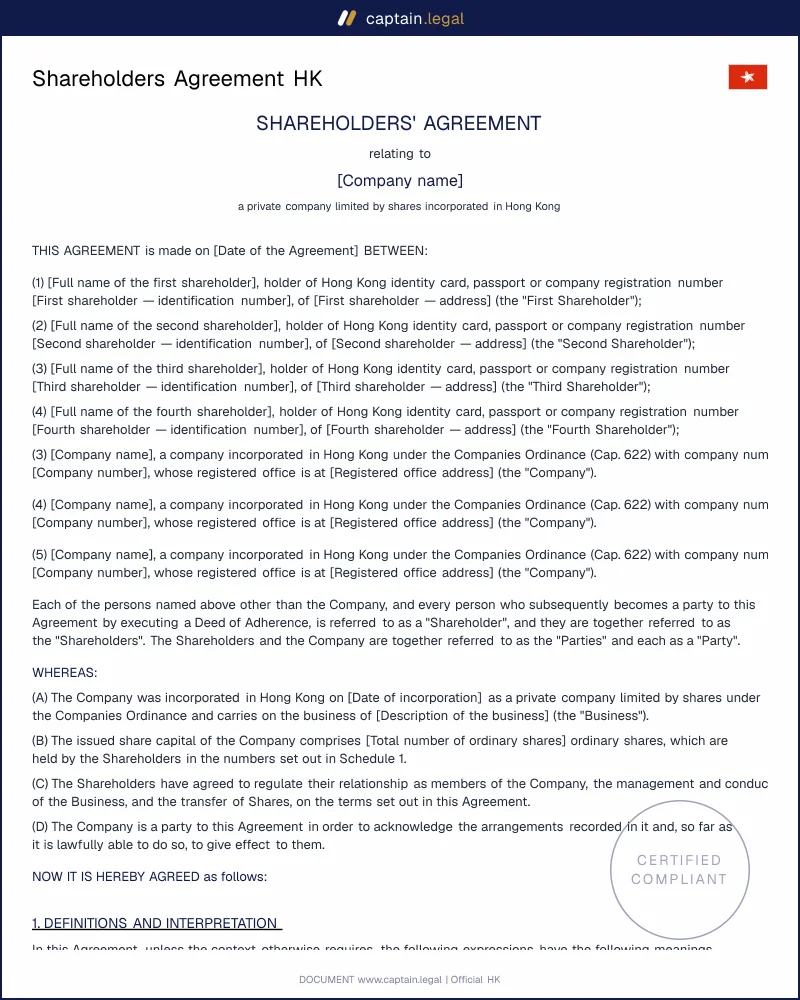
You start by identifying the company, its Companies Registry number and its registered office, then confirm whether the company itself will be a party. Making it a party is standard Hong Kong practice, because it lets the agreement impose information and dividend obligations directly. The form then builds the shareholding schedule, calculating percentages so that later thresholds stay consistent.

Governance is where the real decisions sit. You set the board seats and the shareholding band that earns an appointment right, then pick reserved matters from a Hong Kong specific list and set the consent threshold for each. Transfer provisions follow: the pre-emption offer period, the permitted transferees, the tag-along trigger and the drag-along percentage. Leaver terms come next, with vesting period, leaver definitions and the valuation route on buyback. Dispute resolution is the last step, and the agreement downloads in Word and PDF. Before signing, compare it against your existing articles and amend the articles by special resolution wherever the two disagree.

6

Common mistakes to avoid

The most damaging error is importing a precedent from another common law jurisdiction. English and Singapore agreements read almost identically but rest on different statutory hooks, and a clause built around section 994 of the UK Companies Act 2006 has no counterpart in Hong Kong. The second is signing a shareholders agreement that quietly contradicts the articles. As between owners the agreement governs, but the company and the Registrar act on the articles, so a pre-emption right existing only in the private contract will not stop the directors registering a compliant transfer.

New shareholders are the next blind spot. The agreement binds signatories only, so anyone acquiring shares by allotment, transfer or transmission stays outside it unless a deed of adherence is executed as a condition of registration. Founders also underestimate transfer mechanics: a drag-along naming no valuation method, or a buyback ignoring the solvency requirements for a company acquiring its own shares, creates a right nobody can exercise. And clauses promising that no member will petition are wasted ink, because the statutory right outlives the promise.

Key takeaways

CONFIDENTIALITY

Put sensitive terms in a private contract

The articles of association are filed at the Companies Registry and every change is public, so they are a poor place for terms you would rather not publish. A shareholders agreement stays private and is used for matters like funding obligations, non-compete undertakings, or a valuation formula on exit. Remember section 86 of the Companies Ordinance (Cap. 622): the articles already operate as a statutory contract with members, but they cannot be kept confidential.

WHO IS BOUND

Only signatories are bound by it

Unlike the articles, which bind every member automatically, a shareholders agreement only binds those who sign it (or later execute a deed of adherence). That difference matters in real life when shares are transferred or a new investor comes in: if the newcomer does not adhere, your voting arrangements, transfer hurdles, and reserved matters may be unenforceable against them. Treat adherence as part of your share transfer and onboarding checklist.

STATUTORY LIMITS

You cannot contract out of Cap. 622 remedies

A shareholders agreement sits under Hong Kong contract law, but it cannot override statutory powers and protections. Members cannot block the company changing its own articles by special resolution, and section 462 of Cap. 622 allows members to remove a director by ordinary resolution despite anything in the articles or any agreement. Likewise, remedies such as unfair prejudice (sections 724 to 726) and just and equitable winding up (section 177(1)(f) of Cap. 32) survive any attempted waiver.

Frequently Asked Questions

Yes. It is an ordinary contract, enforceable by damages, specific performance or injunction in the Hong Kong courts, or by arbitration where it so provides. Two qualifications apply. It binds only the parties who signed, so a member who never joined cannot be held to it. And it cannot override mandatory provisions of Cap. 622, including removal of a director under section 462 and the right to petition for unfair prejudice.

No. It is a private document and is never filed, which is the main reason commercial terms sit there rather than in the articles. Only constitutional material goes on the public record: the articles, any special resolution amending them, and the annual return. Keep the signed original with the statutory records at the registered office and give an executed counterpart to every party.

Both stay valid, which is exactly the problem. The articles govern the company's dealings with the world and are what the directors and the Registrar act on, while the agreement governs the relationship between signatories. A shareholder who votes contrary to it can be sued, but the corporate act usually stands. The fix is procedural: amend the articles by special resolution so both say the same thing on transfers, board seats and reserved matters.

Yes, both formats come with every completed document. Keep the Word version, because shareholding schedules and reserved matters lists almost always need adjusting after a funding round or a change of directors. The PDF is what you circulate for signature and file with the company records, alongside the rest of the catalogue of Hong Kong legal templates.

Ideally on or just after incorporation, before a disagreement gives one side a reason to negotiate hard. Completing the template takes about half an hour once you know the shareholding split, the board arrangement and the reserved matters. Signature can follow the same day, since no witnessing, notarisation or registration is required unless you execute it as a deed. If the articles need amending to match, a special resolution takes 21 days notice.

No, and this is the most frequent failure in practice. Someone acquiring shares by transfer, allotment or transmission on death takes them subject to the articles but not to a contract they never entered. The template handles it with a deed of adherence: the directors may not register the transfer until the incoming holder executes it. Check the same condition appears in the articles, or they have no basis to refuse registration.

The agreement itself carries none, because Hong Kong duty attaches to specified instruments rather than to contracts generally. It arises later, on the documents that move shares. When a transfer completes under the pre-emption or leaver provisions, bought and sold notes are chargeable at 0.1 per cent each under Head 2 of the Stamp Duty Ordinance (Cap. 117), on consideration or net asset value, whichever is higher. Contract notes executed in Hong Kong must be stamped within 2 days, with penalties climbing to a multiple of the duty.

4.7/5

22 verified reviews · 50 000+ downloads

Shareholders Agreement HK: Companies Ordinance Cap. 622
  • Immediate access to the document
  • PDF + Word download
  • Compliant with 2026 legislation
  • Reviewed by lawyers
Fill in the template
Secure payment
Updated on August 20, 2026

You might also like

Founders Agreement HK
Board Resolutions Pack Hong Kong