Business & Incorporation

Board & Written Resolutions HK: Cap. 622 ss. 548-561

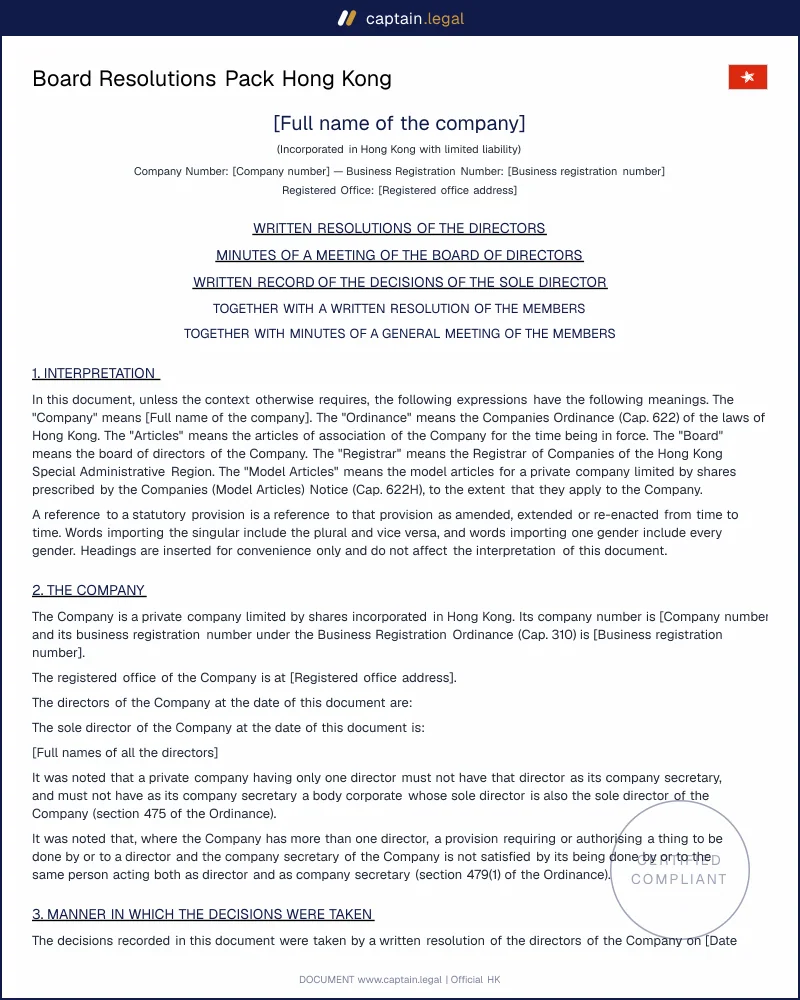
Directors' and members' written resolutions drafted to the Companies Ordinance (Cap. 622) ss. 548-561 and the Cap. 622H model articles. Word and PDF.
4.5/514 reviews50 000+ downloadsInstant download
Share

A board and written resolutions pack gathers the directors' and members' resolutions a Hong Kong private company limited by shares actually needs: the first meeting of the board, the bank account mandate, the appointment or removal of a director or company secretary, the move of the registered office and the change of accounting reference date. Each resolution is drafted to the Companies Ordinance (Cap. 622) and to the model articles, so the minute book matches what the Companies Registry, the auditor and the bank will ask to see. It suits founders, company secretaries and corporate service providers who keep the statutory records of a small board themselves.

Compliant

2026 Legislation

50,000+ clients

trust us

Affordable

From $4.90 / doc

Secure payment

Instant download

Board & Written Resolutions HK: Cap. 622 ss. 548-561

Secure payment

Fill in the template

What is a board and written resolutions pack?

Two very different instruments sit in the same folder. A board resolution is a decision of the directors, taken by a majority at a directors' meeting or, far more often in an owner managed company, as a unanimous written decision signed by every eligible director. A members' written resolution is a decision of the shareholders taken outside a general meeting under sections 548 to 561 of Cap. 622. The board handles management: banking, officer appointments, the registered office, the financial calendar. The members handle ownership and constitutional change.

The pack is not the same thing as minutes. Minutes record a meeting that took place, signed by the chair; a written resolution replaces the meeting and is evidenced by the signatures themselves. Both land in the same statutory record, and both must be kept for at least ten years under section 618(2). For a two or three director board, the unanimous decisions article of the Companies (Model Articles) Notice (Cap. 622H) does most of the work, provided the signing directors would have formed a quorum. The rest of the Hong Kong incorporation and company documents library sits alongside this pack because these papers rarely travel alone.

2

When do you need this document?

The first board meeting is the obvious trigger. A newly incorporated company has a certificate of incorporation and a business registration certificate and nothing else, until the directors accept their appointments, note the shareholdings, fix the accounting reference date and authorise the secretary to open the statutory registers. Bank account opening comes next, and banks scrutinise that paper hardest: the relationship manager needs named authorised signatories, a signing mandate and a clear statement of the business activity before the customer due diligence file under the Anti-Money Laundering and Counter-Terrorist Financing Ordinance (Cap. 615) can close.

Officer changes generate the third cluster. Appointing a director needs a board decision plus that person's written consent to act; a resignation needs the board to note it and the secretary to file. Moving the registered office and altering the financial year sit with the directors. Share dealings pull in both halves of the pack, since a transfer needs board approval to register the transferee alongside the share transfer instrument and contract notes.

One edge case justifies keeping the pack complete. A sole director company cannot use the unanimous decisions article, which assumes a quorum of eligible directors; the model articles instead let a single director decide without regard to the board procedure rules, and that decision still has to be written down.

3

Key clauses included in our template

  • The recitals and capacity statement identify the company by its Companies Registry number and confirm the article of the constitution under which the directors act. Skip this line and you end up arguing later about whether the board had authority at all, particularly where bespoke articles replaced the model set.
  • The quorum and eligibility recital records who was entitled to vote and whether they would have formed a quorum. It matters most for written board decisions, which fail outright if the signatories could not have constituted a quorum at a meeting.
  • The declaration of interest block implements section 536 by naming the interested director, describing the nature and extent of the interest and recording any abstention. Auditors look for it whenever a related party transaction reaches the accounts.
  • The bank mandate resolution names the institution, the account, the authorised signatories and the signing thresholds, and authorises an officer to sign the bank's own forms. The wording is drafted so a compliance team can lift the operative paragraph straight into its file.
  • The appointment and cessation wording covers directors and the company secretary separately, attaches the consent to act and cross refers to the statutory registers. The removal template routes shareholders to a general meeting, because Cap. 622 forbids the written shortcut.
  • The members' written resolution shell carries the circulation date, the eligible members list, the signature blocks and the lapse date, so the section 558 period is visible on the face of the document. The resolution date and the effective date are not always the same, and the Registry counts from the latter.
4

Filing consequences at the Companies Registry

A decision that stays in the minute book is only half the job. Section 658 requires notice of a change of address of the registered office in Form NR1 within 15 days. Miss it and the company and every responsible person commit an offence carrying a level 5 fine plus a daily default fine, though the practical damage is worse: Inland Revenue correspondence and court documents keep going to an address nobody reads.

Officer changes run on the same clock. Sections 645 and 652 require Form ND2A for the appointment or cessation of a director or company secretary within 15 days, and Form ND2B for a change in the particulars of a serving officer. The 15 days run from the effective date, not from the date the paperwork was prepared, which is the single most common reason a filing lands late. A resigning director who fears the company will not notify the Registrar can file Form ND4 himself under section 464(3).

Altering the financial year end is a directors' decision under section 371, with limits that catch people out. The resulting accounting reference period cannot exceed 18 months, extension is not available more than once every five years without Registry approval, and shortening a period can pull forward the annual general meeting deadline under section 610. Form NAR1 under section 662 stays due within 42 days after the anniversary of incorporation whatever the board decides. Ownership changes reach further still: every non listed company must keep a significant controllers register at a prescribed place, so approving a transfer should trigger a matching update to that register, to the register of members and to whatever the shareholders agreement covering transfers and reserved matters requires.

5

How to fill out this board and written resolutions pack

You start by telling the form what kind of decision you are recording, because the answer sets whether the output is a directors' resolution or a members' written resolution. You then enter the company name, the Companies Registry number and the registered office, and the pack carries those details into every document. Next comes the list of directors with a flag for anyone holding a declarable interest, which switches on the section 536 block and the abstention wording.

The decision specific fields follow. A bank mandate asks for the institution, the signatories and the signing rules; an officer appointment asks for the consent date and the effective date; a change of registered office asks for the old and new addresses. For a members' written resolution, the form takes the circulation date and prints the lapse date under section 558 on the signature page. You finish by choosing wet ink or counterpart signature blocks, then download the set. Nothing is filed for you.

6

Common mistakes to avoid

Backdating does the most damage. Directors sign in March and date the paper January because that is when the bank account opened, which turns a governance record into a false instrument and hands the other side an easy point. Record the real signature date and use a separate effective date field. The second recurring error is using a members' written resolution to remove a director, which fails outright under Cap. 622 and leaves that person still in office, still owing duties and still on the register. The third is treating the model articles as universal: bespoke articles may write a quorum of two into the board rules, and a sole surviving director then has no power to act until a further appointment is made.

The last two failures are administrative. Companies sign the paper and forget the filing, so the minute book says one thing and the public register another, which surfaces during a bank review or a buyer's due diligence. And boards omit the interest declaration for related party dealings, especially where the same person is director, shareholder and landlord of the office, a pattern worth checking against the employment and HR documents for Hong Kong staff when a director is also on the payroll.

Key takeaways

WHO DECIDES

Board manages; members change ownership matters

This pack separates directors’ decisions from shareholders’ decisions. Board resolutions cover management items such as banking mandates, appointing or removing officers, moving the registered office and changing the accounting reference date. Members’ written resolutions sit under Companies Ordinance (Cap. 622) ss. 548-561 and are for shareholder decisions taken outside a general meeting. Use the right instrument, or your records may not match what the bank, auditor or Companies Registry expects.

WRITTEN PROCESS

Members’ written resolutions need unanimity

A members’ written resolution is not passed by a simple majority or 75%. Under Cap. 622 s. 556(1), it needs written agreement from all eligible members, so one non-responsive shareholder can stop it. Timing matters too: s. 558 gives 28 days from circulation (unless the articles set a different period), then it lapses and late signatures are ineffective. After it passes, the company must notify every member and the auditor within 15 days (s. 559).

RECORDS & LIMITS

Keep records 10 years; some items excluded

Do not treat these documents as casual paperwork. Minutes record a meeting; a written resolution replaces the meeting and is proved by the signatures, but both belong in the statutory records and must be kept for at least ten years under Cap. 622 s. 618(2). Also, two decisions cannot be done by members’ written resolution: removing a director or removing an auditor before the end of their term. Those require an ordinary resolution at a general meeting, with 28 days’ special notice under s. 578.

Frequently Asked Questions

Yes, provided the procedure is followed. A members' written resolution passed under sections 548 to 561 of Cap. 622 has the same effect as one passed at a general meeting, and a unanimous written decision of the directors matches a majority decision at a board meeting where the model articles apply. The two conditions people miss are unanimity and quorum: section 556(1) needs every eligible member to agree in writing, and a written board decision fails if the signatories would not have made up a quorum.

No. Section 548 excludes the removal of a director, and of an auditor before the end of the term, from that procedure. Removal takes an ordinary resolution at a general meeting under section 462, and section 578 requires special notice of the intention to move it at least 28 days before the meeting. The director is entitled to be heard. Resignation is simpler: the director resigns in writing, the board notes it, and Form ND2A goes to the Registry within 15 days.

Section 558 gives 28 days from the circulation date unless the articles specify another period. A text that has not collected every eligible signature by the end of that window lapses, and agreement signified afterwards is ineffective, so the process starts again from a fresh circulation. Once it passes, section 559 requires notice to every member and to the auditor within 15 days. Diarise both dates when you circulate, because the lapse is automatic and nobody sends a reminder.

The document itself is usually not filed. What gets filed is the consequence: Form NR1 within 15 days for a change of registered office under section 658, and Form ND2A within 15 days for the appointment or cessation of a director or company secretary under sections 645 and 652. Certain members' decisions, an alteration of the articles or a change of name among them, must reach the Registrar. Board minutes stay in the minute book and are produced on request to auditors, banks and buyers.

Yes, and it is one of the more common uses. The model articles for private companies limited by shares disapply the collective decision making rules where the company has only one director and the articles do not require more, so that director decides alone. The decision still has to be written down and kept with the statutory records. Two constraints bite: a sole director cannot also be the company secretary, and bespoke articles imposing a quorum of two leave that director unable to act until a second is appointed.

Both. Every document arrives as an editable Word file and as a print ready PDF, so you can adapt the wording to bespoke articles, add a signature page, or send the PDF straight to a bank without touching the layout. Word matters more than people expect here, because banks frequently ask for their own operative paragraph to be inserted before they open the account. The same dual format runs across the full catalogue of Hong Kong legal documents.

4.5/5

14 verified reviews · 50 000+ downloads

Board & Written Resolutions HK: Cap. 622 ss. 548-561
  • Immediate access to the document
  • PDF + Word download
  • Compliant with 2026 legislation
  • Reviewed by lawyers
Fill in the template
Secure payment
Updated on September 1, 2026

You might also like

Founders Agreement HK
E-commerce Terms and Conditions Hong Kong