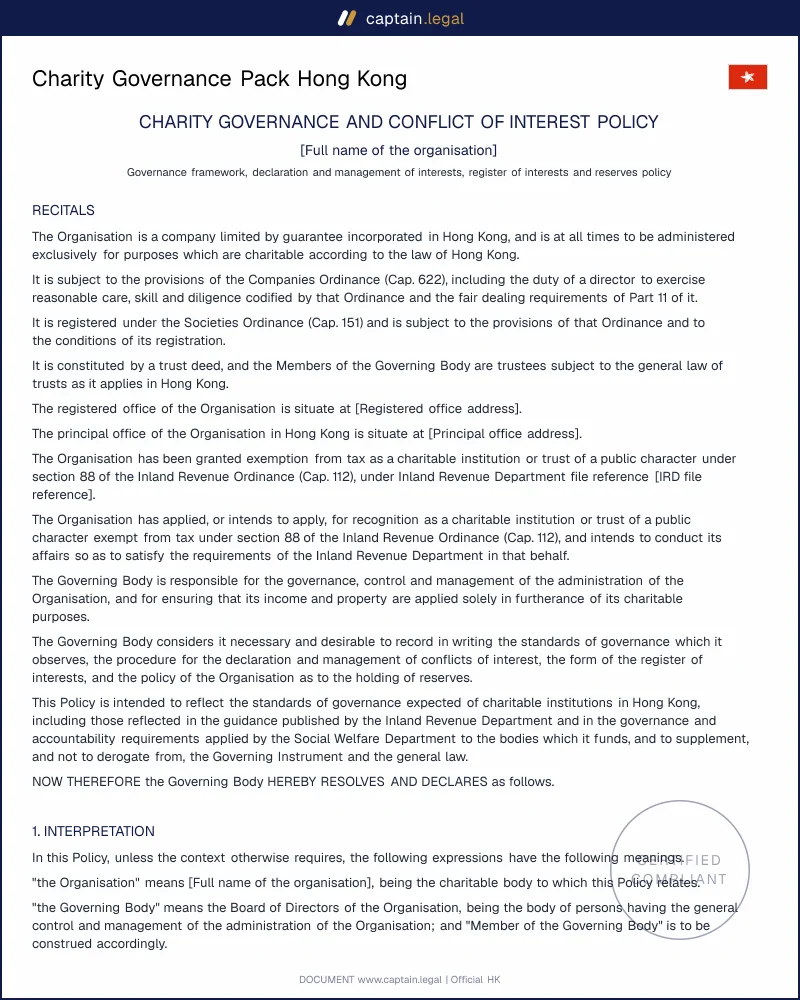
Companies limited by guarantee carry the heaviest load, because the duties in Cap. 622 sit on top of the charity requirements. Directors appear on the Companies Register, file annual returns and financial statements, and declare interests to the board rather than to the Registrar. A guarantee company licensed under section 103 to omit "Limited" from its name faces closer scrutiny of its objects, since the licence rests on the promotion of charity, religion, art or another useful object.
Registered societies operate under lighter regulation and heavier personal risk. A society has no separate legal personality, so office bearers can be exposed personally on its contracts, and nothing equivalent to section 536 applies. Everything depends on the constitution and on the policies the committee adopts, which makes a written recusal procedure more important here, not less.
Subvented NGOs answer to a funder as well as to the Department. A Funding and Service Agreement with the Social Welfare Department brings its Best Practice Manual into play, with reporting on reserves held against subvention income, and these boards face the most questions about staff connected to committee members. The pack therefore sits beside the organisation's employment and HR documents under the Employment Ordinance.
Charitable trusts work through trustees under the Trustee Ordinance (Cap. 29) and the terms of the deed. The rule against unauthorised profit is strict, and a trustee who takes a benefit without express authority must account for it. Authorisation must come from the deed itself, because a board resolution cannot create a power the instrument never granted.